- 100% Natural
- Premium Quality
- No Preservatives
- Fresh & Healthy
Choosing the best dry fruits is about more than picking the most expensive packet. Freshness, aroma, texture, appearance, packaging, storage conditions, and product quality all matter. This guide explains how to choose almonds, walnuts, cashews, pistachios, dates, raisins, and seeds, how to recognize stale or rancid nuts, what to check when buying loose or packaged dry fruits, and how to make smarter purchases for everyday snacking and gifting.
Buying dry fruits can seem straightforward. You see almonds, walnuts, cashews, pistachios, dates, raisins, or mixed nuts, compare the prices, choose a packet, and take it home.
But if you want genuinely good dry fruits, there is more to consider than the name on the package or the price per box.
Two packets of almonds can look similar from a distance while differing in freshness, texture, packaging, storage history, and overall eating quality. The same applies to walnuts, cashews, pistachios, dates, raisins, and other dried fruits.
Knowing what to look for can help you make better purchasing decisions and avoid paying for a product that has already lost some of its quality.
Freshness is particularly important for nuts because they contain natural oils. Heat, light, oxygen, and moisture can contribute to quality deterioration and rancidity over time. Research and consumer guidance on almonds, for example, identifies high storage temperatures, moisture, and light as factors that can promote oxidation and reduce shelf life.
Dried fruits have their own considerations. They need protection from moisture and insects and are generally best kept in tightly sealed packaging in cool, dry, dark conditions.
So how can you tell whether you're choosing good dry fruits?
The answer starts with a few simple checks.
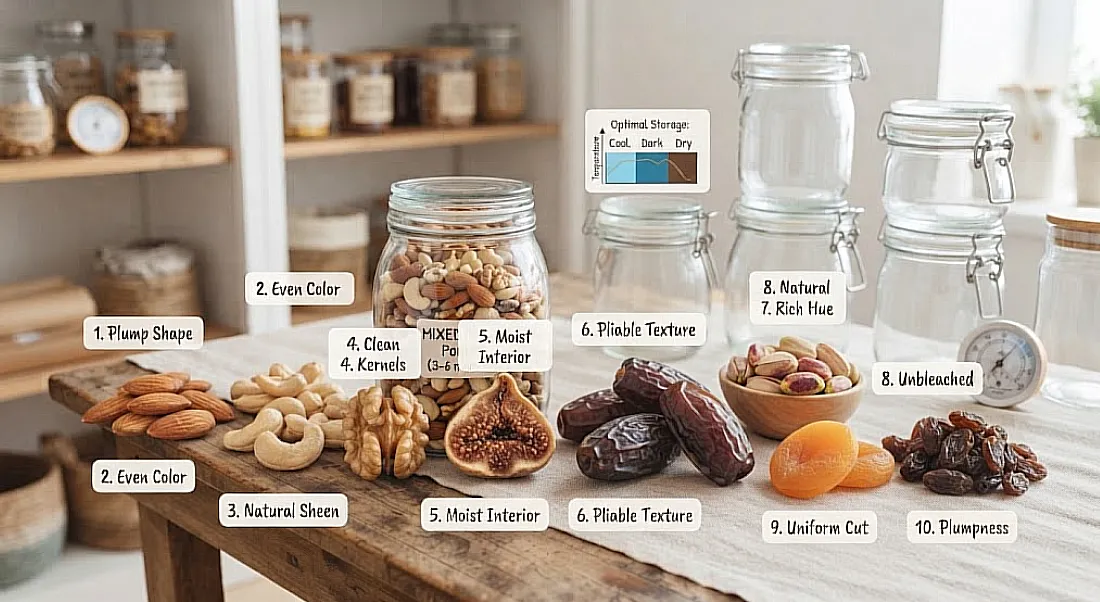
There is no single characteristic that automatically determines quality.
A good purchasing decision considers several factors together:
The exact characteristics also vary by product.
A fresh walnut should not be judged exactly like a date. A crunchy almond has different expectations from a naturally soft dried fig.
That is why learning a few product-specific signs is more useful than relying on one universal rule.
Freshness is one of the most important things to consider when buying dry fruits.
This does not necessarily mean finding the product with the newest printed date. It means looking for products that have been properly handled and stored and still have their expected aroma, flavor, texture, and appearance.
Fresh nuts should generally have a pleasant, recognizable nutty smell.
They should not smell:
Walnuts provide a particularly useful example.
California Walnuts explains that prolonged exposure to warm temperatures can cause walnuts to become rancid. Fresh walnuts have a mildly nutty smell and sweet flavor, while rancid walnuts can develop an unpleasant odor that may resemble paint thinner.
That doesn't mean every unusual smell automatically proves a food is unsafe.
It does mean a strong, clearly abnormal odor is a reason to stop and investigate rather than assuming the product is fresh.
Nuts naturally contain fats and oils.
Over time, these fats can oxidize.
That process can produce undesirable odors and flavors.
Almond research identifies lipid oxidation and rancidity as important causes of quality rejection, with storage temperature, moisture, light, and processing affecting oxidation.
So when buying nuts, freshness isn't just about appearance.
It is also about preserving the flavor and aroma that make the product enjoyable.
Appearance can provide useful clues, but it should not be treated as the only test.
Dry fruits should generally look consistent with the variety you're buying.
For example:
Be cautious when you see:
However, don't automatically assume that a darker color means poor quality.
Some dry fruits naturally vary in color depending on variety, ripeness, processing, and storage.
A beautiful-looking nut isn't necessarily fresh.
Likewise, a naturally darker dried fruit isn't automatically inferior.
Use appearance together with smell, texture, packaging, and storage information.
That's a much more reliable way to assess a product.
Texture is another useful quality indicator.
The expected texture depends on the product.
Almonds should generally have the characteristic firm, crunchy texture expected from the variety and preparation.
If they have become unusually soft, damp, or stale, investigate why.
Walnuts should have a pleasant texture rather than feeling damp or excessively soft.
California Walnut guidance identifies moisture as one of the major quality concerns because it can affect walnut crunch.
Cashews should have the characteristic firm yet creamy-crunchy texture associated with properly stored cashews.
Pistachios should retain an appropriate crispness rather than feeling unexpectedly soft or damp.
Dried fruits are different.
Dates and raisins can naturally be soft, chewy, or somewhat sticky.
That doesn't automatically mean they're spoiled.
The important question is whether the texture is consistent with the particular product and whether there are other warning signs such as mold, unusual odor, or unexplained moisture.
If you're buying from a setting where you can safely inspect the product, smell can be a surprisingly useful quality check.
A fresh nut should generally smell pleasant and characteristic of that nut.
A strong rancid smell is a warning sign.
This is particularly relevant for walnuts and other oil-rich nuts.
If a product smells like:
don't ignore it.
For packaged products, you may not be able to smell them before purchase.
In that case, packaging quality, storage conditions, dates, and the seller's handling practices become more important.
Packaging isn't just about presentation.
It can play an important role in protecting dry fruits from oxygen, moisture, insects, light, and environmental contamination.
The National Center for Home Food Preservation recommends clean, dry, insect-proof, tightly sealed packaging for dried foods because moisture reabsorption and insect contamination can affect quality.
When buying packaged dry fruits, check whether the package is:
Avoid packages that appear:
A damaged package doesn't necessarily tell you exactly what happened to the product, but it is a good reason to choose another package.
Once a package is opened, air and moisture can repeatedly enter.
The National Center for Home Food Preservation recommends packaging dried foods in amounts that can be used at once because repeated opening exposes the food to air and moisture and can lower quality.
For household buyers, resealable packaging can therefore be convenient.
It allows you to protect the remaining product after opening rather than leaving the entire supply exposed.
Sometimes the quality problem begins before you ever buy the dry fruits.
Imagine two stores selling similar walnuts.
One keeps them in a cool, controlled environment.
The other has bags sitting in direct sunlight beside a hot storefront window.
Even if the packaging looks identical, the storage conditions are not.
Heat can accelerate quality deterioration in nuts.
California Walnuts specifically recommends refrigerator or freezer storage for walnuts at home and emphasizes that warm temperatures can contribute to rancidity.
When shopping in a physical store, look at the environment around the product.
Ask yourself:
Is the product exposed to direct sunlight?
Is it sitting beside a heat source?
Does the store appear clean and dry?
Are loose nuts protected from dust and handling?
Does the packaging appear properly sealed?
These observations can help you assess the overall purchasing environment.
Loose dry fruits can be perfectly good.
The problem is that buying loose products may give you less information about their storage history, packaging, dates, and handling.
When buying from a loose display, pay attention to:
A high-turnover shop with good hygiene and appropriate storage can offer a perfectly reasonable loose-buying experience.
On the other hand, a poorly protected display can expose the product to unnecessary environmental factors.
This is worth emphasizing.
Loose dry fruits aren't automatically inferior.
Packaged dry fruits aren't automatically superior either.
The actual quality depends on the product, handling, storage, packaging, and seller practices.
Think in terms of evidence of good handling, rather than simply choosing “loose” or “packed.”
Whole pieces can provide useful information about how the product has been handled.
For example, when buying walnuts, you may see a mixture of:
Some broken pieces are completely normal, particularly in bulk products.
But an excessive amount of tiny fragments can affect the buying experience and may indicate considerable handling or processing.
California Walnut industry guidance identifies excessive “meal” or fine material in a bag as one of the consumer quality concerns for walnuts.
This doesn't mean a bag with broken pieces is bad.
It means you should consider what you're actually paying for.
If you are purchasing walnuts specifically for a decorative gift box, large halves may be more visually appealing.
If you're buying walnuts to grind into a dessert, smaller pieces may be perfectly practical.
The intended use matters.
A common mistake is comparing only the total price.
A packet priced at Rs. 2,000 may sound cheaper than another packet priced at Rs. 2,500.
But what if the first contains 250 grams and the second contains 500 grams?
The second product costs more at checkout but less per gram.
Always compare:
Price ÷ Net Weight = Price per Gram
You can then multiply by 100 or 1,000 to compare the cost per 100 grams or kilogram.
Suppose:
Product A:
Rs. 1,800 ÷ 250 = Rs. 7.20 per gram
Product B:
Rs. 2,400 ÷ 500 = Rs. 4.80 per gram
The packet with the higher total price is actually cheaper per gram.
This simple calculation becomes especially useful when comparing different sizes, gift boxes, mixed assortments, and premium packaging.
A cheaper product isn't automatically a better purchase.
You should compare price per gram after considering quality.
If one product is fresher, better packaged, properly stored, and more suitable for your intended use, the comparison isn't simply about the lowest number.
The goal is reasonable value, not merely the lowest price.
The word premium can mean different things to different sellers.
It shouldn't be treated as a magic guarantee of quality.
When evaluating premium dry fruits, look beyond the label.
Consider:
A premium product should be supported by actual characteristics that customers can recognize.
For example, if you're buying almonds for a gift box, appearance and consistency may matter more than they would for almonds you're simply adding to breakfast.
If you're buying walnuts for baking, flavor and freshness may matter more than perfectly uniform pieces.
The meaning of quality depends partly on what you plan to do with the product.
Almonds are among the most commonly purchased dry fruits, but there are still several things worth checking.
Choose almonds that look clean and consistent with the product being sold.
Avoid packages with visible mold, insects, excessive moisture, or unexplained deterioration.
Fresh almonds should have a characteristic nutty aroma.
A strong rancid or chemical-like odor is a warning sign.
Almond quality research identifies oxidation as a major contributor to undesirable flavors and odors and notes that high temperature, moisture, and light can promote oxidation.
For snacking or gifting, you may prefer:
For baking or cooking, appearance may matter less.
Walnuts deserve special attention because of their natural oil content.
Fresh walnuts should have a pleasant nutty smell.
If they smell strongly sour, stale, chemical-like, or similar to paint thinner, don't buy or consume them. California Walnuts specifically identifies that type of odor as a sign of rancidity.
If you're buying shelled walnuts, consider the proportion of halves, pieces, and fine fragments.
A few broken pieces are normal.
If the product is mostly powder-like fragments, it may not match what you want.
Walnuts benefit from cold storage.
If you're purchasing a large quantity, consider whether you have a suitable refrigerator or freezer before buying.
Cashews are often purchased for snacking, desserts, cooking, and gifting.
Look for:
If you're buying cashews for a gift box, consistent size and appearance can also make the final presentation more attractive.
For everyday cooking, however, slightly irregular pieces may provide perfectly good value.
When purchasing pistachios, look at:
If you're buying shelled pistachios, examine the kernels for unusual discoloration, moisture, or deterioration.
For roasted or salted pistachios, remember that seasoning can affect your perception of flavor.
A strong salt or spice coating shouldn't be used to hide an otherwise unpleasant or stale product.
Dates require a slightly different approach from nuts.
Some dates are naturally soft and sticky.
Others are firmer and drier.
So don't judge every date by the same texture standard.
Instead, look for:
If you're buying dates for Ramadan, Eid, weddings, or gifting, presentation may also matter.
For everyday eating, you may care more about texture, taste, and quantity.
Good raisins should look appropriate for their variety and processing.
Check for:
Because dried fruits can absorb moisture during storage, packaging and storage conditions matter significantly. The National Center for Home Food Preservation recommends keeping dried foods tightly sealed and protecting them from moisture reabsorption.
This depends on your preference and intended use.
Raw nuts provide the natural flavor and texture of the unroasted product.
Roasted nuts have a different flavor and texture and may be preferred for snacking.
Neither label alone tells you whether the product is fresh.
A roasted nut can still become stale or rancid.
A raw nut can also deteriorate if poorly stored.
When choosing between them, consider:
Don't assume “roasted” automatically means better or “raw” automatically means fresher.
Salted nuts can be enjoyable, but they aren't necessarily the best choice for every purpose.
If you're buying dry fruits primarily for cooking, baking, or flexible everyday use, unsalted varieties may give you more control over the final recipe.
If you're buying them as a ready-to-eat snack, salted varieties may suit your preference.
Again, the better choice depends on the purpose.
Online shopping makes it harder to smell or physically inspect the product before buying.
That means you need to rely more heavily on the information provided by the seller.
Before ordering, look for:
The listing should make it reasonably clear what you're purchasing.
Look for:
Images can help you understand the appearance and presentation, although they should not be treated as proof of freshness.
If the image shows a product very different from the description, ask questions before purchasing.
Consider whether the product is:
Reviews can provide useful information about customer experiences.
But don't treat every review as proof of objective product quality.
A customer may love a product because they prefer very soft dates.
Another may dislike the same dates because they prefer a firmer texture.
Reviews are most useful when you look for repeated, specific observations.
If you are buying a larger quantity or placing an important order, asking a few questions can be worthwhile.
For example:
How is the product packaged?
How should it be stored after opening?
Is the product sold by weight?
What is the net quantity?
Is the product roasted, salted, sweetened, or otherwise processed?
What type of packaging is used for delivery?
What is the recommended storage method?
For large gifting orders, you may also want to ask about:
The goal isn't to interrogate the seller.
It's simply to understand what you're buying.
The best dry fruit isn't always the same for every occasion.
For everyday use, prioritize:
You don't necessarily need the largest or most decorative nuts.
For cooking, consider:
Smaller pieces may offer better value when you're going to chop or grind them anyway.
For weddings and formal events, appearance becomes more important.
You may want:
Here, the product's visual presentation becomes part of the purchasing decision.
Dates, almonds, pistachios, cashews, raisins, and mixed assortments are often associated with festive and family gatherings.
When buying for Ramadan or Eid, consider how quickly the household or recipient will consume the product.
If the quantity is large, storage becomes part of the purchase decision.
Buying a large assortment without having suitable storage can reduce the quality before everything is consumed.
Corporate gifting introduces another consideration: consistency.
If you're sending multiple boxes to clients, employees, partners, or guests, you generally want the products and presentation to be consistent from one gift to another.
Consider:
A beautifully presented gift is much more useful when the actual food inside is fresh and appropriately packaged.
Before purchasing dry fruits, run through this checklist.
Does the product have a pleasant, characteristic aroma?
Does it look clean and appropriate for the variety?
Does the texture match what you would expect?
Is the packaging intact and properly sealed?
Has the product been protected from excessive heat, sunlight, moisture, and poor handling?
Does the product appear reasonably fresh rather than stale or deteriorated?
Are you getting the amount you actually need?
Have you compared the actual cost based on weight?
Are you buying the right type for snacking, cooking, gifting, or an event?
Does the seller provide enough useful information for you to understand what you're buying?
If most of these boxes are checked, you've made a much more informed purchase.
Even experienced shoppers can make mistakes.
Here are some of the most common ones.
The cheapest packet isn't necessarily the best value.
Compare weight, freshness, quality, packaging, and intended use.
Beautifully uniform nuts can still be old or poorly stored.
Use smell, packaging, and storage information too.
Marketing language is not a substitute for actual product quality.
Look at the evidence.
Bulk buying can save money in some circumstances, but only if you can store and consume the product appropriately.
A good product in poor packaging may not stay in good condition.
A storage method that works in a cool climate may require adjustment in a hot Pakistani summer.
Never compare two packets purely by their total prices.
Check the net weight.
Getting value isn't necessarily about spending less.
It's about getting the right product for the money you're spending.
A useful approach is:
Choose the quality you need + buy an appropriate quantity + store it properly.
For example, suppose you want almonds for daily breakfast.
You don't necessarily need an elaborate gift box.
A well-packaged, fresh product in a practical quantity may be the smarter purchase.
On the other hand, if you're buying dry fruits for a wedding or corporate gift, presentation and consistency may justify spending more.
The purpose determines what “value” means.
Choosing a high-quality dry fruit is only the first step.
Once you bring it home, storage becomes your responsibility.
Nuts generally benefit from protection against heat, air, light, and moisture. UC Agriculture and Natural Resources recommends clean, moisture-free, odor-tight packaging and notes that refrigeration can substantially extend storage life for many nuts.
Dried fruits should similarly be kept tightly sealed in cool, dry conditions and protected from moisture reabsorption and insects.
That means even an excellent purchase can lose quality if you leave it open beside a stove or in a hot, humid environment.
Your buying decision and your storage decision are connected.
When evaluating a dry fruit brand, don't focus only on attractive packaging or marketing language.
Instead, look for signs of a thoughtful product experience.
A strong buying experience should make it reasonably easy to understand:
For premium gifting, presentation naturally matters more.
But presentation should complement the food rather than distract from it.
The best experience combines good product quality, appropriate packaging, clear information, and reliable handling.
Choosing the best dry fruits doesn't have to be complicated.
You don't need to be a food scientist to make a smarter purchase.
Start with the basics: look, smell, texture, packaging, storage, quantity, and price per gram.
For nuts such as almonds and walnuts, pay particular attention to freshness and signs of rancidity. Nuts contain natural oils, and research on almond quality shows that factors such as heat, moisture, and light can contribute to oxidation and reduced quality. Walnuts are especially worth checking carefully because prolonged exposure to warm temperatures can cause rancid flavors and odors.
For dried fruits such as raisins and dates, consider appearance, texture, moisture, packaging, and storage. Properly dried foods should be protected from moisture and insects and kept in suitable sealed packaging.
When shopping online, rely on clear product information, appropriate packaging, seller transparency, and specific customer feedback rather than photographs alone.
And when buying for weddings, Eid, Ramadan, corporate gifting, or other special occasions, remember that the right product depends on the purpose. Everyday snacking, cooking, and premium gifting each have different priorities.
Ultimately, the best dry fruit isn't necessarily the most expensive one or the one with the fanciest packaging.
It's the product that offers the freshness, quality, quantity, presentation, and value that make sense for what you actually need.
That is the kind of buying decision that turns a simple packet of dry fruits into a genuinely worthwhile purchase.
Consider freshness, aroma, texture, appearance, packaging, storage conditions, and overall product quality. Price alone does not necessarily indicate that a dry-fruit product is better.
Unusual odors, changes in texture, or an unpleasant taste can indicate that nuts are stale or rancid. Checking the product carefully before eating can help you avoid poor-quality dry fruits.
Both loose and packaged dry fruits can be suitable, but you should pay attention to freshness, cleanliness, storage conditions, and product quality. Packaged products should also be checked for appropriate packaging and visible signs of damage or poor storage.
Look for products with a fresh appearance, suitable texture, and pleasant aroma. Checking these qualities can help you distinguish fresher, better-quality nuts from products that may have been stored for too long.
Fasih Frankly
SEO Expert and eCommerce Specialist. Shopify, eBay and online selling.
Questions about this article?
Email us and we will get back to you.
Explore more
For gifting, consider both product quality and presentation, along with freshness, packaging, and storage conditions. Choosing well-presented, high-quality almonds, walnuts, cashews, pistachios, dates, raisins, or seeds can make the gift more suitable for special occasions.
