- 100% Natural
- Premium Quality
- No Preservatives
- Fresh & Healthy
Learn how to make rich homemade dry fruit barfi with almonds, cashews, pistachios, walnuts, khoya, cardamom, and optional saffron. This detailed Pakistani-inspired recipe explains how to roast and prepare the nuts, cook the khoya mixture slowly, recognize the right consistency, set and cut the barfi cleanly, and troubleshoot common problems such as soft, hard, crumbly, greasy, or grainy results. Discover delicious variations with dates, dried figs, coconut, and saffron, along with serving, storage, Eid, wedding, winter, and gifting ideas.
Dry fruit barfi is one of those homemade sweets that feels instantly festive. Rich, fragrant, nutty, and soft enough to melt in the mouth, it brings together some of the most loved ingredients in South Asian kitchens: almonds, cashews, pistachios, walnuts, cardamom, ghee, and, depending on the recipe, khoya, milk powder, dates, or other dried fruits.
Unlike a simple nut snack, barfi is transformed into a proper mithai through careful cooking and setting. The nuts provide texture and richness, while the sweet base gives the mixture enough structure to be pressed into a tray and cut into neat squares or diamonds. Dry-fruit barfi recipes can vary considerably, from milk-based versions made with khoya to date-and-nut versions that rely on the natural stickiness of dates as a binder.
That flexibility is part of what makes homemade dry fruit barfi so appealing.
You can make it luxurious with plenty of pistachios and almonds, give it a softer traditional mithai texture with khoya, create a date-based version with no refined sugar, or add ingredients such as dried figs, coconut, melon seeds, saffron, and rose water.
This guide explains how to make a rich homemade dry fruit barfi, how to prepare the nuts properly, how to cook the mixture without burning it, how to recognize the correct consistency, how to cut clean pieces, and how to store the finished mithai.
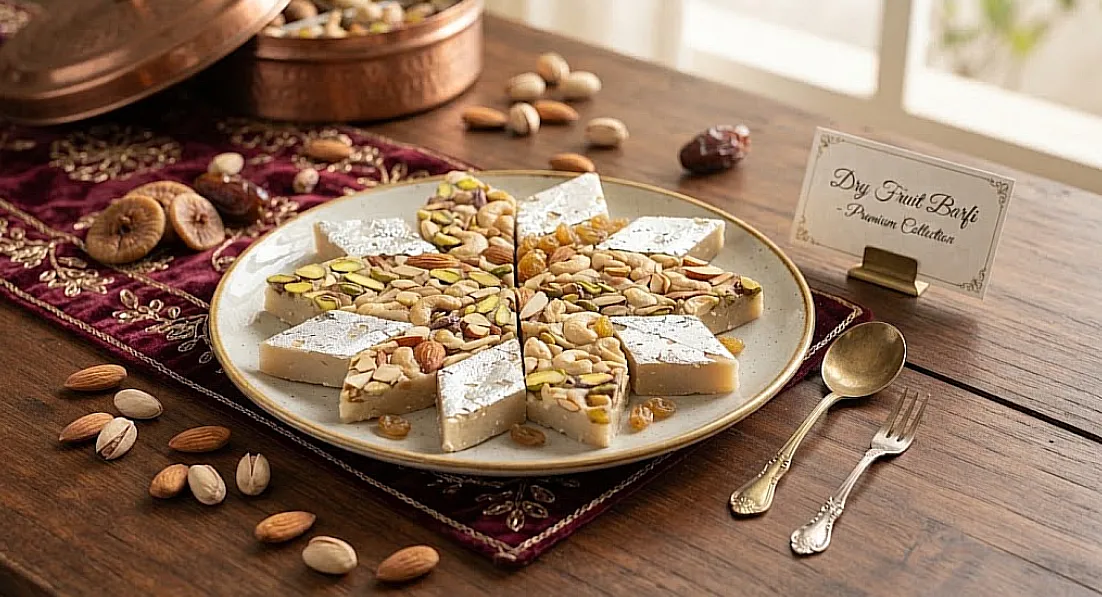
Barfi is a traditional South Asian confectionery generally prepared by cooking a sweet mixture until it thickens enough to set. Depending on the variety, the base may contain milk solids, nuts, sugar, coconut, flour, dates, or other ingredients.
Dry fruit barfi focuses on nuts and dried fruits as the main ingredients. Almonds, cashews, pistachios, and walnuts are among the most common choices, while dates, dried figs, raisins, coconut, and seeds can be added for additional flavor and texture.
In Pakistani kitchens, barfi is associated with mithai shops, family gatherings, Eid, weddings, dawat, celebrations, and other occasions where sweets are served to guests. Dry-fruit versions are particularly suitable for festive presentation because colorful pistachios, almonds, and other nuts make the finished pieces look attractive without requiring elaborate decoration.
A homemade version also gives you control over the ingredients.
You can decide which nuts to use, how sweet you want the barfi, whether to include khoya or milk powder, how coarse the nuts should be, and how thick you want the final pieces.
There are plenty of excellent mithai shops, but homemade barfi has its own advantages.
Instead of relying on whatever nut mixture happens to be included in a prepared sweet, you can build your own combination.
For example, you might use:
Some commercial sweets can be very sweet. At home, you can adjust the amount of sugar or choose dates as part of the sweetening and binding base.
This does not automatically make a barfi “sugar-free.” Dates still contain naturally occurring sugars, and a recipe containing sugar remains a sweetened dessert. The important advantage is simply having control over the ingredients.
Fresh nuts have a noticeably better aroma and flavor than nuts that have been sitting around for too long.
Because dry fruit is the star ingredient, quality makes a significant difference to the finished mithai.
A tray of homemade dry fruit barfi can be cut into uniform diamond or square pieces, arranged in a decorative box, and presented during Eid, weddings, family visits, birthdays, or other celebrations.
For a premium dry-fruit brand, this is also where the difference between ordinary and carefully selected ingredients becomes especially noticeable.
The following recipe makes approximately 20 to 30 small pieces, depending on how thick you spread the mixture and how large you cut the barfi.
The combination can be changed according to taste. A traditional dry-fruit barfi does not need every possible nut. In fact, using too many different ingredients can make the flavors less distinct.
A balanced combination of almonds, cashews, pistachios, and walnuts is usually enough to create a rich and varied texture.
You can customize the recipe with small amounts of:
If you add dates or dried figs, remember that they change the moisture and texture of the mixture. A date-and-nut barfi can be much chewier and more naturally sticky than a khoya-based barfi.
The quality of the nuts matters enormously.
If the almonds or walnuts have a stale or rancid smell, roasting them will not magically fix the problem. In fact, heating can make unpleasant flavors more obvious.
Look for nuts that:
Pistachios should have a pleasant nutty aroma and a vibrant appearance. Cashews should taste creamy and fresh rather than oily or stale. Walnuts deserve particular attention because their higher fat content makes proper storage especially important.
If your dry fruits have been stored in a hot environment for a long time, inspect and smell them before using them.
The first major step is preparing the dry fruits.
Do not rush this stage.
Spread the almonds, cashews, pistachios, and walnuts on a clean plate or tray.
Check for:
Remove anything questionable.
Dry fruit barfi can have either a relatively smooth texture or a more rustic, chunky texture.
For a soft mithai-shop-style texture, chop or pulse some of the nuts fairly finely.
For a more premium homemade texture, keep a portion of the nuts slightly coarse.
One useful approach is to grind roughly half the nuts into a coarse powder while chopping the remaining half into small pieces.
This gives the barfi structure without turning the entire mixture into nut butter.
Place a heavy-bottomed pan over low to medium-low heat.
Add the almonds, cashews, pistachios, and walnuts separately or in small batches.
Dry roast them gently.
The goal is not to make them dark brown.
You are looking for a slightly deeper aroma and a light crispness.
Nuts can burn quickly, particularly when chopped finely. Stir continuously and remove them from the pan as soon as they smell fragrant.
A common dry-fruit barfi technique is to roast or lightly toast the nuts before combining them with the sweet base.
Let the roasted nuts cool before grinding or chopping further.
Not necessarily.
Almonds and cashews can handle light roasting particularly well. Pistachios and walnuts also benefit from gentle heating, but they should not be aggressively browned.
If you prefer a softer, creamier barfi, you can lightly warm the nuts rather than fully roast them.
The important thing is consistency.
Burnt nuts can dominate the entire flavor of the dessert.
Once the nuts have cooled, divide them into two portions.
Pulse approximately half of the nuts in a food processor or grinder.
Use short pulses.
You want a coarse nut powder rather than a smooth paste.
If you grind continuously for too long, the natural oils in the nuts can begin releasing and turn the mixture into nut butter.
That can make the final barfi greasy and difficult to set.
Finely chop the remaining nuts with a knife.
The pieces should be small enough to bite through easily but large enough to provide texture.
Set the nut mixture aside.
Khoya, also called mawa, gives this version of dry fruit barfi a classic rich mithai character.
Crumble the khoya into small pieces.
Place a heavy-bottomed pan over low heat and add approximately one tablespoon of ghee.
Add the khoya.
Cook gently while stirring continuously.
The khoya will gradually soften and become smoother.
Do not use high heat.
Milk solids can catch at the bottom of the pan quickly, especially when the mixture becomes thick.
Cook until the khoya becomes smooth and fragrant but do not deliberately brown it heavily.
Once the khoya has softened, add the prepared nuts.
Stir thoroughly so the nut mixture becomes evenly distributed throughout the khoya.
At this stage, the mixture should be thick but still workable.
Continue cooking over low heat.
Keep stirring.
This is one of the most important stages of the recipe.
The mixture should gradually become more cohesive and begin pulling away from the sides of the pan.
Reduce the heat to very low before adding powdered sugar.
Add the sugar gradually while stirring continuously.
The mixture may become softer or slightly more liquid immediately after the sugar is incorporated. This is normal.
Continue cooking gently.
The goal is to evaporate enough moisture for the mixture to become thick enough to set.
Avoid trying to speed up the process by turning the heat high.
That can cause the bottom to scorch while the rest of the mixture remains undercooked.
Add cardamom powder near the end of cooking.
Cardamom is particularly useful in rich sweets because its fragrance cuts through the richness of ghee, khoya, and nuts.
For saffron barfi, soak a few saffron strands in a tablespoon of warm milk for several minutes before adding the infusion to the mixture.
Use saffron carefully.
The goal is fragrance and subtle color rather than overwhelming the nut flavor.
This is probably the most important part of the entire recipe.
There is no single cooking time that works for every kitchen.
Your pan, heat level, moisture in the khoya, quantity of ingredients, and humidity can all affect the final consistency.
Instead of relying only on the clock, watch the mixture.
The barfi mixture is generally ready when:
A similar principle is used in date-and-nut barfi recipes, where the mixture is cooked until it begins to pull away from the pan before being transferred for setting.
Do not cook it until it becomes completely dry.
Remember that the mixture will firm up as it cools.
If you want a simple traditional-style test, take a tiny amount of the mixture and allow it to cool enough to handle safely.
Roll it gently between your fingers.
If it forms a soft piece that holds together without being runny or excessively sticky, the mixture is approaching the right consistency.
Do not perform this test while the mixture is dangerously hot.
While the barfi is cooking, prepare your tray.
Use a shallow tray, plate, thali, or square baking dish.
Lightly grease the surface with ghee.
You do not need a thick layer.
Just enough to prevent sticking.
If you want especially clean edges, you can also line the tray with parchment paper and lightly grease the paper.
Once the mixture reaches the correct consistency, turn off the heat.
Immediately transfer it to the prepared tray.
Use a greased spatula or the back of a spoon to spread it evenly.
Aim for a thickness of approximately 1 to 1.5 centimeters.
Press gently but firmly.
You want the mixture compact enough that the finished pieces hold together.
Do not press so aggressively that you completely destroy the texture of the nuts.
While the mixture is still warm, sprinkle finely sliced pistachios and almonds over the surface.
Gently press them down.
This helps the garnish stick once the barfi cools.
For a more festive presentation, you can add:
Keep decoration restrained.
The dry fruits themselves should remain the visual focus.
Allow the tray to cool at room temperature first.
Once the barfi has become firm enough to handle, you can refrigerate it briefly if you want a firmer texture.
Do not immediately put a very hot tray into a refrigerator unless your cookware is designed for that temperature change.
The exact setting time varies.
A shallow layer will firm faster than a thick one.
A date-based barfi may also set differently from a khoya-based version.
Recipes using dates and nuts commonly allow the mixture to cool before cutting it into squares or diamonds.
Clean cutting makes homemade barfi look dramatically more professional.
Use a sharp knife.
For traditional presentation, cut the slab into diamonds.
You can also make:
For clean cuts, lightly grease the knife with a tiny amount of ghee.
Press straight down rather than dragging the knife repeatedly through the mixture.
If the barfi is too soft to cut cleanly, give it more time to cool.
If it becomes extremely firm, allow it to sit at room temperature for a short period before cutting.
Soft barfi can happen for several reasons.
If too much moisture remains, the barfi may not set properly.
Return the mixture to a pan and cook it gently for a few additional minutes.
Milk should only be added when necessary, particularly in a khoya-based recipe.
Adding too much can make the mixture difficult to set.
Different khoya varieties contain different amounts of moisture.
Very soft or wet khoya may require additional cooking.
A very thick slab can take longer to firm.
Try spreading the mixture more evenly next time.
Overcooking is the most common reason.
If you cook the mixture until almost all moisture disappears, it may become hard and crumbly after cooling.
Remember that barfi continues to firm as it cools.
Take it off the heat while it is still slightly softer than your desired final texture.
Crumbly barfi may contain too much dry material relative to the binder.
It can also result from overcooking.
For a khoya-based barfi, gently reheating the mixture with a very small amount of milk or ghee can sometimes help restore moisture and cohesion.
Add liquid cautiously.
Too much can create the opposite problem.
Excess ghee is usually the first thing to examine.
Nuts also naturally contain oils.
If the nuts were ground for too long, they may have released additional oil into the mixture.
Use only enough ghee to help cook and bind the ingredients.
The finished barfi should feel rich, not oily.
Graininess can result from several factors, including the ingredients used, cooking temperature, sugar behavior, or the way the mixture was handled.
High heat can be particularly problematic.
Keep the cooking temperature low and stir continuously.
For nut-heavy barfi, avoid grinding the nuts so aggressively that they become an oily paste.
If you want a different style of dry fruit barfi, dates can become the primary binder.
This version is particularly interesting because dates are naturally sticky and can hold chopped nuts together.
Remove the pits from the dates and chop them.
Lightly roast the nuts separately and chop them coarsely.
Heat ghee in a pan over low heat.
Add the dates.
Cook gently until they soften and become a thick paste.
Add the nuts and cardamom.
Stir until everything is evenly combined.
Transfer the mixture to a greased tray.
Flatten firmly.
Allow it to cool before cutting into squares or diamonds.
Date-and-nut barfi recipes commonly use this basic principle: soften the dates, incorporate roasted nuts, cook until the mixture comes together, then press and cool it before cutting.
This version has a chewier texture than traditional khoya-based barfi.
Dried figs are another excellent addition.
They bring small seeds, natural sweetness, and a chewy texture.
You can soak dried figs briefly in warm water, drain them thoroughly, and process them with dates.
Then add roasted almonds, cashews, and pistachios.
This produces a fruit-and-nut barfi that is closer to a dense fruit-and-nut confection than a creamy milk-based mithai.
The American Diabetes Association publishes a fig-and-date barfi-style recipe using dates, figs, almonds, cashews, pistachios, and cardamom, illustrating how these ingredients can work together in a pressed barfi-style sweet.
For a coconut variation, add a small quantity of desiccated coconut to the nut mixture.
Coconut pairs particularly well with:
Toast the coconut lightly before adding it.
Do not brown it heavily.
The goal is a delicate toasted aroma.
Saffron can turn an ordinary-looking barfi into something much more festive.
Soak a few strands in warm milk.
Add the saffron infusion toward the end of cooking.
Pair it with pistachios and almonds for a classic combination.
Because saffron is strong and expensive, a small amount is generally sufficient.
A few drops of culinary rose water can introduce a floral aroma.
Use it sparingly.
Too much rose water can overpower the nuts and make the barfi taste more like perfume than mithai.
Rose and pistachio are especially natural partners.
Presentation matters when serving mithai.
For Eid or a family gathering, arrange the barfi in a shallow serving tray and garnish it with pistachios and almonds.
For weddings or formal dawat, cut the pieces smaller and more uniformly.
For gifting, place individual pieces in food-safe paper cups inside a rigid gift box.
A combination of diamond-shaped pieces and contrasting pistachio garnish can look particularly elegant.
Eid is one of the most natural occasions for homemade barfi.
A tray can be prepared ahead of time and served alongside other mithai, tea, coffee, or after-meal desserts.
For an Eid gift, you can combine dry fruit barfi with:
This creates a complete dry-fruit-themed gift rather than relying on a single sweet.
Barfi has long been associated with celebrations and mithai culture, making it suitable for wedding functions and family events.
For a wedding presentation, consistency is key.
Try to make every piece approximately the same size.
Use high-quality pistachios and almonds for garnish.
Keep the packaging clean and elegant rather than overcrowding the box with decorations.
Small diamond-shaped pieces generally work well for formal presentation.
Winter is particularly suitable for rich nut-based sweets.
Almonds, walnuts, pistachios, cashews, dates, and dried figs can all be incorporated into winter desserts.
A homemade dry fruit barfi can be served with hot tea after dinner or placed on a dessert table during a winter gathering.
If you live in a warmer part of Pakistan, however, storage deserves extra attention.
A sweet containing khoya and other dairy ingredients is more perishable than a very dry nut confection.
Storage depends heavily on the ingredients.
Because khoya is a dairy ingredient, khoya-based barfi generally requires more careful storage than a dry date-and-nut barfi.
Once cooled, place it in an airtight food-safe container and refrigerate if you are not serving it promptly.
Avoid leaving dairy-based barfi sitting in a warm room for extended periods.
A date-and-nut version contains less dairy and may have different storage characteristics.
Once fully cooled, store it in an airtight container.
Refrigeration can help maintain freshness and firmness, especially in warm weather.
Do not store barfi uncovered.
Exposure to air can gradually affect texture and flavor.
Use a clean, dry container and avoid repeatedly opening the container unnecessarily.
Some barfi varieties can be frozen, although texture may change after thawing.
A dry, date-and-nut version may tolerate freezing better than a delicate milk-based barfi, but results depend on the recipe.
If freezing:
Avoid repeatedly freezing and thawing the same batch.
If you are making barfi for guests or gifting, presentation can deteriorate if the pieces become too warm.
Keep them covered until serving.
When transferring them to a serving tray, use clean food-safe utensils.
If the surface becomes slightly moist after refrigeration, allow the pieces to sit briefly in a cool, dry environment before serving.
Avoid direct sunlight.
The nuts are the foundation of the recipe.
Poor-quality nuts will produce poor-quality barfi.
Dark, bitter nuts can ruin the entire batch.
Roast gently.
Short pulses are better than continuous grinding.
Ghee adds flavor and helps with cooking, but excessive amounts can make the finished barfi greasy.
High heat can scorch khoya, sugar, and finely ground nuts.
Overcooked barfi can become hard and crumbly.
Allow the slab to cool and firm before cutting.
If the mixture becomes extremely firm, clean cutting becomes more difficult.
The best time is when the barfi has set enough to hold its shape but is not completely hard.
If you want a more luxurious version, focus on ingredient quality rather than simply adding more ingredients.
Use:
You can also create layers.
For example, a thin pistachio layer over a mixed-nut base can create a striking appearance.
Another approach is to make two mixtures with different colors and textures, then press them together before setting.
The goal is to create contrast without making the recipe unnecessarily complicated.
For an especially rich version, combine:
Keep the dates moderate if you want the finished barfi to retain the soft, creamy character associated with traditional khoya-based sweets.
Too many dates will shift the texture toward a sticky date-and-nut confection.
Dry fruit barfi can be served in several ways.
A small piece alongside Pakistani chai makes an excellent afternoon or evening combination.
Serve bite-sized pieces on a dessert platter.
Combine it with gulab jamun, ras malai, peda, jalebi, or other sweets for a larger celebration.
Create a mixed platter containing barfi, dates, almonds, pistachios, and dried figs.
This works particularly well for guests.
If you are preparing barfi for a wedding, Eid gathering, or large family event, do not simply multiply everything and hope for the best.
Large quantities behave differently.
A very large batch takes longer to cook and can be harder to stir evenly.
Instead, consider making multiple medium-sized batches.
This gives you better control over:
It also reduces the risk of losing an entire large batch because of one cooking mistake.
The number of servings depends on how you cut the barfi.
For a dessert table, smaller pieces are usually more practical.
For a gift box, medium diamond-shaped pieces may look better.
For family tea, larger squares are perfectly reasonable.
If you need a precise quantity for an event, measure the finished slab and divide it into equal sections before making the final cuts.
Children can help with some preparation tasks, but hot sugar, ghee, khoya, and cooking pans should be handled by an adult.
Children can help:
Keep them away from the hot cooking mixture.
Dry fruits such as almonds, walnuts, pistachios, and cashews provide nutrients including fats, protein, fiber, vitamins, minerals, and other plant compounds.
However, dry fruit barfi is still a dessert.
Traditional versions can contain substantial amounts of sugar, ghee, khoya, or other calorie-dense ingredients.
That means the presence of nuts does not automatically make barfi a health food.
A sensible approach is to enjoy it as a treat and pay attention to portion size.
Date-based versions may contain less added sugar depending on the recipe, but dates themselves contribute natural sugars and calories.
If you prefer less sweetness, gradually reduce the powdered sugar rather than removing it completely from a recipe designed around sugar.
You can also experiment with a date-and-nut version.
Dates provide sweetness and stickiness, allowing you to make a barfi-style confection without relying on a traditional sugar-heavy base.
Keep in mind that changing the amount of sugar can also change the texture and setting behavior.
A good barfi should have balance.
It should not taste like pure sugar.
It should not be overwhelmingly greasy.
It should not be so hard that it feels like a brittle.
And it should not be so soft that it collapses when picked up.
The ideal texture depends on the style you are making, but a well-made dry fruit barfi generally holds its shape while remaining pleasant to bite.
The nuts should contribute noticeable flavor and texture.
The cardamom should provide fragrance without overpowering the main ingredients.
And the sweetness should complement rather than completely hide the dry fruits.
If this is your first attempt, do not start with an enormous batch.
Make a medium tray.
This allows you to learn how your particular khoya behaves, how quickly your stove heats the pan, and how long the mixture takes to reach the correct consistency.
Once you have made one successful batch, scaling up becomes much easier.
Keep notes about:
The next batch can then be adjusted according to the result.
If there is one lesson to remember from this recipe, it is this:
Low and steady heat is your friend.
Dry fruit barfi is not a recipe that rewards rushing.
The nuts need gentle roasting.
The khoya needs careful cooking.
The sugar needs to dissolve and cook without scorching.
The final mixture needs enough evaporation to set but not so much that it becomes dry and hard.
Patience makes a noticeable difference.
Store-bought barfi offers convenience and professional presentation.
Homemade barfi offers control.
At home, you can select premium almonds, fresh walnuts, generous pistachios, and the exact amount of sweetness you prefer.
You can also create a signature recipe for your family.
For example, one household may prefer a soft almond-and-cashew barfi, while another may prefer a chewy date-and-pistachio version.
There is no single correct combination.
That flexibility is part of the appeal.
If you want to turn your homemade barfi into a thoughtful gift, start with the sweet itself.
Cut the barfi into uniform pieces.
Then add complementary dry fruits such as:
Use separate compartments or food-safe cups so the barfi does not become mixed with loose nuts.
For a premium presentation, choose a sturdy box with a clean interior and simple decorative elements.
A small personalized card can make the gift feel more intentional.
You do not need to wait for a major festival.
Dry fruit barfi works well for:
Because the recipe can be made in advance, it is particularly useful when you are preparing several dishes for guests.
Before putting the barfi on the table, check:
If the answer is yes, you are ready to serve.
Homemade dry fruit barfi is a beautiful way to turn premium nuts and dried fruits into a traditional South Asian sweet that feels both comforting and festive.
The basic method is straightforward: prepare and lightly roast the nuts, create a rich sweet base with khoya or another suitable binder, combine the ingredients over low heat, cook until the mixture reaches the right consistency, spread it into a greased tray, garnish it, and allow it to set before cutting.
The biggest challenge is not the ingredient list. It is learning to recognize the correct cooking stage.
Cook too little and the barfi may remain soft. Cook too long and it can become hard or crumbly. Use too much ghee and it may turn greasy. Use poor-quality nuts and the entire dessert can lose the fresh, rich character that makes dry fruit barfi special.
Once you understand those details, however, the recipe becomes highly adaptable.
You can make a classic almond, cashew, pistachio, and walnut barfi with khoya. You can create a date-and-nut version using dates as a natural binder. You can introduce dried figs, coconut, saffron, cardamom, or rose water. You can make small pieces for an Eid dessert table or prepare an elegant batch for a wedding or family gift.
Most importantly, homemade barfi gives you the freedom to let the dry fruits actually shine.
Choose fresh ingredients, roast them carefully, cook patiently, and give the finished mixture enough time to set. The result is a rich, fragrant, beautifully textured mithai that can sit comfortably alongside the classic sweets of Pakistani celebrations while still having its own distinct dry-fruit character.
Dry fruit barfi can be made with almonds, cashews, pistachios, walnuts, khoya, and cardamom. Optional saffron can add additional flavor and aroma, while dates, dried figs, or coconut can be used for variations.
The nuts should be properly prepared and roasted before being added to the barfi mixture. Careful roasting helps develop their flavor while preparing them for combination with the cooked khoya mixture.
The mixture needs to reach an appropriate consistency before it is transferred for setting. Recognizing the correct consistency helps the finished barfi set properly and makes it easier to cut cleanly.
Texture problems can result from issues during preparation or cooking of the khoya and nut mixture. The recipe includes troubleshooting guidance for adjusting common problems such as excessive softness, hardness, crumbliness, greasiness, or graininess.
Fasih Frankly
SEO Expert and eCommerce Specialist. Shopify, eBay and online selling.
Questions about this article?
Email us and we will get back to you.
Explore more
Dry fruit barfi can be served during Eid, weddings, winter gatherings, and other special occasions. It can also be prepared as a homemade gift or enjoyed as a dessert with family and guests.
