- 100% Natural
- Premium Quality
- No Preservatives
- Fresh & Healthy
Dry fruits can make breakfast more flavorful, convenient, and satisfying without requiring complicated recipes. Almonds, walnuts, pistachios, cashews, dates, raisins, and seeds can be added to oats, yogurt, smoothies, toast, eggs, milk, and traditional breakfast dishes in simple ways. This guide shares 10 delicious dry fruit breakfast ideas, including quick 5-minute options, make-ahead breakfasts, Pakistani-inspired combinations, and family-friendly choices. You’ll also learn how to choose portions, combine dry fruits with other breakfast foods, and decide when to use raw, roasted, chopped, or soaked varieties.
Breakfast does not have to be complicated to be enjoyable. Sometimes, a bowl of yogurt, a few almonds, some raisins, and a piece of fruit can be enough to turn an ordinary morning into something much more satisfying. Dry fruit breakfast are especially convenient because they can be stored easily and added to foods you already eat. Almonds can bring crunch to yogurt or toast. Walnuts work beautifully with oats. Dates can add sweetness to porridge or smoothies, while raisins can be mixed into cereal, daliya, or overnight oats. Pistachios and cashews can add both texture and flavor to everything from breakfast bowls to traditional milk-based drinks.
Recent breakfast guides from Pakistan-based dry-fruit retailers have highlighted simple combinations such as yogurt with almonds and raisins, oatmeal or daliya with walnuts and dates, eggs with toasted seeds, toast with nut butter and almonds, and warm badam milk.
The best part is that you do not need to completely redesign your breakfast routine. You can simply take the foods you already enjoy and add a small amount of dry fruit.
This guide explores 10 easy dry fruit breakfast ideas, from five-minute options to make-ahead breakfasts, along with practical tips for choosing portions, preparing dry fruits, and creating balanced morning meals.
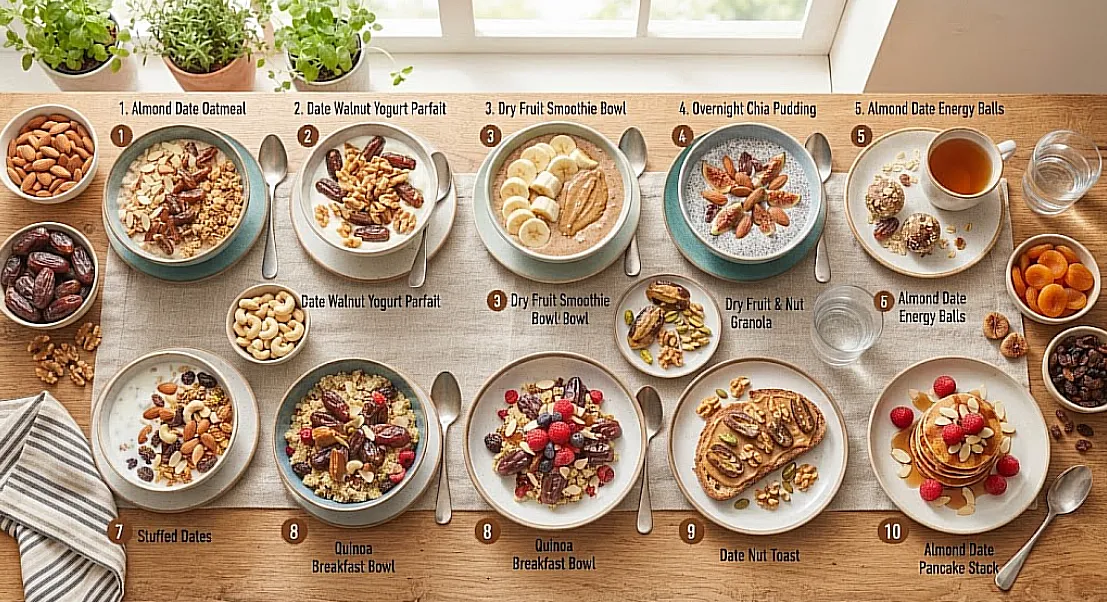
Dry fruits can be a convenient addition to breakfast because many varieties combine useful nutrients with concentrated flavor and relatively little preparation.
Nuts such as almonds, walnuts, pistachios, and cashews provide fats and other nutrients, while dried fruits such as dates and raisins provide carbohydrates and natural sweetness. Seeds such as pumpkin or chia seeds can also be used to add variety.
However, dry fruits do not need to become the entire breakfast. A more practical approach is to use them as one component of a meal alongside foods such as oats, yogurt, milk, eggs, fruit, whole-grain bread, or other breakfast staples.
The current Dietary Guidelines for Americans emphasize eating nutrient-dense foods and limiting highly processed foods, added sugars, and refined carbohydrates.
That does not mean every breakfast needs to look like a nutrition textbook. It simply means dry fruits can fit naturally into a broader meal rather than being treated as a replacement for the meal itself.
For example:
The combinations are almost endless.
One of the easiest mistakes is assuming that because a food is nutritious, more is automatically better.
Nuts and dried fruits can be easy to overeat because they are small, flavorful, and convenient. A practical starting point is a modest portion rather than filling half the breakfast bowl with them.
One recent Pakistan-focused breakfast guide suggests roughly 20–30 grams of nuts or around 1–2 dates or figs, with a smaller spoonful of raisins as another option.
You do not necessarily need to weigh everything.
A simple approach is:
For example, a breakfast containing yogurt, oats, banana, almonds, walnuts, dates, raisins, honey, and nut butter can become quite substantial very quickly.
You do not need every ingredient.
Sometimes oats + milk + walnuts + a date is all you need.
This may be one of the easiest dry fruit breakfasts of all.
Start with plain yogurt and add chopped almonds. Then add a few raisins and some fresh fruit such as banana, apple, berries, or seasonal fruit.
You can finish it with cinnamon if you like.
If you prefer more texture, lightly toasted almonds can work particularly well.
The idea is not to drown the yogurt in toppings. Instead, use the almonds and raisins as accents.
This combination is also easy to customize.
Try:
Almonds + banana + cinnamon
or:
Almonds + apple + raisins
or:
Almonds + berries + yogurt
For a more substantial breakfast, add a serving of oats or another whole-grain ingredient.
A similar combination of yogurt, almonds, and raisins is specifically recommended in a recent Pakistan-focused dry-fruit breakfast guide.
The yogurt gives you a creamy base, the almonds add crunch, and raisins provide little bursts of sweetness.
It also requires almost no cooking.
That makes it particularly useful on mornings when the last thing you want to do is stand in front of the stove.
If you enjoy warm breakfasts, this is a classic combination.
Prepare your oats with milk or water, then stir in chopped dates while the oatmeal is warm. Add chopped walnuts on top before serving.
The dates can provide sweetness, while the walnuts bring a richer, slightly earthy flavor.
A recipe from the Whole Grains Council combines oats with date paste, raisins, almonds, flaxseed, and milk, showing how dried fruits and nuts can easily be incorporated into a simple oatmeal breakfast.
Use:
You can also add raisins.
For additional flavor, try:
If the dates are naturally sweet enough for you, there may be little reason to add additional sweeteners.
You can give ordinary oats a more familiar flavor by adding a little cardamom and chopped dates.
Alternatively, use daliya instead of oats.
Daliya with milk, dates, and walnuts makes a simple breakfast that feels closer to familiar South Asian breakfast flavors while still being easy to prepare.
Badam milk is another familiar way to bring almonds into breakfast.
The basic idea is straightforward: milk combined with almonds and flavorings such as cardamom or cinnamon.
You can use finely chopped or blended almonds depending on the texture you prefer.
If you use dates, they can provide sweetness without requiring a large amount of added sugar.
Badam milk can be served warm or chilled depending on the weather and your preference.
In cooler weather, a warm cup can be particularly comforting.
During hot Pakistani mornings, chilled badam milk may be more appealing.
Rather than treating the drink as your entire breakfast, pair it with something else.
For example:
Badam milk + boiled eggs + fruit
or:
Badam milk + whole-grain toast + banana
or:
Badam milk + small bowl of oats
This keeps the drink as part of breakfast instead of asking it to do all the work.
Smoothies are useful when you need breakfast that can be prepared quickly.
Dates can add sweetness, while almonds, walnuts, or cashews can contribute flavor and texture.
A simple smoothie could contain:
Blend until smooth.
For a thicker version, add yogurt or oats.
Banana + dates + almonds + milk
Apple + dates + walnuts + yogurt
Banana + dates + cashews + milk
Dates + oats + almond butter + milk
You can also add chia or pumpkin seeds if you enjoy them.
The key is not to throw every ingredient in the kitchen into the blender.
Choose two or three main flavors.
For example, banana and dates are already sweet, so you may not need honey or another sweetener.
Overnight oats are particularly useful for busy mornings because most of the preparation happens the night before.
A typical version combines rolled oats, milk, yogurt, raisins, almonds, and fruit in a jar or container. Refrigerate it overnight and add fresh toppings in the morning.
The Mayo Clinic Diet has a make-ahead overnight oats recipe that combines rolled oats, yogurt, milk, raisins, banana, berries, sliced almonds, and pumpkin seeds.
Combine:
Then refrigerate overnight.
In the morning, add:
You can adjust the consistency with a little more milk.
There is no morning cooking.
You simply open the refrigerator, add your toppings, and eat.
That makes this especially useful for students, office workers, parents, and anyone whose mornings are already chaotic.
A similar overnight-oats approach using apple, walnuts, raisins, yogurt, and oats is also used in published breakfast recipes.
Toast can become much more interesting with a few simple toppings.
One option is mashed banana with crushed walnuts.
Another is a thin layer of nut butter topped with sliced almonds.
You could also combine:
Or:
The goal is to use dry fruits for texture and flavor rather than piling them on.
Toast your bread.
Spread a thin layer of peanut or almond butter.
Add banana slices.
Finish with crushed walnuts.
Done.
It is simple enough for a rushed morning but feels much more interesting than plain toast.
A recent Pakistan-focused breakfast guide similarly suggests toast or paratha with nut butter and sliced almonds as an easy combination.
Dry fruits do not have to appear inside a sweet breakfast.
You can also use nuts and seeds around a savory breakfast.
Prepare eggs however you like:
Then serve them with vegetables, toast, and a small portion of nuts or seeds.
Pumpkin seeds can be sprinkled over eggs or vegetables.
A few pistachios or almonds can be served on the side.
This approach is useful if you prefer savory breakfasts but still want dry fruits included.
You do not have to turn every dry-fruit breakfast into oatmeal.
That is the beauty of these ingredients: they can fit into sweet or savory meals.
Daliya is a fantastic base for experimenting with dry fruits.
Prepare your daliya with milk or water and add:
You can also add fresh fruit.
Daliya + milk + dates + walnuts + cinnamon
That's it.
If you want more texture, add almonds after cooking.
If you prefer a sweeter bowl, add fruit rather than automatically reaching for sugar.
The soft texture of cooked daliya contrasts nicely with crunchy nuts.
Dates and raisins also work naturally with grains.
For a more traditional flavor, cardamom can make the combination feel familiar.
For a modern twist, add banana and cinnamon.
For a more refreshing version, allow the daliya to cool and serve it with yogurt and chopped nuts.
Some mornings simply do not allow for recipes.
That's where a prepared dry-fruit mix can save the day.
Make a small container containing:
Then use a modest portion alongside another breakfast food.
For example:
Dry-fruit mix + banana + yogurt
or:
Dry-fruit mix + toast + boiled egg
or:
Dry-fruit mix + milk + fruit
You can even prepare several small portions in advance.
That way, you are less likely to stand in the kitchen wondering what to eat at 8:15 a.m. while your phone is already yelling at you about being late. 😄
There is no requirement to use six or seven varieties.
A three-ingredient mix can be excellent:
Almonds + walnuts + raisins
Or:
Pistachios + cashews + dates
Choose combinations you actually enjoy.
Dry fruits can also be incorporated into familiar Pakistani breakfast habits without replacing everything you already love.
Breakfast does not have to become an imported bowl of granola overnight.
You can work with familiar foods.
If paratha is part of your normal breakfast, you could pair it with a smaller portion of dry fruits and another food such as yogurt or eggs.
For example:
Paratha + plain yogurt + a few almonds
Or:
Eggs + paratha + small dry-fruit portion
The point is not that dry fruits somehow make a paratha “healthy.” It is simply a way to diversify the breakfast.
This is one of the easiest combinations.
Cook daliya with milk or water and add chopped dates and walnuts.
This requires almost no preparation and works particularly well during warm weather.
Pair homemade badam milk with eggs, toast, fruit, or another breakfast staple.
If you normally have morning tea, one or two dates can be a simple alternative to reaching for biscuits or other sweet snacks.
A recent Pakistan-focused breakfast guide also suggests dates as a simple companion to tea or coffee.
The goal is not to completely overhaul Pakistani breakfast culture.
It's to make dry fruits fit into it naturally.
There is no single preparation method that you have to use for every dry fruit.
The choice often comes down to texture, convenience, and personal preference.
Raw almonds, walnuts, pistachios, and cashews can be added directly to breakfast.
They are especially convenient for:
Roasting can give nuts a deeper flavor and a crispier texture.
Lightly toasted almonds or walnuts can be excellent on oatmeal or yogurt.
Just watch flavored or heavily salted varieties if you are trying to keep the breakfast simple.
Chopping is useful when you want a little dry fruit distributed throughout the meal.
Instead of biting into a large almond every few seconds, chopped almonds can be mixed throughout yogurt or oats.
Some people prefer soaked almonds or other dry fruits because they like the softer texture.
Soaking is optional, not a requirement.
A recent breakfast guide specifically notes that people who do not enjoy soaking can simply eat raw or toasted nuts instead.
So choose the method that makes breakfast easiest for you.
This is one of the most common questions surrounding dry-fruit breakfasts.
If you enjoy soaked almonds, there is nothing inherently wrong with incorporating them into your routine.
The main practical difference is texture.
Soaking softens almonds and can make them easier to chew.
But you do not need to soak almonds to make them suitable for breakfast.
Raw or lightly toasted almonds can work perfectly well in:
Soaking should be treated as a personal preference rather than a mandatory health ritual.
The easiest way to build a good breakfast is to think beyond the dry fruits themselves.
Dry fruits are an ingredient.
They are not automatically a complete meal.
A useful framework is:
Base + protein-rich food + dry fruit + fruit or other produce
For example:
Oats + milk + walnuts + banana
Yogurt + almonds + raisins + apple
Eggs + whole-grain toast + pumpkin seeds + fruit
Daliya + milk + dates + walnuts
Smoothie + yogurt + dates + almonds
This approach gives you more variety than simply eating a bowl of mixed nuts.
The current U.S. Dietary Guidelines emphasize nutrient-dense foods and reducing highly processed foods, added sugars, and refined carbohydrates, which supports the broader idea of building meals around a variety of foods rather than relying on one ingredient.
If you are always rushing in the morning, complicated breakfast recipes are probably not going to survive past Tuesday.
Instead, create a few combinations that take less than five minutes.
Yogurt + almonds + raisins + banana.
Toast + nut butter + banana + walnuts.
Instant or quick oats + milk + chopped dates + almonds.
Prepared dry-fruit portion + banana + yogurt.
Milk + banana + dates + almonds.
Having the ingredients ready is often more important than having the perfect recipe.
Keep your dry fruits in properly sealed containers and portion them ahead of time if that helps.
That way, breakfast becomes an assembly job rather than a cooking project.
Children can enjoy dry fruits as part of breakfast, but presentation matters.
A child who refuses a bowl of “healthy nuts” might happily eat:
For younger children, texture and choking safety deserve particular attention. Whole nuts can be a choking hazard for young children, so parents should follow age-appropriate food-safety guidance and use suitable forms such as finely chopped or ground nuts when appropriate.
You also need to account for allergies.
If a child has a known nut allergy, do not assume that another nut is automatically safe.
Older adults may prefer softer foods that are easy to chew.
In that case, chopped or ground dry fruits can be easier to incorporate than whole nuts.
Examples include:
Texture can be adjusted without removing dry fruits from the meal.
Not every packet of dry fruits is equally convenient for breakfast.
When buying almonds, walnuts, pistachios, cashews, dates, or raisins, look for products with good packaging and appropriate storage.
Check:
For breakfast, smaller packs can sometimes be more practical because you can finish them while they are still fresh.
This is especially relevant for households that do not consume nuts every day.
Flavored dry fruits can be enjoyable, but they are not always necessary for breakfast.
If you are adding nuts to yogurt, oats, smoothies, or toast, plain almonds, walnuts, pistachios, or cashews give you more flexibility.
Salted nuts may work better with savory breakfasts.
Sweetened or coated products can turn an otherwise simple breakfast topping into something much sweeter.
There is nothing wrong with enjoying them occasionally, but check the label so you know what you are buying.
The quality of your breakfast ingredients matters.
Nuts contain fats that can deteriorate when exposed to unfavorable storage conditions, while moisture can affect dried fruits and encourage spoilage.
Keep dry fruits:
If you live in a hot or humid environment, storage becomes even more important.
You may find that refrigeration is useful for certain nuts, particularly when you are keeping them for longer periods.
Avoid leaving open containers sitting beside a hot stove or in direct sunlight.
And if something smells rancid, looks moldy, or otherwise seems spoiled, do not eat it.
If you want variety, you can rotate your breakfast rather than eating the same combination every morning.
Almond yogurt bowl
Yogurt + almonds + raisins + banana.
Walnut date oats
Oats + milk + dates + walnuts + cinnamon.
Egg and seed plate
Eggs + toast + pumpkin seeds + fruit.
Badam milk breakfast
Badam milk + toast + eggs + fruit.
Overnight oats
Oats + yogurt + raisins + almonds + banana.
Daliya bowl
Daliya + milk + dates + walnuts.
Dry fruit breakfast mix
Mixed nuts + raisins + yogurt + fresh fruit.
This gives you seven different combinations without requiring seven completely different shopping lists.
If you find yourself getting bored, change the flavor profile instead of changing the entire meal.
Excellent with:
Especially good with:
Works with:
Pairs nicely with:
Good with:
A few small changes can make the same basic ingredients taste completely different.
Dry fruits are easy to use, but there are a few mistakes worth avoiding.
A huge bowl of nuts and dried fruit can turn a small topping into a very substantial portion.
Start modestly.
Dates, raisins, bananas, honey, maple syrup, sweetened yogurt, and flavored granola can all appear in the same bowl.
You probably do not need all of them.
Choose a few.
A handful of almonds and raisins may be a snack, but many people will want more variety and substance from a complete breakfast.
Pair dry fruits with foods such as yogurt, oats, eggs, milk, whole grains, or fruit.
Always take known food allergies seriously.
Poor storage can affect freshness and flavor.
Large packs may look economical, but if your household eats dry fruits slowly, a smaller quantity may be more practical.
For most healthy adults, dry fruits can be part of a regular breakfast.
The important question is how they fit into the overall meal and diet.
A modest portion of almonds, walnuts, pistachios, raisins, or dates can be used regularly alongside other foods.
But individual dietary needs vary.
People managing conditions such as diabetes, kidney disease, food allergies, or other medical issues may need more specific guidance about portions and food choices.
If you have a medical condition or dietary restriction, follow advice from your healthcare professional rather than treating a general breakfast guide as personalized nutrition advice.
The same ingredients can work in both situations.
As a snack, you might eat:
Almonds + raisins
As part of breakfast, you could turn those same ingredients into:
Yogurt + almonds + raisins + banana
That difference is important.
The dry fruits themselves do not have to change.
The surrounding meal changes.
This makes dry fruits especially useful for households that want versatile pantry ingredients.
If you want to keep breakfast simple, you do not need an enormous collection.
Start with a few basics.
With those ingredients, you can make dozens of combinations.
You can also adapt the list according to your family's preferences and budget.
One of the biggest advantages of dry fruits is flexibility.
Try:
Try:
Try:
Try:
Try:
Breakfast may seem unrelated to gifting, but premium dry fruits can also have a place in lifestyle and gifting content because they are practical pantry foods.
A beautifully packaged assortment of almonds, walnuts, pistachios, dates, cashews, or raisins can be useful as a household gift, especially when the recipient enjoys hosting or preparing food.
Dry-fruit gifting is common around occasions such as Eid, Ramadan, weddings, and corporate events in South Asian markets.
For gifting, presentation becomes just as important as the individual ingredients.
Consider:
A gift box that contains ingredients people actually eat can be more useful than a decorative item that simply sits on a shelf.
Once you know the basics, creating combinations becomes easy.
Use this formula:
One base + one or two dry fruits + one fresh ingredient + one flavor
For example:
Yogurt + almonds + banana + cinnamon
Or:
Oats + walnuts + dates + cardamom
Or:
Toast + almond butter + banana + cinnamon
Or:
Daliya + raisins + walnuts + cardamom
Or:
Smoothie + dates + almonds + banana
This approach keeps breakfast flexible without turning it into a complicated recipe.
Keep a few things in mind.
Start small. You can always add more.
Use variety. Rotate almonds, walnuts, pistachios, cashews, dates, raisins, and seeds rather than relying on one ingredient.
Pair dry fruits with other foods. Yogurt, oats, eggs, fruit, milk, and whole grains can make the meal more complete.
Choose flavors you enjoy. There is no reason to force yourself to eat a combination you dislike.
Prepare ahead when possible. Overnight oats and pre-portioned dry-fruit mixes can make busy mornings easier.
Watch added ingredients. Check whether products contain added sugar, salt, coatings, or flavorings.
Store properly. Fresh ingredients make a noticeable difference.
Consider the season. Warm badam milk may be comforting in cooler weather, while chilled yogurt bowls and smoothies can be more appealing during hot months.
Keep breakfast realistic. The best breakfast is often the one you can actually prepare and enjoy consistently.
Dry fruits can be an easy and versatile addition to breakfast. Almonds, walnuts, pistachios, cashews, dates, raisins, and seeds can add texture, flavor, and variety to foods you may already have in your kitchen.
You do not need complicated recipes or an entirely new breakfast routine.
A few almonds can transform a yogurt bowl. Walnuts and dates can make oatmeal more interesting. Raisins work naturally with daliya and cereal. Dates can add sweetness to smoothies, while pumpkin seeds can bring crunch to eggs and savory breakfast plates.
For busy mornings, simple combinations such as yogurt with almonds and raisins, overnight oats with walnuts, banana and dates, or toast with nut butter and crushed nuts can be prepared in minutes. For Pakistani households, familiar options such as daliya, badam milk, yogurt, paratha, eggs, fruit, and chai can all be paired with dry fruits in practical ways.
The key is balance.
Dry fruits are best viewed as part of breakfast rather than a replacement for the entire meal. Choose sensible portions, combine them with a variety of other foods, and select raw, roasted, chopped, or soaked varieties according to your preferences.
Most importantly, keep breakfast enjoyable.
When nutritious ingredients are convenient, flavorful, and easy to use, they are much more likely to become part of an everyday routine.
Almonds, walnuts, pistachios, cashews, dates, raisins, and seeds can be added to foods such as oats, yogurt, smoothies, toast, eggs, and milk. They can also be included in traditional breakfast dishes for extra flavor and variety.
Dry fruits can be combined with simple breakfast foods to create quick options that require little preparation. For example, they can be added to oats, yogurt, smoothies, toast, or milk for an easy breakfast.
Yes, dry fruits can be incorporated into breakfast dishes prepared in advance. Options such as oats and other prepared combinations can make it easier to include dry fruits in a convenient morning meal.
The choice depends on the breakfast dish and personal preference. Raw, roasted, chopped, and soaked dry fruits can each be used in different recipes and combinations.
Questions about this article?
Email us and we will get back to you.
Explore more
Portions should be considered alongside the other foods included in your breakfast. Combining an appropriate amount of dry fruits with foods such as oats, yogurt, milk, eggs, or other breakfast ingredients can create a varied and satisfying meal.
