- 100% Natural
- Premium Quality
- No Preservatives
- Fresh & Healthy
Make delicious homemade dry fruit ladoo with soft dates, roasted almonds, cashews, walnuts, pistachios, and fragrant cardamom. This easy recipe uses dates as a natural binder, so you can make ladoos without a traditional sugar syrup and customize them with figs, raisins, coconut, seeds, or other favorite dry fruits. Learn how to roast the nuts properly, prepare the date mixture, get the perfect texture, fix ladoos that are too dry or sticky, shape and coat them, and store the finished treats for family snacking, winter gatherings, Ramadan, Eid, weddings, or gifting.
There are few homemade sweets as satisfying as a good dry fruit ladoo.
They're naturally rich, packed with roasted nuts, pleasantly chewy from dates, fragrant with cardamom, and easy to shape once the mixture comes together. Unlike many traditional ladoos, this version doesn't require a sugar syrup, complicated thread-stage testing, or a long list of ingredients.
The secret is the dates.
Soft dates provide both sweetness and the sticky texture needed to hold the roasted dry fruits together. Recent dry-fruit ladoo recipes from Pakistan and South Asia use this same basic approach: roast the nuts lightly, process softened dates into a sticky mixture, combine everything with cardamom and optional ghee, and shape the mixture while it is still warm and pliable.
That makes dry fruit ladoo particularly approachable for home cooks.
You can use almonds, cashews, walnuts, pistachios, raisins, dried figs, coconut, seeds, or other ingredients depending on your taste. You can also make a simple version with only dates and a few nuts or create a richer festive batch with several varieties of dry fruits.
This guide explains exactly how to make dry fruit ladoo at home, how to choose the right dates, how to roast the nuts without burning them, how to get the mixture to bind properly, how to fix common problems, and how to store the finished ladoos.
The result is a homemade treat that's equally comfortable on a family dessert table, alongside tea, during Ramadan and Eid gatherings, or packed into a thoughtful food gift.
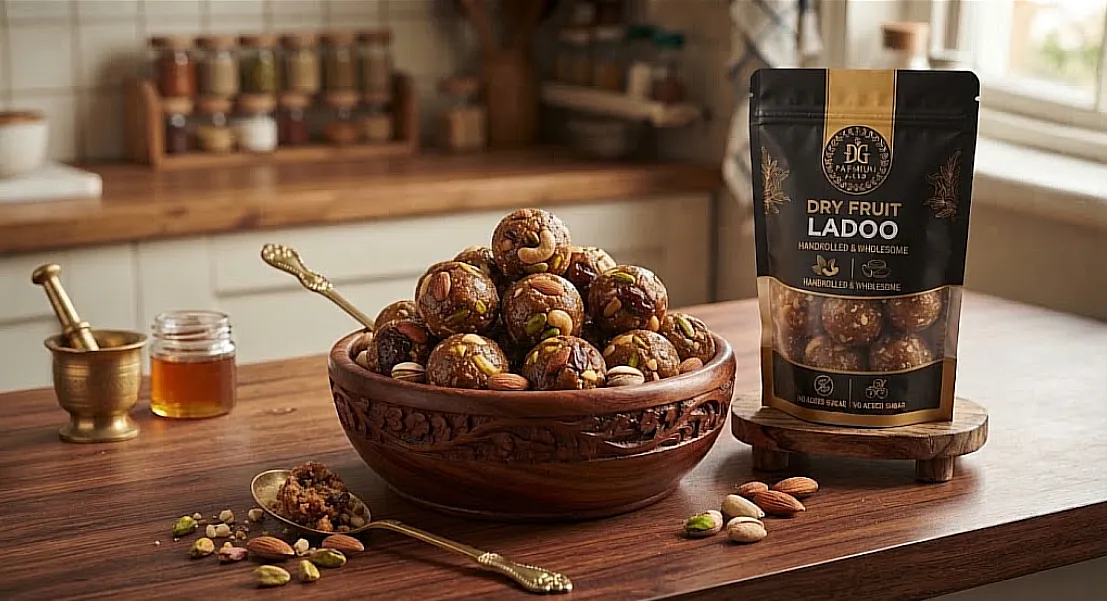
Dry fruit ladoo is a round sweet made primarily from dried fruits and nuts.
Depending on the recipe, it may also be called:
There isn't one universal recipe.
Some versions use dates as the primary binder and contain no added sugar. Others use jaggery, sugar, ghee, coconut, edible gum, figs, raisins, seeds, or additional ingredients.
A recent Pakistani recipe from Khan Dry Fruits uses dates, almonds, cashews, pistachios, optional ghee, cardamom, and a pinch of salt, while other recipes use combinations of walnuts, figs, raisins, coconut, and seeds.
That flexibility is one of the best things about making ladoos at home.
You can build the recipe around whatever dry fruits you already enjoy.
Dates are the star ingredient in this style of ladoo.
Soft dates have a naturally sticky texture, which means they can hold chopped or ground nuts together without requiring a traditional sugar syrup.
This gives you several advantages.
You don't have to cook sugar to a specific stage.
The sticky date mixture helps the nuts form a cohesive dough.
Dates provide the primary sweetness in the recipe.
When the mixture is warm and properly balanced, you can press it together and roll it into balls.
That's why many date-ladoo recipes use dates as both the sweet component and the binder.
The type of date can affect the final texture.
For ladoo, look for dates that are:
Very dry dates can still be used, but they may need to be softened first.
Soft varieties can often be processed directly after removing the pits.
If you're using particularly firm dried dates, a short soak in warm water can help soften them. After soaking, however, drain them extremely well and pat them dry.
You don't want excess water in the ladoo mixture.
A recent Pakistani dry-fruit recipe specifically recommends warming soft dates to create a sticky paste and notes that firmer dates can be softened before processing.
This recipe makes approximately 14–18 medium-sized ladoos, depending on how large you shape them.
The quantities don't need to be treated as absolute.
You can increase the nuts for a crunchier ladoo or increase the dates if your mixture needs additional binding.
The basic principle is:
Dates provide the sticky base. Nuts provide structure and texture.
Once you've mastered the basic recipe, you can experiment with:
One South Asian recipe, for example, combines dates with walnuts, almonds, sunflower seeds, melon seeds, figs, and black raisins, demonstrating how easily the basic formula can be expanded.
But don't feel like you need every ingredient.
A simpler ladoo can be fantastic.
Before doing anything else, inspect your nuts.
Look for:
If a nut smells stale or rancid, don't try to hide the flavor by roasting it heavily.
Use fresh ingredients instead.
Next, remove any remaining pieces of shell and chop large nuts if necessary.
You don't need to chop everything finely because you'll be pulsing the nuts later.
Generally, there's no need to wash packaged nuts immediately before roasting.
If you do wash or soak nuts for a particular preparation, make sure they're thoroughly dried before roasting.
Moisture can interfere with browning and can make the finished ladoo mixture harder to control.
For this recipe, dry, ready-to-roast nuts are easiest.
Place a dry heavy-bottomed pan over low to medium heat.
Add the almonds.
Stir frequently.
You aren't trying to make dark roasted almonds.
You want them:
Depending on the pan and quantity, this may take several minutes.
Don't walk away.
Nuts contain natural oils and can burn quickly once the pan becomes hot.
A Pakistani dry-fruit ladoo recipe recommends dry-roasting almonds and cashews for several minutes over medium-low heat until fragrant, then cooling them before processing.
Once the almonds are ready, transfer them to a plate.
Use the same pan.
Add the cashews.
Keep the heat moderate and stir frequently.
Cashews can brown quickly.
You're looking for a light golden color and a pleasant toasted aroma.
Once they reach that point, remove them immediately.
Don't leave them in the hot pan while preparing the next ingredient.
Walnuts need a lighter touch.
Add the walnut pieces to the pan.
Toast them briefly.
You want to enhance their natural flavor without making them bitter.
Once fragrant, remove them.
If you're using pistachios, they can also be lightly warmed.
Avoid aggressively roasting them.
Because they don't all behave the same way.
Almonds are relatively firm.
Cashews can brown quickly.
Walnuts have irregular surfaces.
Pistachios are smaller and can toast faster.
If you throw everything into the pan at once, you can easily end up with some nuts burnt while others are barely toasted.
Roasting separately gives you control.
It also allows you to stop each ingredient at the point where its flavor is best.
This is an easy step to overlook.
Don't immediately throw hot nuts into your food processor.
Spread them onto a plate and let them cool.
Warm nuts release their oils more readily when processed.
If you blend them while they're hot, you can accidentally turn part of the mixture into nut butter.
For ladoo, you generally want coarse, textured nuts, not a smooth paste.
So give them a few minutes to cool.
Transfer the cooled nuts to a food processor or grinder.
Pulse in short bursts.
Don't continuously blend.
Your target texture is:
Coarse → crumbly → small visible nut pieces
Not:
Fine powder → nut butter
You should still be able to see tiny pieces of almonds, cashews, walnuts, and pistachios.
That gives the ladoos a much better bite.
Several dry-fruit ladoo recipes specifically recommend coarse processing rather than turning the nuts into a fine powder.
Coarse nuts give you:
If you grind everything into a smooth paste, the finished ladoo can become dense and overly oily.
Remove every pit.
Even if the package says seedless, check them.
It's worth the few seconds.
If the dates are very soft, simply chop them into smaller pieces.
If they're firm and dry, soften them first.
Place the pitted dates in warm water for approximately 10–20 minutes.
Then drain them thoroughly.
Pat them dry.
You don't want water remaining on the surface.
Excess water can make the mixture sticky and shorten its storage life.
Yes.
If you have good-quality date paste without unnecessary added ingredients, it can be convenient.
However, whole dates give you more control over texture and sweetness.
You can decide exactly how coarse or smooth the date mixture should be.
Place the chopped dates into the food processor.
Pulse them in short bursts.
Scrape the sides when necessary.
Eventually, the dates should form a sticky, cohesive mass.
It doesn't need to be perfectly smooth.
In fact, a slightly coarse date paste can work very well.
You're looking for something that:
If the food processor struggles, stop and scrape the sides rather than continuously running the machine.
Place a heavy pan over low heat.
Add the optional ghee.
Then add the date mixture.
Warm it gently for a few minutes.
Stir continuously.
The purpose isn't to fry the dates.
You simply want to soften them and make the mixture more workable.
A recent Pakistani recipe uses a small amount of ghee to warm the dates until they become glossy and soft, then combines them with the roasted nuts.
Don't overcook the dates.
If they become dry, hard, or caramelized, the mixture can become difficult to shape.
Add approximately ½ teaspoon of freshly ground or powdered green cardamom.
Mix it through the warm date paste.
The aroma should become noticeable immediately.
If you love cardamom, you can add a little more.
But don't overwhelm the natural flavor of the dates and nuts.
Turn off the heat.
Add the coarse nut mixture to the warm dates.
Add:
Start mixing.
At first, it may look like there are far too many nuts.
Keep going.
Press and fold the mixture.
The warm dates should gradually coat the nuts.
The finished mixture should resemble a soft, pliable dough.
When you squeeze a portion in your hand, it should hold together.
It should not:
This is the point where you can make small adjustments.
If the mixture won't hold together, don't panic.
This is one of the easiest problems to solve.
This is usually the most direct solution.
Add one or two softened dates.
Process them into a paste.
Mix them into the dry mixture.
If the mixture is only slightly dry, a teaspoon of warm ghee may help.
Don't pour in a large amount.
Too much ghee can make the ladoos greasy and difficult to shape.
Sometimes the mixture simply needs a little warmth.
Warm it gently and mix again.
The dates may become more pliable.
If the mixture feels like date paste with a few nuts floating around, you probably need more dry ingredients.
Add:
Add small amounts at a time.
Mix thoroughly.
Don't dump in a large quantity all at once.
You want to preserve the balance between sweetness and texture.
This usually happens when too much ghee has been added or when the nuts were processed while warm.
The easiest fix is to add more dry ingredients.
Try:
Mix and allow the mixture to cool slightly.
As it cools, the fats will firm up and the texture should become easier to manage.
This is the fun part.
Take a small portion of the warm mixture.
Press it firmly between your fingers.
Then roll it between your palms.
Apply consistent pressure.
Don't squeeze aggressively.
You're aiming for a compact, smooth ball.
Continue until you've used all the mixture.
That's completely up to you.
Good for:
Good for everyday homemade snacks.
Better suited to individual dessert servings.
For a gift box, smaller ladoos often look more elegant because you can fit several into a compartment.
You can leave the ladoos plain.
Or coat them.
Popular options include:
For a particularly attractive finish, roll the ladoo in finely chopped pistachios.
The green color contrasts beautifully with the dark date mixture.
Roll each ladoo in desiccated coconut while the outside is still slightly warm.
The coconut will adhere naturally.
This creates a lighter-colored exterior and adds another texture.
Place the finished ladoos on a clean tray.
Let them cool completely.
Don't immediately stack them into a container while they're still warm.
Cooling allows the mixture to firm up.
Once cool, they should hold their shape well.
If you want to keep things simple, make this version:
This is probably the easiest version for beginners.
The dates provide sweetness and binding while the almonds and cashews provide crunch.
For a more premium version, increase the pistachios.
Use:
Reserve a small amount of pistachio for coating.
Roll the finished ladoos in finely chopped pistachios.
The result looks much more elaborate than the recipe actually is.
Walnuts can become the star of the recipe.
Try:
Don't over-roast the walnuts.
You want their rich flavor to remain pleasant rather than bitter.
Dried figs are an excellent addition when you want a more complex texture.
Use:
Soften the figs if necessary.
Remove the hard stem.
Process them together with the dates.
Then combine with the roasted nuts.
A number of dry-fruit ladoo recipes use figs alongside dates and nuts, showing how naturally they fit into the basic mixture.
Raisins can increase the sweetness and add a chewy texture.
Try:
Keep the raisins relatively low compared with the dates.
Too many raisins can make the mixture overly sticky.
Seeds can give your ladoos a more textured finish.
Try adding:
Lightly toast them first.
Then mix them into the coarse nut mixture.
Because seeds are small, watch them carefully during roasting.
Coconut is one of the easiest ways to change the flavor.
Use:
You can mix the coconut into the ladoo or use it as an outer coating.
For a stronger coconut flavor, lightly toast the coconut before using it.
Yes.
Ghee is optional in many date-based ladoo recipes.
If the dates are soft and sticky enough, they may provide sufficient binding on their own.
Some recipes use no ghee at all and rely entirely on the dates and nuts.
Ghee can nevertheless make the mixture:
If you're making the recipe without ghee, pay particular attention to the dates.
They need to be soft enough to bind the nuts.
Yes.
That's one of the biggest advantages of a date-based recipe.
You don't need to add refined sugar if the dates provide enough sweetness.
But there's an important distinction:
No added sugar does not mean sugar-free.
Dates naturally contain sugars.
So if you're describing the ladoos, “no added sugar” is more accurate than “sugar-free.”
This distinction matters particularly when discussing food for people managing blood glucose or other dietary requirements.
You can, but you may not need it.
If your dates are already sweet, adding jaggery can make the ladoos excessively sweet.
If you prefer a deeper caramel-like flavor, a small amount of finely powdered jaggery can be incorporated.
Taste the mixture before adding it.
That's the easiest way to avoid over-sweetening.
Use:
The easiest approach is to increase the nut-to-date ratio.
Remember that dates are doing double duty as both sweetener and binder.
If you remove too many dates, you'll need another ingredient to hold the mixture together.
Increase:
You can also add:
But don't increase everything at once.
The dates still need to be sufficient to bind the mixture.
Use softer dates.
Don't overcook the date paste.
Don't over-roast the nuts.
Use a small amount of ghee if needed.
Shape the ladoos while the mixture is warm.
These steps help maintain a softer texture.
Use a slightly higher proportion of roasted nuts.
Allow the finished ladoos to cool completely.
Refrigerating them can also firm the texture.
If you're preparing them for transport, a slightly firmer mixture can be easier to handle.
If your ladoos crumble when you try to roll them, one of three things is probably happening.
The nut-to-date ratio is too high.
The dates didn't provide enough moisture or stickiness.
Fine nut powder can sometimes make the mixture behave differently from coarse nuts.
The easiest solution is usually to add a little more soft date paste.
This can happen if:
Add a little soft date paste and gently warm the mixture.
Don't add water unless you're deliberately changing the recipe and understand that additional moisture can affect storage.
You may have:
Add more roasted nuts or coconut.
Then allow the mixture to cool.
If necessary, refrigerate it before shaping.
The most common reason is excess added fat or processing warm nuts.
Remember:
Nuts already contain natural oils.
You don't need a lot of ghee.
Start with a teaspoon or two and only add more if the mixture genuinely needs it.
Once completely cool, place the ladoos in an airtight food-safe container.
Keep them:
For humid weather, refrigeration can be particularly useful.
A recent Pakistani dry-fruit recipe recommends airtight storage at cool room temperature for a short period and refrigeration for longer storage, especially during humid weather.
Because homemade ladoos can contain different combinations of dates, nuts, coconut, figs, seeds, and ghee, their storage life can vary significantly.
Treat shelf-life estimates as guidelines rather than guarantees.
Check for:
If something seems wrong, discard the ladoos.
Don't rely on roasting or reheating to make spoiled food safe.
If your kitchen is warm or humid, refrigeration is a sensible option.
It's especially useful if you've added:
Place the ladoos in an airtight container so they don't absorb refrigerator odors.
Allow them to sit at room temperature briefly before serving if you prefer a softer texture.
For longer storage, freezing can be an option depending on the recipe.
Wrap or seal the ladoos well.
Avoid repeatedly thawing and refreezing the same batch.
For everyday homemade use, however, making a smaller quantity and refrigerating it is often simpler.
Dates make dry fruit ladoos especially suitable for Ramadan-themed food preparation.
A simple version containing:
can be prepared ahead of time and served as a small sweet.
You can also make smaller ladoos so they're easier to serve after iftar.
For Ramadan gifting, individually packed ladoos can be placed alongside dates and other dry fruits in a larger hamper.
For Eid, presentation becomes part of the fun.
Try making smaller ladoos and coating them with:
Arrange them in small paper cups inside a gift box.
You can mix several coatings in the same box.
That creates variety without changing the basic recipe.
A richer winter version can include:
You can add a small amount of warming spice such as cinnamon or dry ginger if you enjoy the flavor.
Keep the spices subtle.
The dry fruits should remain the main attraction.
If you're making ladoos for a wedding, presentation matters as much as flavor.
Make them relatively uniform in size.
Choose one or two coatings.
Good options include:
Then place them in individual mini liners or small compartments.
A uniform appearance makes homemade ladoos look much more polished.
Homemade ladoos can make a lovely edible gift.
You can use:
Add a simple label.
For example:
Homemade Dry Fruit Ladoo
Ingredients: Dates, almonds, cashews, walnuts, pistachios, cardamom.
If you're gifting them to someone whose allergies you don't know, listing the nuts is particularly important.
Tree nuts are recognized allergens, and cross-contact can result in undeclared allergens in food products.
Consistency is everything.
Try to make every ladoo roughly the same size.
Then choose one finishing style.
For example:
Plain ladoos with a pistachio garnish.
Coconut-coated ladoos.
Pistachio-coated ladoos with a tiny saffron garnish.
Plain ladoos packed in a kraft-style food-safe box.
You don't need elaborate decoration.
Good food and clean presentation do most of the work.
Serve two or three small ladoos with:
For a dessert platter, combine them with:
This creates a beautiful dry-fruit-focused serving board.
Dry fruit ladoos can contain whole or chunky nuts, so texture and age matter.
For young children, whole nuts and firm pieces can present a choking hazard.
If you're making ladoos for children, follow age-appropriate food safety guidance and adjust the texture accordingly.
For older children, you can make smaller ladoos with finely chopped or appropriately processed nuts.
Also remember that nuts are common allergens.
If a child has a known food allergy, avoid ingredients that are unsafe for them and prevent cross-contact.
It's tempting to slap the word “healthy” onto any recipe containing nuts and dates.
But food isn't quite that simple.
Dry fruit ladoo can contain nutritious ingredients such as nuts, seeds, and dried fruit, but it is still a concentrated sweet.
Dates contain naturally occurring sugars, and nuts and ghee contribute substantial calories and fat.
So “no added sugar” doesn't mean unlimited.
A better way to think about these ladoos is as a rich homemade treat made from dry fruits and dates.
Enjoy them in sensible portions as part of an overall varied diet.
If you're managing diabetes or another medical condition, don't assume that a date-based ladoo is automatically appropriate simply because it contains no refined sugar.
Once you understand the recipe, you don't really need to memorize every measurement.
Think of it as:
Soft dates + roasted nuts + flavoring = ladoo
Then adjust the ratio depending on what you want.
More dates:
Softer + sweeter + stickier
More nuts:
Crunchier + firmer + less sweet
More ghee:
Richer + softer + more aromatic
More coconut:
Lighter texture + additional sweetness
More seeds:
More texture + different flavor
This makes the recipe incredibly flexible.
If this is your first attempt, don't make a giant batch.
Start with:
That's enough to learn the technique without wasting a large quantity if you make a mistake.
Once you've nailed the texture, scale it up.
The dates are your binder.
You want aroma, not burnt flavor.
This helps prevent excessive oil release during processing.
Keep some texture.
You want them soft and sticky.
You can always add a little more.
The mixture is easier to work with.
This helps the ladoos firm up and reduces condensation.
It's much easier to adjust the mixture before you've rolled 18 ladoos.
Dry fruit ladoo is one of those recipes that looks impressive once it's sitting on a plate but is surprisingly straightforward to make.
The foundation is beautifully simple: soft dates for sweetness and binding, lightly roasted dry fruits for crunch and flavor, and cardamom for aroma.
From there, you can make the recipe completely your own.
Almonds and cashews create a classic combination. Walnuts add a richer flavor. Pistachios bring color and a premium touch. Raisins and figs add chewiness and sweetness, while coconut and seeds introduce another layer of texture.
The biggest secret is getting the consistency right.
Use dates that are soft enough to bind. Roast the nuts gently rather than aggressively. Let them cool before processing. Pulse them until they're coarse rather than turning them into butter. Warm the dates just enough to make them pliable, combine everything while the mixture is workable, and shape the ladoos before they cool completely.
And if the first batch doesn't cooperate, don't bin it. Too dry? Add more date. Too sticky? Add more roasted nuts. Too greasy? Add dry ingredients and let it cool. Too hard? Check the dates and avoid overcooking them. That's the beauty of this recipe: it's forgiving.
You can make a small batch for the family, prepare a richer version for winter, create smaller ladoos for Ramadan or Eid, or package beautifully finished pieces as homemade gifts.
Most importantly, don't get trapped by the idea that there is only one correct dry fruit ladoo recipe. Pakistani and South Asian versions already vary widely in their use of dates, nuts, figs, raisins, coconut, seeds, ghee, and spices.
Build the recipe around the flavors you actually enjoy.
And when you bite into that first ladoo—the soft date, the roasted almond crunch, the buttery cashew, the walnut richness, and that little hit of cardamom—you'll understand why this is one homemade dry-fruit treat that's very hard to stop eating after “just one.”
Dry fruit ladoos can be made with soft dates, roasted almonds, cashews, walnuts, pistachios, and cardamom. You can also customize them with figs, raisins, coconut, seeds, or other favorite dry fruits.
Yes, dates can act as a natural binder, allowing the ladoos to be prepared without traditional sugar syrup. The date mixture helps hold the roasted nuts and other ingredients together.
Properly roasting the nuts and preparing the date mixture are important for achieving the desired texture. If the mixture becomes too dry or sticky, it may need to be adjusted before shaping the ladoos.
The mixture can be adjusted to improve its consistency before shaping. Paying attention to the preparation of the dates and roasted nuts can also help you achieve a mixture that holds together without being excessively sticky.
Fasih Frankly
SEO Expert and eCommerce Specialist. Shopify, eBay and online selling.
Questions about this article?
Email us and we will get back to you.
Explore more
Store the finished ladoos in a suitable airtight container to help maintain their texture and freshness. Proper storage can make them convenient for family snacking, winter gatherings, Ramadan, Eid, weddings, or gifting.
