- 100% Natural
- Premium Quality
- No Preservatives
- Fresh & Healthy
Learn how to build a premium dry fruit platter at home with simple presentation techniques and 10 elegant ideas for guests, Ramadan, Eid, weddings, tea parties, family gatherings, and special occasions. Discover how to choose almonds, walnuts, pistachios, cashews, dates, raisins, figs, apricots, and seeds, arrange different colors and textures, create attractive serving sections, keep dry fruits fresh, and make a simple platter look sophisticated without excessive decoration.
A beautifully arranged dry fruit platter can turn a simple table into something that feels thoughtful, generous, and elegant. Instead of placing almonds, pistachios, dates, or raisins in separate bowls, you can combine different colors, shapes, textures, and flavors into one attractive presentation.
The best part is that you do not need professional catering equipment or an expensive serving tray to create one. With a suitable platter, a few quality dry fruits, small serving bowls, and a little attention to arrangement, you can create a presentation that works for family gatherings, afternoon tea, dinner guests, Ramadan, Eid, weddings, birthdays, winter evenings, or even a quiet weekend at home.
Dry fruits are particularly well suited to this style of serving because they naturally offer variety. Almonds provide a firm crunch, walnuts add a distinctive texture, pistachios bring color, cashews add a creamy bite, while dates, raisins, dried figs, and apricots provide natural sweetness. Seeds can add another visual and textural element.
Dryzen Royal's current range includes almonds, walnuts, cashews, pistachios, dates, raisins, dried fruits, and seeds, while its gifting collection also emphasizes presentation and hand-arranged boxes for occasions such as weddings, Ramadan, Eid, birthdays, and corporate gifting.
This guide explains how to build a premium-looking dry fruit platter at home, how to select the right combination of ingredients, how to arrange everything attractively, and how to create different platter styles for different occasions.
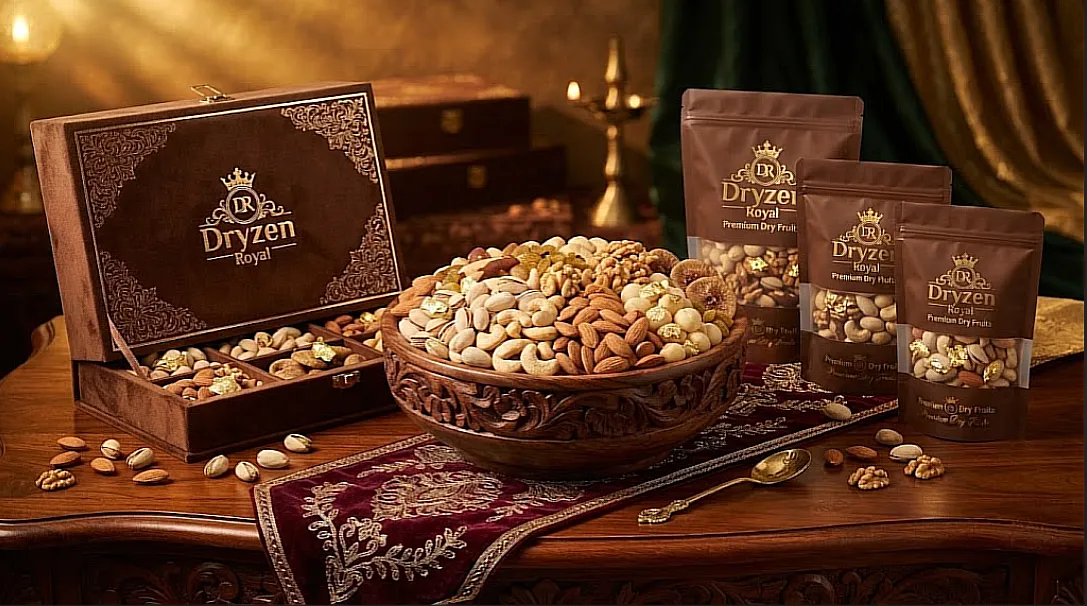
A dry fruit platter is a serving arrangement featuring a selection of nuts, dried fruits, seeds, and sometimes complementary foods such as chocolate, coconut, or fresh fruit.
Unlike a simple bowl of mixed nuts, a platter gives each ingredient its own visual space. The goal is not necessarily to mix everything together. Instead, different varieties can be arranged in sections, small bowls, lines, circles, or clusters.
A well-designed platter usually combines:
For example, a platter containing only almonds may taste excellent but look relatively uniform. Adding green pistachios, golden cashews, dark walnuts, brown dates, and golden raisins immediately creates more contrast.
The presentation becomes part of the experience.
Dry fruits are already popular for serving guests in many Pakistani households, especially during festivals, family visits, winter gatherings, and celebrations.
A platter simply gives the traditional idea a more organized and attractive presentation.
There are several reasons to use one.
A thoughtfully arranged platter can make even a casual gathering feel more special.
Instead of putting several packets or bowls on the table, you can create one central presentation that immediately attracts attention.
Not everyone prefers the same dry fruit.
One guest may reach for almonds, another may prefer pistachios, while someone else may choose dates or cashews.
A mixed platter allows people to choose what they like.
The same basic idea can be adapted for:
A platter does not have to contain every dry fruit available.
You can make a simple three-item platter, a family-sized selection, or a premium arrangement featuring several varieties.
The important thing is balance rather than quantity.
Before thinking about decoration, start with the actual food.
A beautiful platter is only successful if the ingredients are fresh and enjoyable to eat.
When selecting dry fruits, consider four things: flavor, texture, color, and size.
Almonds are one of the easiest foundations for a dry fruit platter.
Their neutral flavor works well alongside sweeter dried fruits and richer nuts.
You can serve them:
Whole almonds are particularly useful when you want a clean, traditional presentation.
Walnuts have a distinctive shape and naturally create visual interest.
Their irregular appearance can actually help make a platter look less uniform.
Serve walnut halves rather than breaking them into very small pieces when presentation is the priority.
They can form a curved section around the center of a platter or sit in a dedicated bowl.
Pistachios are extremely useful when designing a visually attractive platter.
Their green color contrasts with the earthy tones of almonds, walnuts, cashews, dates, and raisins.
You can use shelled pistachios for easy eating or present pistachios in their shells for a more traditional serving style.
Cashews provide a different shape and texture from almonds and walnuts.
Their curved appearance also helps break up repetitive patterns.
Roasted cashews can work particularly well for an evening platter, while plain or lightly roasted cashews can suit a more understated arrangement.
Dates are one of the most natural additions to a Pakistani dry fruit platter.
They provide sweetness and a soft texture that contrasts with crunchy nuts.
For a more premium presentation, you can serve whole dates in a dedicated section rather than mixing them with smaller dry fruits.
Ajwa dates can also be used when creating a more formal Ramadan or gifting-inspired platter.
Dryzen Royal currently features Ajwa dates alongside almonds, cashews, walnuts, pistachios, and raisins in its Ramadan gift selection.
Raisins are small but useful for adding color and sweetness.
Because they are much smaller than whole nuts, they are best placed in a small bowl or contained section rather than scattered randomly across the platter.
Golden and dark raisins can also be combined for additional visual contrast if available.
Dried figs and apricots can make a platter feel more varied and sophisticated.
They introduce different shapes and colors while providing another naturally sweet option.
Cut larger dried figs into halves or quarters if you want their interior texture to become part of the presentation.
Pumpkin seeds, sunflower seeds, sesame seeds, or other edible seeds can add a small-scale texture to the platter.
However, because seeds are tiny compared with whole nuts, they usually work best in small bowls.
Dryzen Royal's current range includes pumpkin seeds, making them an option for adding another texture to a homemade platter.
You do not need twenty ingredients.
A simple formula can make planning much easier.
Try using:
2–3 main nuts + 1–2 dried fruits + 1 optional seed or specialty ingredient.
For example:
Classic platter
Premium platter
Winter platter
Elegant evening platter
The goal is to create contrast without making the platter visually chaotic.
Once you understand the basics, you can create different styles depending on the occasion.
For a traditional family gathering, keep things simple.
Use:
Place the larger nuts around the outer portion of the platter and use smaller dried fruits in bowls toward the center.
This style works especially well with tea and after-dinner serving.
A wooden, brass, ceramic, or neutral-colored platter can complement the traditional appearance.
For a more formal presentation, arrange the ingredients in circular sections.
Start with a large round serving platter.
Place one ingredient along the outer edge, then another beside it, continuing around the platter.
For example:
Place a small bowl in the middle containing a specialty ingredient.
The result is symmetrical and visually organized.
This arrangement works particularly well when serving guests at a formal dinner.
A Ramadan platter can focus on dates while using nuts and dried fruits as supporting elements.
A simple arrangement could include:
Place the dates in the center or in the most prominent section.
Use smaller bowls for raisins and seeds.
Keep the arrangement practical rather than overly decorative because the platter should remain easy for guests to serve from.
Dryzen Royal's Ramadan collection itself centers a selection around Ajwa dates and includes almonds, cashews, walnuts, pistachios, and raisins.
Eid is an ideal time for a more colorful arrangement.
Combine different shades:
You can place the platter alongside tea, coffee, desserts, or traditional Eid sweets.
For a polished appearance, avoid overfilling the platter. Leave a little space between sections so each ingredient remains visually identifiable.
Wedding gatherings call for a more luxurious presentation.
Consider using:
The presentation can be more formal, with larger portions arranged in clearly defined sections.
You can also use a large decorative tray and smaller bowls for the ingredients.
Dryzen Royal's wedding gift collection currently combines jumbo almonds, cashews, walnuts, pistachios, raisins, and premium Ajwa dates, illustrating a combination that can also inspire a wedding-serving platter.
A tea-time platter does not need to be enormous.
Try:
Keep the portions modest and arrange the ingredients around a central bowl.
This works particularly well for family visits or when unexpected guests arrive.
You can serve the platter alongside:
The dry fruits can provide a contrasting option to sweeter snacks.
Winter is naturally associated with dry fruits in many Pakistani households.
A winter platter can emphasize richer, crunchier ingredients.
Use:
For a cozy presentation, use a wooden or ceramic tray.
You can also serve the platter with warm tea, coffee, or milk.
The key is to make it feel abundant without creating unnecessary waste.
Luxury does not always mean using more ingredients.
A minimalist platter can contain only four carefully selected items:
Use a large neutral-colored platter and leave generous space around each section.
Arrange each variety in a clean line, crescent, or geometric shape.
This approach works particularly well for formal dinners, photography, private events, and modern home interiors.
The ingredients become the decoration.
For a relaxed family gathering, presentation can be more generous.
Use a large tray containing:
Instead of arranging everything perfectly, create natural clusters.
Place small bowls of the smaller ingredients between larger piles of nuts.
This makes the platter easier for several people to share.
Dry fruits do not have to be the only food on the table.
Create a dessert companion platter by combining dry fruits with small amounts of complementary foods.
For example:
Keep the sweet elements limited so the platter still feels like a dry-fruit presentation rather than a dessert tray.
Once the ingredients are selected, the arrangement becomes much easier if you work from large elements to small ones.
Your serving tray should match the number of people and amount of food.
For a small family serving, a medium platter is usually enough.
For a wedding, party, or larger gathering, use several smaller platters rather than creating one enormous tray.
Suitable materials include:
The platter does not need to be expensive.
It simply needs to be clean, stable, food-safe, and visually compatible with the occasion.
Choose one ingredient to act as the visual center.
Dates are a natural choice.
A small bowl of pistachios or a premium nut mixture can also work.
Once the focal point is established, arrange other ingredients around it.
Start with walnuts, dates, and whole almonds.
These larger pieces establish the overall structure.
Do not worry about filling every space yet.
Next, add cashews and pistachios.
Use them to create balance between the larger sections.
If one side looks visually heavier, add a contrasting ingredient to the opposite side.
Finally, add:
These can fill gaps without overwhelming the main arrangement.
Look at the platter from a short distance.
Does everything look like one large brown mass?
If so, add color contrast.
Pistachios, dried apricots, golden raisins, or lighter-colored cashews can help break up the darker tones.
This is one of the easiest ways to make a platter look more premium.
Do not cover every centimeter.
Empty space gives the ingredients room to stand out.
A crowded platter can look cheaper even when the ingredients themselves are expensive.
You do not necessarily need premium decorations.
Presentation usually matters more than decoration.
Here are some simple tricks.
If you are using small bowls, choose bowls that match.
Three or four identical ceramic bowls often look more polished than several unrelated containers.
A wooden tray with ceramic bowls creates more visual interest than placing everything directly onto one flat surface.
You can place a small bowl slightly higher than the surrounding ingredients.
This creates depth.
Avoid making the platter so tall that guests struggle to reach the food.
Try not to place every green ingredient together unless you are deliberately creating a color section.
Spread contrasting ingredients around the platter.
Flowers, ribbons, glitter, artificial leaves, and elaborate decorations can sometimes distract from the food.
For an elegant platter, simplicity usually works better.
There is no universal amount because it depends on the number of guests and whether the platter is the main snack or simply one item among several.
For a small gathering, you might use several hundred grams of mixed dry fruits.
For a large event, multiple platters are usually easier to manage.
A useful approach is to think about the purpose.
If the platter is being served alongside tea, desserts, and other snacks, you do not need huge quantities.
If dry fruits are the main snack, plan more generously.
Avoid buying significantly more food than you expect to serve simply to make the platter look full.
You can always refill a smaller platter from sealed containers when necessary.
Presentation should never come at the expense of food safety.
Before preparing the platter:
If the event is outdoors, consider using smaller covered containers and replenishing the platter periodically.
This is particularly important during hot weather.
Nuts and dried fruits generally have a longer storage life than many fresh foods, but they can still lose quality when exposed to heat, moisture, air, or light.
Do not prepare a platter hours in advance and leave it uncovered in a hot room.
Instead, keep the ingredients stored properly and assemble the platter closer to serving time.
For items that are particularly sensitive to heat or humidity, refrigeration may be appropriate depending on the ingredient and packaging.
Once opened, follow appropriate storage practices for each dry fruit.
Dryzen Royal's product information similarly recommends storing certain gift-box contents in a cool, dry place away from direct sunlight.
Yes, but timing matters.
For a small gathering, assembling the platter shortly before guests arrive is usually the simplest approach.
If you need to prepare earlier:
If chocolate or other temperature-sensitive ingredients are included, take the room temperature into account.
A dry fruit platter can be adapted to many occasions that are common in Pakistan.
Focus on dates and combine them with almonds, walnuts, pistachios, cashews, and raisins.
The platter can be placed on an iftar table alongside water, fruit, chaat, pakoras, and other foods.
Use a more colorful arrangement with dates, pistachios, almonds, cashews, raisins, and dried fruit.
The platter can be served with tea when relatives visit.
Choose premium-looking varieties and larger presentation trays.
Jumbo almonds, pistachios, cashews, walnuts, dates, and dried fruits can create a more formal arrangement.
Smaller individual platters or several matching trays can work well for intimate gatherings.
Use coordinated servingware to create a consistent look.
Keep the presentation clean and understated.
A minimalist combination of almonds, cashews, pistachios, walnuts, and dates can work better than an overly decorative arrangement.
A traditional mixed platter is often enough.
There is no need to turn every guest visit into a formal event.
A simple tray of good-quality dry fruits with tea can feel warm and welcoming.
A premium-looking platter does not require premium quantities of every ingredient.
Choose one or two ingredients that you want to emphasize and use more affordable options to build the rest.
For example:
This can look more impressive than buying eight different varieties in small amounts.
Presentation is about composition.
You can also use a platter you already own instead of buying a dedicated serving tray.
Even good ingredients can look disappointing if the arrangement is poorly planned.
More food does not automatically mean a better presentation.
Leave space between sections.
Ten or fifteen different ingredients can make the platter visually confusing.
Start with four to seven.
If everything has a similar brown tone, the platter can appear flat.
Use pistachios, dried apricots, golden raisins, or other contrasting ingredients.
Dates and other sticky dried fruits can affect nearby ingredients.
Keep them in their own section or bowl.
The food may be premium, but unclean or unsuitable servingware will immediately affect the presentation.
Leaving nuts and dried fruits exposed for too long can reduce freshness.
Assemble closer to serving time.
The dry fruits should remain the star.
If you want to take the concept beyond home serving, you can create a platter-inspired gift arrangement.
Use a decorative tray, wooden box, or gift basket.
Then arrange:
Add a ribbon and personalized message if appropriate.
Dryzen Royal's gifting collection currently emphasizes customizable fillings, presentation, ribbons, personalized cards, and occasion-specific boxes for weddings, Eid, Ramadan, birthdays, corporate gifting, and other occasions.
A homemade platter can therefore also serve as inspiration for a personalized dry-fruit gift.
If you want a quick formula without overthinking the design, use this:
Choose five ingredients.
Then add one optional ingredient such as dried figs or pumpkin seeds.
Arrange the largest ingredients first, place the smallest ingredients in bowls, add color around the platter, and leave some empty space.
That is enough to create a polished presentation.
Before bringing the platter to the table, quickly check:
That last point is particularly important.
If a guest has a known nut allergy, do not assume that removing one visible ingredient makes a mixed platter safe. Cross-contact can occur, and guests with allergies should be informed about the ingredients.
A premium dry fruit platter is ultimately about thoughtful presentation rather than complicated decoration.
Start with a small selection of fresh, good-quality ingredients and build the platter around contrast. Almonds, walnuts, pistachios, cashews, dates, raisins, figs, apricots, and seeds can provide plenty of variety without requiring an enormous ingredient list.
For everyday family gatherings, a simple mixed platter can be warm and inviting. For Ramadan and Eid, dates can take center stage. For weddings and formal occasions, larger serving trays and premium selections can create a more sophisticated presentation. For tea-time, a smaller platter may be all you need.
The key is balance: balance between colors, textures, flavors, portions, and empty space.
You do not need an expensive serving tray or elaborate decorations to make dry fruits look special. With thoughtful arrangement and fresh ingredients, even a simple homemade platter can become an attractive centerpiece that makes guests feel welcome.
Popular choices include almonds, walnuts, pistachios, cashews, dates, raisins, figs, apricots, and seeds. Combining different varieties can create a pleasing mix of colors, flavors, and textures.
Arrange the dry fruits in organized sections and combine different colors and textures for visual variety. Simple, thoughtful presentation can make the platter look sophisticated without requiring excessive decoration.
A dry fruit platter can be prepared for guests, Ramadan, Eid, weddings, tea parties, family gatherings, and other special occasions. The selection and presentation can be adjusted to suit the event.
Create separate serving sections for different types of nuts, dried fruits, and seeds while balancing their colors and textures across the platter. This makes the selection easier to serve and gives the overall presentation a more organized appearance.
Fasih Frankly
SEO Expert and eCommerce Specialist. Shopify, eBay and online selling.
Questions about this article?
Email us and we will get back to you.
Explore more
Dry fruits should be protected from moisture, excessive heat, and other conditions that can affect their quality. Preparing the platter close to serving time and using appropriate storage before serving can help maintain freshness.
