- 100% Natural
- Premium Quality
- No Preservatives
- Fresh & Healthy
Why do roasted dry fruits taste so much better to some people? Roasting changes moisture, texture, aroma, color, and flavor, creating the familiar toasted character of almonds, cashews, walnuts, pistachios, and other nuts. This guide explores the science behind roasting, the Maillard reaction, raw versus roasted dry fruits, nutrition changes, dry and oil roasting, the best nuts to roast, Pakistani-inspired flavors, common mistakes, storage, and practical tips for getting perfectly roasted dry fruits at home.
There is something almost irresistible about freshly roasted dry fruits.
The moment almonds turn golden, cashews develop a deeper aroma, pistachios become intensely fragrant, or walnuts pick up that warm toasted character, the experience changes. The nuts may be the same ingredients you started with, but they can taste noticeably richer, smell more inviting, and develop a completely different texture.
So what actually happens when dry fruits are roasted?
It is not simply a matter of making them hot.
Roasting triggers a series of physical and chemical changes inside the nuts. Heat removes some moisture, changes texture, develops new aromas, and encourages browning reactions that contribute to the familiar flavor of roasted foods. The Maillard reaction, in particular, plays an important role in the development of the color and characteristic roasted flavors associated with many foods. USDA research on roasted peanuts has linked these browning reactions with changes in flavor and antioxidant activity.
But roasting is not automatically better in every situation.
Different nuts respond differently to heat. A walnut that tastes beautifully toasted after gentle roasting can become bitter if overheated. Almonds can develop a wonderful crunch, while cashews can go from lightly golden to burnt surprisingly quickly. Pistachios may become more aromatic, but excessive heat can damage their delicate flavor.
The difference often comes down to temperature, timing, moisture, and the type of roasting method used.
This guide explores why roasting changes dry fruits, what happens to flavor and texture, how raw and roasted nuts compare, which varieties respond especially well to roasting, how to roast them at home, and how to avoid turning a premium batch into a burnt one.
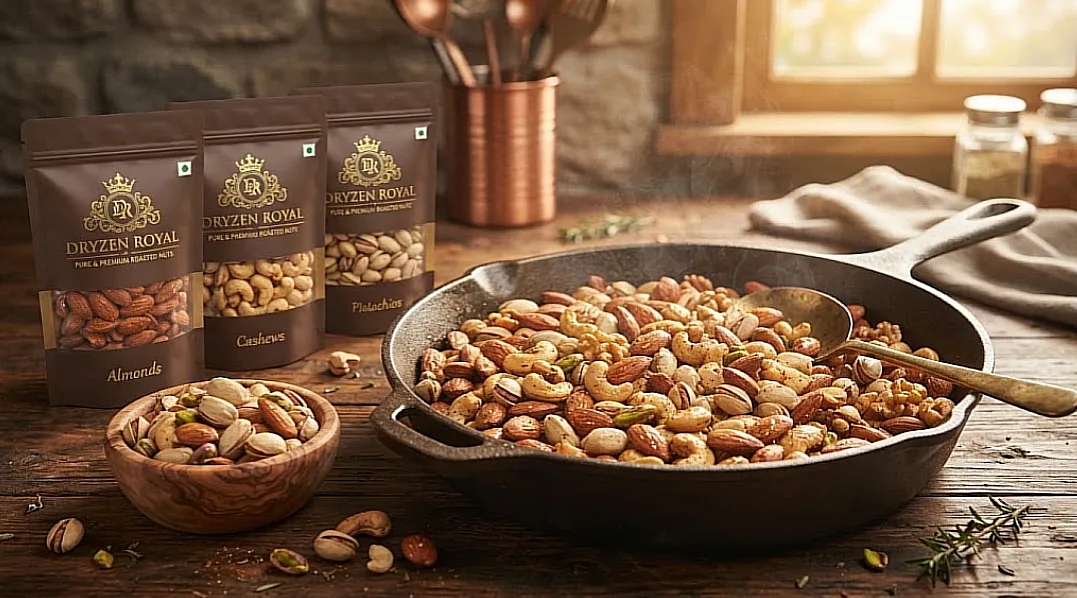
Roasting is essentially controlled heating.
As nuts and seeds are exposed to heat, several things begin happening simultaneously.
Moisture moves out of the food.
The structure of the nut changes.
Aromas develop.
The surface becomes darker.
Flavor compounds are created or transformed.
The texture becomes firmer and crispier.
These changes depend on the type of nut and the roasting conditions.
A nut contains water, fats, proteins, carbohydrates, sugars, minerals, and many other compounds. Heating changes how these components interact.
One of the most noticeable effects is the reduction of moisture.
As moisture decreases, the nut generally becomes crunchier.
At the same time, heat promotes browning reactions that create new flavor and aroma compounds.
That combination explains why a freshly roasted almond can taste so different from a raw almond even though the basic ingredient has not changed.
If you want to understand roasted flavor, the Maillard reaction is one of the most important concepts.
The Maillard reaction is a complex group of chemical reactions that occurs when heat causes certain amino compounds and reducing sugars to interact.
It contributes to browning and creates many of the aroma and flavor compounds associated with cooked foods.
This is not unique to dry fruits.
The same broad family of reactions contributes to the flavor of foods such as:
USDA research on peanuts found that roasting produced browning reaction products and linked these reactions to characteristic roasted peanut flavor.
This is one reason roasted nuts can smell deeper, warmer, and more complex than their raw counterparts.
The aroma is not simply the original nut becoming stronger.
New compounds are being created during heating.
Raw nuts can have a mild aroma.
Roasting changes that.
As heat acts on fats, proteins, sugars, and other components, volatile compounds can be released or formed.
These compounds travel through the air and reach your nose.
That is why the smell of roasting almonds can fill a kitchen.
The aroma is particularly noticeable when nuts are freshly roasted because many volatile compounds are released during and immediately after heating.
This creates the familiar experience of opening an oven and immediately smelling toasted nuts.
The aroma itself can influence how we perceive flavor.
Before you even taste the nut, your sense of smell has already created expectations about what it will taste like.
Raw almonds, for example, can have a clean, mildly sweet, slightly earthy flavor.
Roasted almonds often have a deeper, toastier character.
Cashews can become more buttery and aromatic.
Walnuts can develop a richer roasted note.
Pistachios can become more fragrant and savory.
The exact changes depend on the variety and roasting conditions.
Roasting essentially adds another layer of flavor.
Instead of tasting only the natural characteristics of the nut, you are also tasting compounds created through heating.
That is why roasted nuts can work particularly well in:
One of the biggest sensory differences between raw and roasted nuts is texture.
Roasting removes moisture.
Less moisture generally means a firmer, crispier bite.
Think about the difference between a raw almond and a properly roasted almond.
The raw almond has a firm crunch, but the roasted version can feel noticeably lighter and more brittle.
The same principle applies to many other nuts.
However, roasting needs to be controlled.
Too little heat may leave the nut softer than desired.
Too much heat can create an unpleasantly hard, dry, or burnt texture.
The ideal texture depends on the nut and the intended use.
Moisture is one of the hidden factors in roasting.
Nuts naturally contain some water.
When heated, that water begins moving out of the nut.
As moisture decreases, the internal structure changes.
This contributes to crispness.
However, moisture loss needs to be controlled.
If a nut is exposed to excessive heat for too long, it can become overly dry.
Instead of a pleasant crunch, the result may be:
This is particularly important when roasting smaller nuts or pieces, which can heat faster than large whole nuts.
There is no universal winner between raw and roasted nuts.
The better choice depends on what you want from them.
Raw nuts generally preserve their natural flavor and texture.
They are useful when you want:
Roasted nuts provide:
They are particularly useful for:
Neither form automatically makes a nut better.
They simply offer different eating experiences.
Yes, heating can change some nutritional characteristics, but the effect varies according to the nut, temperature, roasting method, and duration.
The basic macronutrients in nuts do not simply disappear when the nuts are roasted.
For example, USDA FoodData Central provides separate nutrient records for raw almonds and dry-roasted almonds, illustrating that nutritional values can differ between preparation methods.
However, roasting can affect certain heat-sensitive compounds.
Research examining almonds, walnuts, hazelnuts, macadamias, pistachios, and other nuts has found that roasting can affect tocopherols, antioxidant activity, and other compounds, with the magnitude and direction depending on roasting conditions.
That means it is too simplistic to say either:
“Roasting destroys all the nutrients.”
or:
“Roasting makes nuts healthier.”
Neither statement accurately describes the range of effects.
Temperature and duration matter.
One of the most important lessons from nut-roasting research is that more heat is not necessarily better.
A study examining different nuts under different roasting conditions found that lower-to-medium roasting temperatures generally produced favorable sensory results, while higher temperatures could increase some undesirable chemical changes.
This makes practical sense.
You want enough heat to:
But you do not want so much heat that the surface burns before the interior develops the right texture.
Roasting is about control.
Almonds are excellent candidates for roasting because they are relatively firm and respond well to dry heat.
A properly roasted almond can develop:
Whole almonds can be roasted with or without their skins.
Sliced and slivered almonds require more attention because their smaller size allows them to heat much faster.
Roasted almonds work well in:
They can also be lightly seasoned with salt, cinnamon, paprika, or other spices.
Cashews are particularly popular for roasting because their naturally rich flavor becomes even more pronounced with gentle heat.
However, cashews can burn faster than many people expect.
Their pale color can also make it difficult to notice the transition from lightly roasted to over-roasted.
Watch them carefully.
A good roasted cashew should have:
If they become very dark, the flavor can turn bitter.
Walnuts are slightly more challenging.
Their natural flavor is already strong, and their higher unsaturated-fat content makes careful temperature control important.
Gentle roasting can make walnuts smell beautifully toasted and enhance their flavor.
But excessive heat can create unpleasant bitterness or overly dry texture.
Walnuts therefore benefit from a lighter roast than you might use for some firmer nuts.
Try them in:
A few roasted walnut pieces can completely change the flavor of a simple dessert.
Pistachios are already flavorful, but roasting can make their aroma more noticeable.
They can be roasted:
Roasted pistachios are particularly useful in snack mixes because their green color remains visually distinctive alongside darker nuts.
They also work beautifully in desserts.
Think:
Not every dry fruit should be treated like an almond or cashew.
Raisins contain considerably more natural sugar and have a different moisture profile.
Heating them can soften them, concentrate their sweetness, or even cause them to scorch if exposed to excessive heat.
If you are making a roasted nut mix, it is often better to add raisins after roasting the nuts rather than roasting everything together.
This gives you better control.
Dates are also different from nuts.
They are naturally soft, sticky, and sugar-rich.
Heating dates can change their texture significantly.
If you are preparing a dry-fruit snack mix, dates are often better added after the nuts have been roasted and cooled.
This prevents them from sticking to the hot nuts and helps preserve their soft texture.
For stuffed dates or recipes that specifically call for heated dates, follow the recipe rather than treating them like roasting nuts.
This is one of the biggest mistakes people make when preparing homemade dry-fruit mixes.
Different ingredients roast at different speeds.
For example:
Putting everything onto one tray at the same time can result in some ingredients being under-roasted while others burn.
Instead, roast ingredients separately or group them according to similar roasting times.
Then combine them once everything has cooled.
There are two common approaches.
Dry roasting means heating the nuts without adding oil.
This allows the natural fats in the nuts to contribute to the roasting process.
Advantages include:
Oil roasting involves adding oil during the cooking process.
This can produce a richer mouthfeel and help seasonings adhere to the surface.
However, it also adds extra fat and can change the flavor.
The choice depends on the intended recipe.
For a simple premium dry-fruit snack, dry roasting is often enough.
The oven provides relatively even heat and is useful when roasting larger quantities.
A moderate temperature is generally preferable to extremely high heat.
The exact temperature and time depend on the ingredient and oven.
Spread the nuts into a single layer.
Avoid piling them on top of each other.
A single layer allows heat to circulate more evenly.
Place the tray in the oven.
Keep an eye on the nuts rather than relying entirely on the timer.
If appropriate, stir or shake the nuts partway through roasting.
This can help them brown more evenly.
The moment you begin smelling a strong roasted aroma, start checking frequently.
The difference between perfectly toasted and burnt can happen quickly.
Remember that the nuts continue to carry heat after leaving the oven.
Transfer them to a cool surface and let them cool completely before storing.
A frying pan or heavy skillet can also work well.
This method has one major advantage:
You can watch the nuts constantly.
Place the nuts in a dry pan over low to medium heat.
Stir frequently.
Do not walk away.
Because the nuts are in direct contact with the pan, they can develop dark spots quickly.
This method works particularly well for small batches.
It is also convenient when you want to toast a handful of almonds, cashews, or pistachios for immediate use.
There are three major signals.
The nut should smell toasted and fragrant.
The surface may become slightly darker or golden depending on the variety.
The nut should develop a crisp bite after cooling.
Do not judge everything immediately while it is still hot.
Some nuts become noticeably crunchier as they cool.
Color is useful, but it is not perfect.
Different nuts naturally have different colors.
A walnut may look dark even when perfectly roasted.
A cashew may remain relatively pale while already being strongly toasted.
A pistachio can retain much of its green color.
Therefore, combine visual cues with aroma and roasting time.
High heat may seem like the fastest way to roast nuts.
It can also be the fastest way to ruin them.
When the surface becomes too hot, the outside can brown or burn before the interior has developed the desired texture.
The result may be:
A moderate temperature with careful monitoring generally gives you more control.
Roasting is not the time to start scrolling through your phone.
Nuts can change dramatically within a short period.
A batch that looks pale can suddenly become dark.
Stay nearby.
Stir regularly when using a stovetop.
Check frequently when using an oven.
If nuts are piled together, they may roast unevenly.
Some pieces can remain pale while others receive more direct heat.
Spread them into a single layer whenever possible.
For large batches, use multiple trays rather than creating a deep pile.
Salt and spices can burn depending on the ingredient and roasting method.
If you want a simple seasoned snack, consider adding delicate seasonings after roasting.
For some recipes, however, seasoning before roasting can be intentional.
The key is understanding that spices themselves can burn.
Once the nuts are roasted, you can season them while they are still slightly warm.
Try:
Use small amounts first.
It is much easier to add more seasoning than to fix an overly salty batch.
Roasted nuts can also take inspiration from familiar South Asian flavors.
Try combinations such as:
The important thing is to use seasoning as an accent rather than covering the natural flavor of good-quality nuts.
Roasted nuts do not have to be savory.
You can create sweeter combinations using:
If using honey or another sweet coating, pay close attention to temperature because sugars can brown and burn quickly.
Granola depends heavily on texture.
Crunchy roasted almonds, walnuts, cashews, and seeds can add a satisfying contrast to oats and dried fruits.
For homemade granola, it is often useful to understand which ingredients can tolerate prolonged baking and which should be added later.
Dried fruits such as raisins and chopped dates can become overly hard or sticky if exposed to high heat for too long.
Adding them after baking can help preserve their texture.
Roasting can also make dry fruits more interesting in Pakistani and South Asian desserts.
Try lightly roasted:
A small amount of toasted nuts can provide contrast against a soft dessert.
That contrast is one reason roasted nuts are so useful in cooking.
A handful of roasted dry fruits can also transform ordinary breakfast foods.
Try adding them to:
For breakfast, unsalted or lightly seasoned nuts are generally more versatile than heavily spiced varieties.
Roasted nuts can be incredibly easy to snack on.
The stronger aroma, crisp texture, and concentrated flavor can make them especially appealing.
But roasting does not remove the calories naturally present in nuts.
USDA food data lists raw and roasted almonds as energy-dense foods, with preparation affecting the values somewhat.
A small bowl can therefore be more practical than eating directly from a large container.
If salt, sugar, honey, chocolate, or oil is added, those ingredients also contribute to the overall nutritional profile.
For some people, yes.
Roasting changes texture and can make nuts more aromatic and crisp.
This can make them feel more snack-like.
But preference is subjective.
Some people prefer the softer, milder character of raw nuts.
Others strongly prefer roasted varieties.
There is no requirement to choose one form all the time.
Roasting does not make nuts immune to spoilage.
Nuts contain fats, and fats can oxidize over time.
Exposure to:
can reduce quality.
After roasting, allow the nuts to cool completely before placing them in a sealed container.
Store them according to the characteristics of the ingredient and your local conditions.
In warm or humid environments, refrigeration may be useful for some nuts, particularly when you want to preserve them for longer.
Always watch for changes in:
A rancid nut can develop an unpleasant paint-like, stale, or bitter odor and flavor.
Use an airtight container.
Keep the container away from:
Do not place warm nuts directly into a tightly sealed container.
Let them cool first.
Otherwise, trapped heat and moisture can contribute to condensation.
For longer storage, refrigeration or freezing can be appropriate for some nuts, provided they are packaged properly and protected from moisture and odors.
You can, but it depends on how you plan to use them.
If you roast a large batch in advance, you have ready-to-eat nuts for snacks and recipes.
However, roasting can change the shelf-life characteristics of nuts because heat affects oils and other compounds.
If you already have a good storage system for raw nuts, there may be no need to roast everything at once.
For maximum flexibility, roast smaller batches more frequently.
Commercial nut processors have much more precise control over roasting.
They can control:
Industrial systems may use continuous roasting equipment or specialized heating technologies.
The goal is consistency.
Every batch should ideally have similar color, texture, aroma, and moisture.
At home, you do not have that level of control.
But you can still get excellent results by roasting small quantities and paying attention to the nuts rather than treating the process as a fixed recipe.
Not necessarily.
Dark roasting can produce stronger roasted notes, but stronger does not automatically mean better.
At some point, desirable toasted flavors can become bitter or burnt.
Research on roasting conditions shows that increasing temperature can also increase certain degradation products, while moderate roasting can provide desirable sensory characteristics.
The ideal roast is therefore not the darkest roast.
It is the roast that produces the flavor and texture you actually want.
If your nuts are only slightly darker than intended, you may still be able to use them.
Try combining them with:
The stronger flavor may become less noticeable when balanced with other ingredients.
However, if nuts are genuinely burnt and taste sharply bitter, it is better not to try to hide the problem with excessive seasoning.
Creating your own mix is easy once you understand how different ingredients respond to heat.
Start with:
2–3 nuts
For example:
Add:
1 additional texture
Such as:
Then add after cooling:
1–2 dried fruits
Such as:
Finally, choose your flavor direction.
Lightly salted.
Chili + cumin + chaat masala.
Cinnamon + cardamom.
Plain roasted nuts with a small amount of dried figs and dates.
This approach gives you flexibility without creating an unnecessarily complicated mixture.
If you are roasting nuts for the first time, keep things simple.
Start with almonds or cashews.
Use a small batch.
Roast at moderate heat.
Check frequently.
Stir or shake as appropriate.
Remove the nuts when they develop a pleasant toasted aroma and light browning.
Let them cool.
Taste one.
If the flavor is too mild, roast the next batch slightly longer.
If the flavor is bitter, reduce the temperature or roasting time.
Learning to roast nuts is partly about understanding your own oven or stovetop.
Every appliance behaves differently.
If you want an easy starting point, consider:
Excellent for beginners and versatile in snacks and recipes.
Rich and aromatic but require careful monitoring.
Excellent for flavor and color.
Delicious when gently toasted.
Small and quick to toast, so watch them carefully.
You can experiment with other nuts and seeds once you understand how quickly your equipment heats them.
Roasting is not always necessary.
Raw nuts can be preferable when:
The best choice depends on the recipe and your personal preference.
Roasted nuts are particularly useful when:
The same ingredient can therefore have two completely different culinary personalities.
Part of the appeal is freshness.
Freshly roasted nuts have a combination of:
That combination is difficult to reproduce after a long period of storage.
This is why freshly roasted nuts can feel like a completely different product from nuts that have been sitting open for weeks.
The quality of the original nuts still matters, however.
Roasting cannot magically turn stale or rancid nuts into premium ingredients.
Start with fresh, good-quality dry fruits.
Then use controlled heat to enhance them.
Nuts are common allergens.
If you are preparing roasted dry fruits for guests, especially at weddings, parties, schools, or corporate events, be mindful of allergies and possible cross-contact.
Keep different ingredients properly identified when necessary.
Also make sure:
Roasting is a cooking technique, not a substitute for proper food handling.
Roasting dry fruits is much more than simply heating nuts until they turn brown.
Heat changes moisture, texture, aroma, color, and flavor. Browning reactions such as the Maillard reaction help create the characteristic toasted aromas and flavors that make roasted nuts so appealing. USDA research has documented the connection between roasting, browning reactions, and changes in the sensory characteristics of roasted peanuts.
But good roasting is all about balance.
Too little heat can leave nuts underdeveloped in flavor and texture. Too much heat can create bitterness, dryness, and unwanted chemical changes. Research across different nuts shows that roasting conditions can affect both sensory qualities and nutritional compounds, which is why temperature and roasting time matter.
Almonds, cashews, walnuts, pistachios, and pumpkin seeds can all become delicious when roasted carefully, but they should not necessarily be treated exactly the same way. Larger, harder nuts may tolerate longer roasting, while smaller or more delicate ingredients can burn quickly.
The simplest approach is to start with small batches, use moderate heat, watch the ingredients closely, and let them cool before judging the final texture.
And perhaps the best part is the versatility.
A lightly roasted almond can become a breakfast topping. Roasted cashews can turn into a savory snack. Toasted walnuts can transform a dessert. Pistachios can add aroma and color to traditional sweets. A mixture of roasted nuts and dried fruits can become an entirely new snack.
The next time you smell almonds, cashews, or pistachios roasting, remember that you're not just making them hotter. You're creating a whole new layer of flavor.
Roasting changes the moisture, texture, aroma, color, and flavor of dry fruits. These changes create the familiar toasted character that many people enjoy in almonds, cashews, walnuts, pistachios, and other nuts.
Roasting can cause some changes in the nutritional composition of dry fruits, depending on the nut and roasting method used. The guide explores these differences as well as the effects of dry and oil roasting.
Almonds, cashews, walnuts, and pistachios are among the dry fruits commonly roasted for their toasted flavor and texture. Different nuts can respond differently to roasting, so the preferred choice depends on the desired result.
Fasih Frankly
SEO Expert and eCommerce Specialist. Shopify, eBay and online selling.
Questions about this article?
Email us and we will get back to you.
Explore more
