- 100% Natural
- Premium Quality
- No Preservatives
- Fresh & Healthy
Dry fruits have long had a place in Pakistani wedding gifting, appearing in traditional trays, family exchanges, guest favors, and festive hampers. This guide explores why almonds, pistachios, cashews, walnuts, dates, and raisins suit Pakistani weddings, how dry fruits fit into mehndi, nikkah, baraat, and walima celebrations, and how traditional gifting has evolved into modern personalized boxes, luxury hampers, and elegant wedding favors.
Pakistani wedding traditions are famous for their colors, elaborate celebrations, generous hospitality, and traditions that bring families together. From mehndi and dholki gatherings to nikkah, baraat, and walima celebrations, every stage of a wedding can involve its own customs, foods, clothing, and gifts.
Among these traditions, dry fruits have a particularly interesting place.
A beautifully arranged box of almonds, pistachios, cashews, walnuts, raisins, or dates may look like a simple gift today, but dry fruits have long carried associations with hospitality, generosity, celebration, and respect across South Asian households. They can appear in family gift exchanges, wedding trays, guest favors, festive hampers, and formal gifts between families.
What makes dry fruits especially interesting for weddings is their ability to combine tradition with modern presentation. The ingredients themselves can remain familiar while the packaging changes completely. A traditional tray can become a modern wooden box. A simple collection of nuts can become a personalized wedding favor. A handful of dates and almonds can become part of a carefully designed gift arrangement.
Dry fruits are also practical. Unlike many delicate wedding favors, quality nuts and dried fruits can be transported, stored, shared with family members, and enjoyed after the celebrations are over.
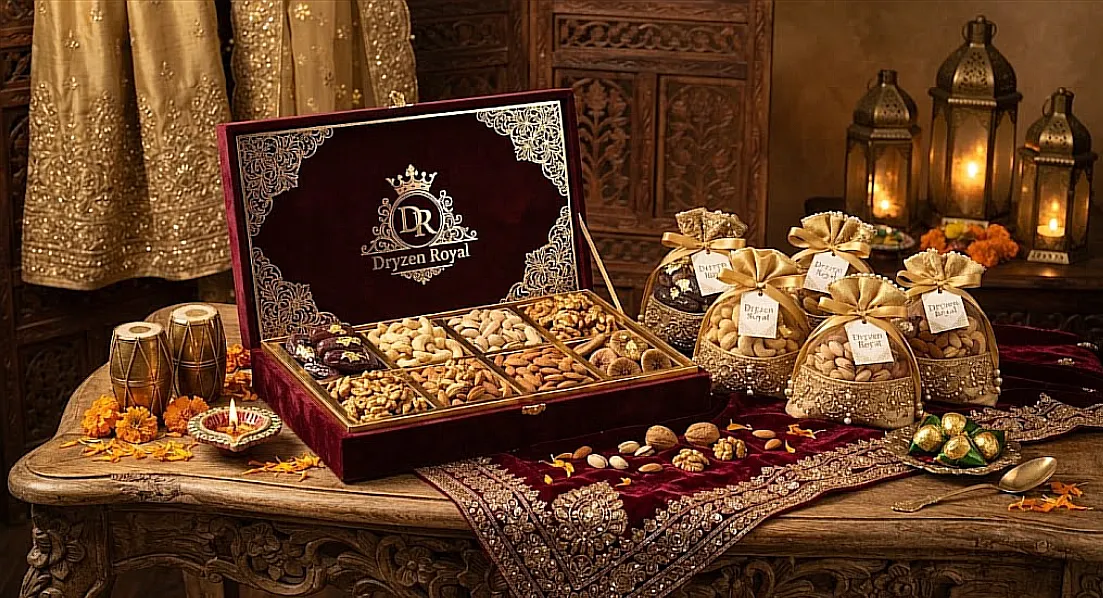
Today, Pakistani wedding gifting has expanded considerably. Families may choose personalized boxes, decorative trays, customized hampers, ribbons, message cards, and coordinated packaging that matches the wedding theme. Dryzen Royal, for example, currently offers a wedding gift box containing jumbo almonds, cashews, walnuts, pistachios, raisins, and Ajwa dates, with options intended for guest favors, baraat exchanges, and family gifting.
But how did dry fruits become so closely associated with formal gifting in the first place?
This guide explores the cultural role of dry fruits in Pakistani weddings, how they fit into different wedding events, why families continue to choose them, and how traditional dry-fruit gifting is evolving into something more modern and personalized.
There is no single historical moment when dry fruits became a universal Pakistani wedding tradition.
Instead, their role has developed through broader South Asian customs surrounding hospitality, family exchanges, festive foods, and gift-giving.
Dry fruits have historically been considered valuable food items because they are concentrated, relatively durable, easy to store, and suitable for serving to guests. Nuts and dried fruits could be kept for longer than many fresh foods and could be transported between households.
That made them particularly practical for occasions involving large numbers of visitors and extended families.
Weddings naturally created the perfect setting for this kind of exchange.
Families needed gifts that were:
Dry fruits fit many of those requirements.
A box containing premium nuts could be presented to a family without requiring the giver to know the recipient's exact preferences, clothing size, home décor style, or other personal details.
The gift was useful, recognizable, and culturally appropriate.
Hospitality is deeply important in Pakistani family culture.
When relatives arrive, hosts commonly want to offer something special rather than simply serving the most basic everyday food.
Dry fruits have naturally suited this purpose.
A bowl of almonds, pistachios, cashews, walnuts, dates, or raisins can be placed alongside tea, coffee, sweets, or other refreshments.
At weddings, this idea becomes more elaborate.
Instead of serving dry fruits casually in a bowl, families may present them in decorative trays, baskets, boxes, or specially prepared gift arrangements.
The presentation communicates something beyond the food itself.
It says that the guests were considered important enough to receive something prepared specifically for the occasion.
That is one reason packaging has become such an important part of modern dry-fruit gifting.
Pakistani weddings are not only celebrations of two individuals.
They are often occasions where two extended families meet, interact, exchange gifts, and establish relationships.
This creates many opportunities for formal gifting.
Depending on the family and wedding customs, gifts may be exchanged between:
Dry fruits can fit into several of these situations because they are generally viewed as a shared household gift rather than something intended only for one person.
A well-presented box can be opened by a family and enjoyed together.
That makes it particularly suitable for formal family exchanges.
One traditional form of wedding gifting is the decorated tray or basket.
Instead of placing a single item into a conventional gift bag, families may arrange multiple items together.
Depending on the occasion and family tradition, a tray can include:
Dry fruits work particularly well in these arrangements because they add texture, color, and visual variety.
Almonds provide a light brown base, pistachios add green, cashews offer a pale creamy tone, walnuts add darker texture, while dates and raisins introduce deeper colors.
The result can look abundant even when the number of individual ingredients is relatively small.
A wedding dry fruit box takes the traditional idea of a dry-fruit tray and gives it a more structured presentation.
Instead of arranging loose ingredients across a large tray, the dry fruits are placed into separate compartments.
This creates several advantages.
Each variety has its own space.
Guests can immediately see what is included without having to search through a mixed pile.
Individual compartments can create a more polished appearance.
Different family members can select the varieties they prefer.
Sealed compartments or individual packaging can help protect the contents during transportation and storage.
Boxes can be customized with names, messages, ribbons, colors, or other wedding details.
Dryzen Royal's current gifting collection emphasizes made-to-order presentation, personalized names and messages, ribbons, and hand-arranged compartments.
Mehndi and dholki celebrations are often more colorful, casual, and energetic than formal family gift exchanges.
That doesn't mean dry-fruit gifts cannot work.
The presentation can simply become more playful.
For example, smaller guest favors can contain:
The packaging can match the event's colors.
If the wedding theme uses green and gold, for example, the packaging and ribbon can reflect those colors while the natural colors of pistachios, almonds, and dates provide additional contrast.
Small dry-fruit favors can also be useful when the guest list is large.
Rather than giving every guest an expensive individual gift, families can create smaller portions that still feel thoughtful.
Nikkah ceremonies can range from very intimate family gatherings to large formal events.
A small dry-fruit favor can work particularly well for a simple nikkah.
Dates have a natural connection with Islamic food traditions and are frequently included in Ramadan and religious occasions. Some Pakistani wedding favor traditions also incorporate dates alongside nuts and sweets.
For a contemporary nikkah favor, a small box could contain:
The packaging can remain simple and elegant.
A neutral-colored box with a small personalized card may be more appropriate for an intimate ceremony than a heavily decorated favor.
Baraat is often one of the most formal stages of a Pakistani wedding.
Family exchanges can be more elaborate, and gifts may be presented to the bride's or groom's family.
Dry fruits are particularly suitable here because they can be incorporated into larger formal gift boxes.
A baraat gift might include:
The presentation can be elevated with a rigid wooden box, decorative compartments, ribbon, and a personalized message.
A Pakistani ethnographic study of Punjabi wedding practices also documents dry fruit as part of the broader gift exchanges associated with the baraat and bride's family.
The walima has its own character and may call for a slightly different approach to gifting.
For a formal reception, a premium dry-fruit hamper can work as a family gift or host gift.
Instead of focusing on small guest favors, the presentation can emphasize quality and abundance.
A larger arrangement might include:
The container itself becomes part of the gift.
A high-quality wooden box or structured hamper can later be reused for storage, making the packaging more valuable than a disposable wrapper.
Not every wedding gift needs to be large.
Guest favors are a perfect example.
If a wedding has hundreds of guests, providing a large dry-fruit box to everyone may be impractical.
Instead, families can create smaller portions.
For example:
The goal is not to provide an enormous quantity.
The goal is to give guests something they can take home and enjoy.
The packaging can carry the wedding couple's names or wedding date, making the favor feel connected to the celebration.
There is also a very practical reason dry fruits continue to work well at weddings.
They are relatively easy to transport compared with many other foods.
A properly packaged dry-fruit box can travel from one city to another without the same concerns associated with delicate desserts or fresh foods.
They can also be stored after the wedding.
That matters because weddings often involve huge quantities of food and gifts arriving at the same time.
A box of dry fruits does not necessarily need to be consumed immediately.
Proper storage can help maintain quality for an extended period, depending on the specific product and packaging.
For example, Dryzen Royal's wedding gift box currently lists a shelf life of up to six months when stored in a cool, dry place away from direct sunlight.
Almonds are one of the most recognizable dry fruits in Pakistan.
They are versatile, visually attractive, and easy to combine with other nuts.
They also provide a substantial base for a mixed gift box.
A wedding box might use almonds as one of its largest compartments and then add pistachios, cashews, walnuts, dates, and raisins around them.
For premium presentation, larger or more uniform almonds can create a particularly polished appearance.
The important consideration is not simply size.
Freshness, texture, appearance, aroma, and appropriate packaging all matter.
Pistachios have an advantage that goes beyond taste.
They add color.
The green tones immediately create contrast against almonds, walnuts, cashews, and dates.
That makes them especially valuable in wedding presentation.
A box containing several pale and brown ingredients can look considerably more attractive once pistachios are included.
They can also make a gift feel more premium without requiring the entire box to consist of expensive specialty nuts.
Cashews are another common choice because of their mild flavor and distinctive curved shape.
They provide a creamy, rich bite that contrasts with the firmer texture of almonds.
Visually, they also break up the repetitive shapes of other nuts.
A mixed box containing almonds, pistachios, walnuts, and cashews therefore has natural variety in both color and form.
Walnuts are immediately recognizable because of their irregular shape.
That can make them particularly attractive in a gift box.
Instead of everything looking perfectly uniform, walnuts create a more natural appearance.
They can also make a box feel more abundant because their large pieces occupy considerable visual space.
Dates have a special place in many Muslim households and can be particularly appropriate for nikkah, Ramadan, and other meaningful occasions.
Premium dates can also add a softer texture and natural sweetness to an otherwise crunchy selection of nuts.
Ajwa dates are frequently chosen for premium gifting.
Dryzen Royal's wedding box currently includes premium Ajwa dates alongside jumbo almonds, cashews, walnuts, pistachios, and raisins.
When dates are included, they can either receive their own compartment or become the centerpiece of the arrangement.
One of the most interesting changes in Pakistani wedding gifting is not necessarily the ingredients.
It is the packaging.
The same almonds, pistachios, walnuts, dates, and cashews that might once have appeared on a traditional tray can now be presented in:
This allows families to preserve the familiar contents while giving the gift a contemporary appearance.
Dryzen Royal's current gift collection, for example, offers different box styles and allows customers to select fillings, box sizes, ribbons, names, and messages for personalized gifting.
Personalization can turn a generic gift into something connected specifically to the wedding.
A box can include:
The personalization does not have to be excessive.
Sometimes a simple name card and coordinated ribbon are enough.
The purpose is to make the recipient feel that the gift was prepared for this occasion rather than purchased randomly from a shelf.
There is no universal combination that every wedding must use.
The right selection depends on the event, budget, guest list, and relationship with the recipient.
For a simple guest favor, three or four varieties may be enough.
For a family gift, five or six varieties may make more sense.
For a premium hamper, additional dried fruits and specialty ingredients can be added.
A practical starting combination is:
This provides different textures, colors, and flavors without making the selection unnecessarily complicated.
There is no single correct wedding-gift budget.
The appropriate amount depends on the event and your relationship with the recipient.
A guest favor may naturally be smaller.
A gift for the bride's or groom's parents may be considerably more substantial.
Likewise, a corporate wedding gift for an employee or business associate may follow an entirely different budget.
Instead of starting with price, start with the purpose:
Is this a guest favor, a family gift, a host gift, or a formal exchange between families?
Once that is clear, choose the size and contents accordingly.
Premium presentation does not require covering the box with decorations.
A few details can make a major difference.
A rigid box generally looks more formal than a thin disposable package.
Separate sections make the contents easier to see and prevent everything from looking like one mixed pile.
Match the ribbon or card with the wedding theme.
Too many decorations can make a gift look busy.
Beautiful packaging cannot compensate for stale or poorly stored dry fruits.
The food itself should remain the central focus.
A short wedding message can make the gift feel more thoughtful.
Large weddings create a logistical challenge.
If you need dozens or hundreds of favors, consistency becomes important.
Every box should ideally contain:
Ordering well in advance can also make the process easier.
Dryzen Royal currently states that it offers bulk pricing for wedding orders of 20 or more boxes and recommends ordering 10–14 days ahead for bulk wedding orders.
For particularly large weddings, families may want to plan even earlier to allow time for personalization, quantity checks, and event-specific arrangements.
Not necessarily.
Different levels of gifting can make sense.
For example:
Wedding guests: Small favor boxes
Close relatives: Medium dry-fruit boxes
Parents and elders: Premium hampers
Bride and groom: Larger personalized gift
Corporate contacts: Professionally branded or customized boxes
This creates a hierarchy without requiring every gift to be identical.
A major reason dry fruits continue to work as gifts is that they can communicate generosity without being excessively extravagant.
A box of quality nuts can look substantial because the ingredients themselves have visual volume and variety.
The recipient can also share them with the household.
That makes the gift feel communal rather than purely individual.
This is particularly appropriate for weddings, where families rather than individuals are often involved in receiving and sharing gifts.
Mithai remains deeply connected to Pakistani celebrations, and there is no need to treat dry fruits as a replacement for traditional sweets.
Instead, the two can complement each other.
A wedding gift might contain:
However, dry fruits offer one practical advantage: they can often be stored and consumed over time rather than needing to be finished quickly.
That can make them especially useful when a household receives multiple wedding gifts at once.
For many weddings, they can be.
But the best favor depends on the guests and event.
Dry fruits are particularly useful when the goal is to provide something:
They may not be the right choice for every wedding, but they offer a combination of tradition and practicality that explains their continued popularity.
If you receive multiple boxes after a wedding, resist the temptation to open everything immediately.
Keep unopened packages in an appropriate environment according to the manufacturer's storage instructions.
In general, dry fruits should be protected from:
Once a package is opened, transferring appropriate products into airtight containers can help maintain freshness.
Always follow the specific storage guidance supplied with the product because different nuts and dried fruits can have different storage requirements.
It is rarely just the contents.
A memorable gift usually combines several elements:
Quality
The dry fruits should be fresh and enjoyable.
Presentation
The packaging should suit the importance of the event.
Personalization
Names, messages, or colors can make the gift feel specific to the wedding.
Practicality
The recipient should actually be able to enjoy and use the gift.
Thoughtfulness
The selection should make sense for the relationship and occasion.
This is why a relatively simple box can sometimes feel more meaningful than a much more expensive but generic gift.
Wedding traditions change gradually.
The core idea often remains while the presentation evolves.
Traditional dry-fruit trays are becoming modern gift boxes.
Simple family exchanges can become personalized hampers.
Guest favors can be coordinated with wedding themes.
And premium packaging can transform familiar ingredients into something that feels contemporary.
This does not necessarily mean that traditional wedding customs are disappearing.
Instead, they are being adapted.
The almonds remain almonds.
The pistachios remain pistachios.
The dates remain dates.
What changes is how they are selected, arranged, packaged, and presented.
That balance between familiarity and modern design is one reason dry-fruit gifting continues to fit naturally into contemporary Pakistani weddings.
If you are currently planning wedding gifting, start with these questions:
A guest favor and a gift for the bride's parents should not necessarily be the same size.
Mehndi, nikkah, baraat, and walima can each have a different atmosphere.
Large guest lists require a different approach from a small family ceremony.
Set a total budget first, then divide it according to the different recipient groups.
Almonds, pistachios, cashews, walnuts, dates, and raisins provide a reliable starting point.
If you want names, messages, ribbons, or custom packaging, allow extra time.
For large or personalized orders, planning early can reduce last-minute stress.
Choose packaging that can withstand handling and travel.
Before finalizing your wedding dry-fruit order, check:
For large weddings, it can also be useful to order a sample before committing to a large quantity.
That gives you an opportunity to check the actual size, presentation, packaging, and ingredient selection.
Dry fruits have earned a distinctive place in Pakistani wedding culture because they combine several things that matter at celebrations: hospitality, generosity, practicality, and presentation.
From traditional wedding trays to modern personalized boxes, almonds, pistachios, cashews, walnuts, raisins, and dates can be adapted to almost any style of celebration.
They can appear as small guest favors at a mehndi, elegant boxes at a nikkah, formal family gifts during the baraat, or premium hampers for the walima. Their role does not have to remain fixed because the presentation can change with the event.
What makes the tradition particularly interesting is the way it has evolved.
The ingredients may be familiar, but today's wedding gifts can feature personalized names, coordinated ribbons, carefully divided compartments, premium wooden boxes, custom messages, and event-specific designs. Dryzen Royal's current wedding collection reflects this modern approach while retaining a familiar selection of nuts and dates.
Ultimately, a wedding dry-fruit gift does not need to be enormous or extravagant to be meaningful. Fresh ingredients, thoughtful selection, attractive presentation, and a personal touch can turn a simple box of dry fruits into a memorable part of the celebration.
That is perhaps why this tradition continues to work so well: it preserves something familiar while leaving plenty of room for families to make it their own.
Dry fruits have traditionally been used in Pakistani weddings as gifts, guest favors, family exchanges, and festive hampers. Their variety and presentation make them suitable for both traditional and modern wedding celebrations.
Almonds, pistachios, cashews, walnuts, dates, and raisins are popular choices for wedding gifting. Different combinations can be selected based on the type of gift, presentation, and occasion.
Dry fruits can be incorporated into gifting for events such as mehndi, nikkah, baraat, and walima celebrations. They may appear in traditional trays, guest favors, family exchanges, or larger gift hampers.
Traditional gifting has evolved from simple trays and exchanges into more personalized presentations. Modern options can include customized boxes, luxury hampers, and elegantly designed wedding favors.
Questions about this article?
Email us and we will get back to you.
Explore more
Dry fruits can be arranged in personalized boxes, decorative trays, or carefully designed hampers. Combining suitable dry fruits with thoughtful packaging can create a polished favor that complements the wedding celebration.
