- 100% Natural
- Premium Quality
- No Preservatives
- Fresh & Healthy
Natural and treated dried fruit can look surprisingly similar, but their ingredients and processing methods may differ. Discover why dried fruit changes color, how sulphites and added sugar affect product labels, and what to check before buying apricots, raisins, mango, and other dried fruits.
Dried fruit looks simple enough. Fresh fruit loses most of its water, becomes smaller, and develops a sweeter, more concentrated flavor. Yet a walk down the grocery aisle reveals a surprising variety of products: bright orange dried apricots, golden raisins, dark brown figs, glossy mango slices, and fruit labeled natural, organic, unsweetened, or preservative-free.
These differences can raise an important question: are you buying fruit that has simply been dried, or has it undergone additional processing?
The answer depends on the fruit, the drying method, and the ingredients used during production. Some dried fruits contain only fruit. Others have added sugar, oil, sulphites, or other ingredients intended to influence their color, texture, flavor, or shelf life. Some treatments help preserve quality, while others change the nutritional profile or may matter to people with particular sensitivities.
Unfortunately, appearance alone cannot tell you the whole story. A bright orange apricot is not automatically unhealthy, and a dark brown apricot is not automatically more natural. Golden raisins and darker raisins can both fit into a balanced diet. What matters is understanding how the product was made, reading the ingredient list, and choosing an option that suits your needs.
This guide explains the differences between natural and treated dried fruit, why colors vary, what added sugar and sulphite preservatives mean, and how to compare products confidently. Whether you shop for dried mango, apricots, raisins, figs, or mixed dried fruit, a few simple label-reading habits can help you make more informed choices.
Natural dried fruit generally refers to fruit that has been dried without certain additional ingredients, such as added sugar, artificial flavoring, or particular preservatives. However, the word natural does not have one universal meaning across every food label and market.
A package that says “natural” does not necessarily mean the fruit is untreated in every respect. The fruit may have been washed, cut, exposed to heat, dried using commercial equipment, or processed in other ways that help prepare it for sale.
Drying itself is a form of food processing. Removing water changes the fruit's texture, concentrates its sugars, and helps reduce the conditions that allow many microorganisms to grow. The process can also change color, aroma, and flavor.
For example, grapes become raisins, apricots become chewy dried pieces, and mango slices lose much of their original moisture. Even when no sugar or preservatives are added, the finished products may look and taste very different from their fresh counterparts.
Natural dried fruit can therefore be understood as a product whose ingredients and processing align with what the manufacturer means by that claim. To evaluate it properly, look beyond the front of the package.
A package may use phrases such as:
These phrases do not all mean the same thing.
“No added sugar” indicates that sugars were not added as ingredients under the applicable labeling rules. It does not mean the fruit contains no sugar. Fruit naturally contains sugars, and drying concentrates them into a smaller serving.
“Unsweetened” generally signals that sweetening ingredients have not been added, but the exact wording and applicable rules can vary by country.
“Organic” relates to how the product was produced under the relevant certification system. It does not automatically mean that the fruit contains no sugar, no preservatives, or fewer calories.
“Preservative-free” addresses preservatives, not necessarily added oil, sweeteners, or other ingredients.
The most reliable starting point is the ingredient list. If it names only apricots, for example, the product has a simpler ingredient profile than a version listing apricots, sugar, oil, and sulphur dioxide. That does not automatically make the first product best for everyone, but it gives you clearer information about what you are buying.
Color is one of the most noticeable differences between dried fruit products. Fresh apricots are orange, grapes come in several colors, and mango flesh is naturally yellow or orange. Once these fruits are dried, however, their original colors may change considerably.
Exposure to oxygen, light, heat, enzymes, and storage conditions can affect natural pigments. Browning is a common result of chemical reactions that occur during processing and storage. Some pigments may also break down as the fruit is exposed to heat or air.
Manufacturers use different drying methods and may apply treatments to limit particular changes. Consequently, two products made from the same type of fruit can have different appearances.
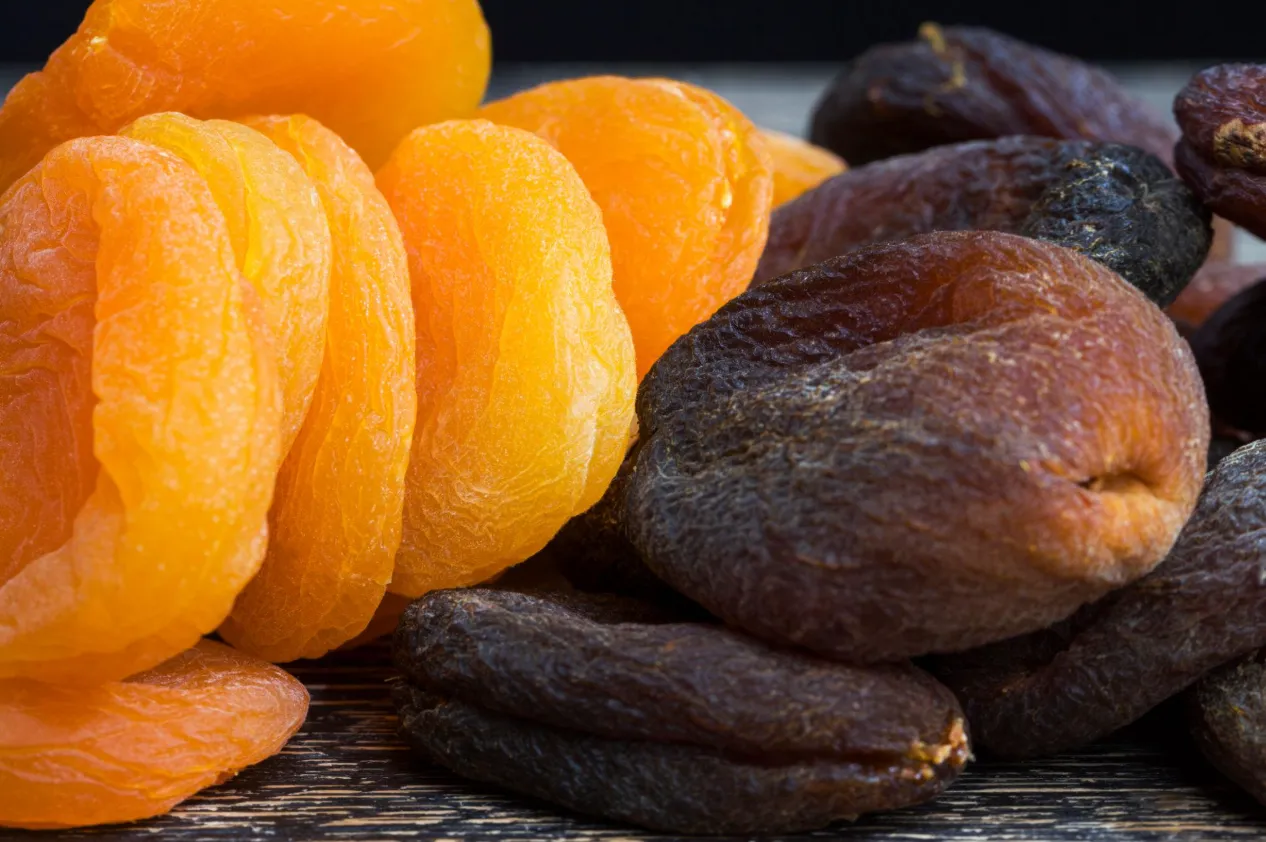
Dried apricots are a familiar example. Some retain a bright orange color, while others become darker brown or amber.
Sulphur dioxide and related sulphite preservatives may be used to help maintain color and protect quality during storage. Apricots dried without such treatments often darken through natural oxidation and browning.
The difference can be striking, but it should not be treated as a simple health ranking.
Bright orange apricots may contain sulphites, but their color alone cannot establish whether they do. Brown apricots may have been produced without sulphites, but the shade is not definitive proof of that either. Processing conditions, the original fruit, and storage can all affect appearance.
Check the ingredient list for terms such as sulphur dioxide, sulfur dioxide, or relevant sulphite names and codes used in your market. If the label is unclear, contact the manufacturer rather than relying on color.
Raisins may be dark brown, nearly black, golden, or somewhere in between. The final color depends on the grape variety, drying method, exposure to air, and any treatments used.
Golden raisins are often processed under conditions designed to preserve a lighter color. Certain products may use sulphites, while others may use different methods. Darker raisins commonly develop their color during drying and storage.
Neither shade automatically guarantees better nutrition. A useful comparison considers the ingredients, serving size, added sweeteners, and your own dietary requirements.
Dried mango, pineapple, papaya, cranberries, and mixed fruit products can have even more variation.
Some dried mango consists of mango alone. Other products contain added sugar, while some use oils to reduce sticking or improve handling. Certain fruit products may include preservatives or acidity regulators.
Dried cranberries are particularly worth checking because some products contain added sugar to balance their naturally tart flavor. Dried pineapple and papaya can also be sold in sweetened forms.
A vivid color is not enough to determine whether a product has been sweetened or preserved. Read the label to find out.
Sulphites are compounds used in some foods as preservatives. Depending on the product and permitted use, they can help control browning, maintain color, or protect against certain forms of deterioration.
They are used in a range of foods and beverages, including some dried fruits. On a package, they may appear under names such as sulphur dioxide or sulfur dioxide, sodium metabisulphite, or potassium metabisulphite. Labeling terminology varies by market.
No. The presence of a permitted preservative does not automatically mean a food is unsafe. Food additives are subject to regulatory requirements, including rules about their permitted uses and labeling.
However, sulphites are important for some consumers. Certain people, including some individuals with asthma, can experience sensitivity reactions. Symptoms and severity vary, and a reaction should not be assumed to be the same for everyone.
People with a known sulphite sensitivity should read ingredient and allergen-related information carefully and follow advice from their healthcare professional. If a product's label does not provide enough detail, contact the manufacturer.
For consumers without a known sensitivity, the presence of sulphites is a consideration rather than a universal reason to reject a product.
Start with the ingredients section rather than the product's color or the large claims printed on the front.
Look for sulphur dioxide, sulfur dioxide, sodium metabisulphite, potassium metabisulphite, or other sulphite-related ingredients. Some markets use additive numbers or specific declaration rules, so the exact terminology may differ.
If you are buying loose dried fruit from a market, the information may not be displayed as clearly as it is on a packaged product. Ask the seller whether preservatives have been used and whether ingredient information is available.
If you must avoid sulphites for medical reasons, do not assume that a darker product or one described as traditional is safe without verification.
Fruit naturally contains sugar. When water is removed, the remaining fruit becomes smaller and its sugars become more concentrated by weight. This is one reason dried fruit tastes sweeter than fresh fruit.
But naturally concentrated sugar and added sugar are not the same thing.
Some manufacturers add sugar, syrup, or other sweetening ingredients to improve flavor or create a particular texture. Sweetened dried cranberries, mango, pineapple, and fruit mixes are examples of products where this can occur.
The ingredient list is the first place to look. Ingredients such as sugar, glucose syrup, dextrose, honey, and other sweetening ingredients can indicate that the product contains added sweeteners.
The nutrition information panel can help you compare total sugars and, where required, added sugars. Total sugars may include both naturally occurring sugars and added sugars. The exact format depends on local labeling regulations.
Consider two packages of dried mango. One lists mango as its only ingredient. Another lists mango and sugar. Both are dried fruit, but the second includes an added sweetener.
That difference does not mean the sweetened product must never be eaten. It means you should know what you are choosing, particularly if you are trying to limit added sugar.
No. Dried fruit without added sugar still contains naturally occurring sugars.
A small amount of dried fruit can deliver a concentrated taste because the fruit has lost much of its water. It is therefore easy to eat more fruit than you intended, especially when snacking directly from a large bag.
If you are monitoring carbohydrate intake or managing blood glucose, pay attention to portion size and the total carbohydrate information on the label. Individual responses can vary, and people following a diabetes management plan should use advice tailored to their needs.
The goal is not to treat all fruit sugar as something to avoid. It is to understand how the fruit has been processed and how the portion fits into your overall diet.
Dried fruit can provide fiber, carbohydrates, and varying amounts of vitamins and minerals. The precise nutritional profile depends on the type of fruit, its growing conditions, processing method, and storage.
Drying removes water, so nutrients and natural sugars become more concentrated per gram. This can make dried fruit a convenient source of certain nutrients in a relatively small serving.
However, drying can also reduce some nutrients, particularly heat-sensitive vitamins. The amount lost varies with the fruit and processing conditions.
It is not accurate to say that every naturally dried product is more nutritious than every treated product. A preservative may be used primarily to maintain color or quality, while added sugar changes the product's sugar profile. These are different considerations.
Many dried fruits provide dietary fiber, which contributes to normal digestive function. Depending on the fruit, they may also provide minerals such as potassium or iron.
Dried figs, apricots, raisins, and prunes have different nutritional profiles. There is no single nutrient ranking that applies to all dried fruits or every brand.
Some vitamins are sensitive to oxygen, heat, and storage conditions. The drying process can therefore affect their levels. At the same time, other nutrients may remain in meaningful amounts.
If your goal is to increase your intake of a particular nutrient, compare reliable nutrition information for the actual products rather than assuming that a color or a “natural” claim tells you everything.
Not necessarily. A treated dried fruit may still provide fiber and useful nutrients. The relevance of a treatment depends on the ingredient, the amount used, the consumer's needs, and the overall product.
A person who needs to avoid sulphites may prefer a verified sulphite-free option. Someone trying to reduce added sugar may choose unsweetened fruit. Another shopper may prioritize convenience, taste, or price.
A balanced decision looks at the full product rather than placing all dried fruit into two rigid categories: good natural fruit and bad treated fruit.
These terms can sound similar, but each communicates something different. Understanding the distinctions can prevent you from paying extra for a product that does not meet your actual needs.
Label term | What it generally indicates | What it does not automatically guarantee |
|---|---|---|
Natural | A broad claim about the product or its ingredients | No processing, no preservatives, or superior nutrition |
No added sugar | No sugar or other qualifying sweetener has been added under applicable rules | No naturally occurring sugar |
Unsweetened | The product has not been sweetened, subject to applicable labeling rules | No preservatives or low carbohydrate content |
Organic | Production follows an applicable organic certification system | No additives, no sugar, or greater nutritional value |
Preservative-free | No preservatives of the relevant declared category have been added | No added sugar, oil, or other processing aids |
Sulphite-free | The product is represented as free of sulphites, subject to the claim and applicable rules | No other additives or sweeteners |
Always consider the regulations and definitions that apply in the country where the product is sold. A claim on the front of a package is useful only when you understand what it means and can verify it from the available product information.
For many shoppers, the best approach is to begin with the ingredient list, check the nutrition panel, and use front-of-package claims as supporting information.
You do not need to memorize food chemistry to shop confidently. A few practical checks can make the process much easier.
Look for the actual fruit name and any additional ingredients. If you want a simple product, a short ingredient list is a helpful starting point.
For example, a bag listing only “dried apricots” offers a different ingredient profile from one listing apricots, sugar, and preservatives. A longer list is not automatically bad, but it tells you to examine what each ingredient does.
If you prefer unsweetened fruit, look for sugar, syrups, honey, and other sweetening ingredients. Check the nutrition panel where available.
Remember that naturally occurring sugar remains present even when the package says “no added sugar.”
If you have a known sensitivity or have been advised to avoid sulphites, check the ingredient declaration carefully. Do not use color as a substitute for ingredient information.
If the package is incomplete or the product is sold loose, ask the seller or manufacturer for confirmation.
Dried fruit is compact, making portions easy to underestimate. Compare the nutrition information using the same serving size or per-100-gram values when available.
A small handful can be a convenient snack, but the amount that works for you depends on your energy needs, dietary pattern, and any relevant health considerations.
Different products may suit different recipes and preferences.
The best choice is the one that meets your needs without requiring you to pay for claims that are not important to you.
Look for intact packaging, clear labeling, and a product that has been stored according to the manufacturer's instructions. Avoid fruit with visible mold, unusual contamination, or signs of damaged packaging.
Some dried fruit naturally sticks together or becomes firm during storage, so texture alone does not always indicate spoilage. Follow the product's storage guidance and discard fruit that shows signs of spoilage.
A brightly packaged product with words such as premium, natural, or artisan may cost more without necessarily offering a better ingredient profile.
Compare the price per 100 grams, the ingredients, and the amount of fruit in the package. This helps separate meaningful differences from marketing.
Yes. Drying fruit at home can give you greater control over the ingredients, although safe preparation and storage remain essential.
A food dehydrator is designed to remove moisture under controlled conditions. An oven may also be used for certain fruits when operated according to a reliable recipe and appropriate temperature guidance.
Fruit should be washed properly, prepared evenly, and dried using a method suitable for that fruit. Pieces that are too thick may dry unevenly, while inadequate drying can leave enough moisture for spoilage. Some fruits also require pretreatment to limit browning or improve quality.
When you dry fruit yourself, you can avoid adding sugar or preservatives if the recipe does not require them. You can also choose the fruit and control the thickness of the slices.
However, homemade dried fruit is not automatically safer or nutritionally superior. Poor preparation, insufficient drying, or unsuitable storage can create problems. Homemade products may also darken more quickly because you have not used treatments designed to preserve their color.
Use tested food-preservation instructions rather than guessing at drying times or assuming that a leathery surface means the fruit is fully dried. Once prepared, store the fruit according to trusted guidance and check it for moisture or spoilage during storage.
Several common assumptions can make shopping more confusing than it needs to be.
Brown color can result from natural browning, but it does not prove that a product has no additives, no added sugar, or a superior nutrient profile. Check the ingredients.
Bright color can result from the fruit itself, the drying process, or treatments used to preserve appearance. It is not enough to determine which ingredients are present. The label is more useful than appearance alone.
Natural fruit contains sugar, and drying concentrates it by weight. A product can contain no added sugar while still being relatively high in total sugars per serving.
Preservatives have specific functions, and permitted food additives are regulated. Some people need to avoid particular preservatives, but their presence does not make every product universally unsafe.
Organic certification does not automatically mean that every additive is prohibited or that the product has no added sugar. Rules vary by certification system, and permitted ingredients depend on the specific standard.
Price can reflect packaging, sourcing, brand positioning, and other factors. It does not reliably prove that a dried fruit contains fewer additives or more nutrients.
Imagine you are comparing three packages of dried apricots.
Product A lists apricots as its only ingredient. It is brown and has a chewy texture.
Product B lists apricots and sulphur dioxide. It is bright orange and has no added sugar listed.
Product C lists apricots, sugar, and a preservative. It is soft, sweet, and brightly colored.
Which is best?
There is no universal answer without considering your preferences and dietary needs. Product A has the simplest listed ingredient profile. Product B contains a preservative but may suit someone who wants dried apricots without added sugar and has no reason to avoid that preservative. Product C contains added sugar, which may matter to someone who wants an unsweetened snack.
A person with a sulphite sensitivity would need to evaluate Product B and any other relevant ingredient declarations carefully. Someone trying to limit added sugar might favor A or B, assuming the labels are accurate and suitable for their needs.
The important lesson is that the color does not provide enough information to make the decision. The ingredient list does.
Dried fruit can be a convenient part of a balanced eating pattern. It is portable, easy to add to meals, and available in many varieties throughout the year.
You can mix raisins into oatmeal, add chopped apricots to plain yogurt, combine unsweetened dried fruit with seeds, or use small amounts in homemade baked goods. Pairing dried fruit with foods containing protein, fat, or additional fiber can also make a snack more satisfying for some people.
Portion size still matters because dried fruit is more concentrated than fresh fruit by weight. A large bowl of dried fruit can represent much more fruit than it appears to contain.
If you have a condition that requires monitoring carbohydrates, potassium, or another nutrient, choose portions based on individualized dietary advice. People with digestive sensitivities may also find that large amounts of certain dried fruits cause discomfort.
There is no need to treat dried fruit as a forbidden food simply because it contains natural sugar. The more useful approach is to consider the type, ingredients, amount, and role it plays in your overall diet.
For more food and nutrition reading, you can explore Dryzen Royal. Readers interested in broader personal-finance decisions can visit Finiuo, while Jurnza provides a separate resource for legal information. Each site serves a different purpose, but the same principle applies across them: understanding the details is more useful than judging something by its appearance.
Natural and treated dried fruit are not always as different as their appearance suggests. Some products contain only fruit, while others include added sugar, sulphites, oil, or additional ingredients that affect flavor, color, texture, or shelf life.
Bright orange apricots are not automatically unhealthy, and darker fruit is not automatically untreated. Golden raisins are not necessarily more nutritious than dark raisins. Color can offer clues about processing, but it cannot confirm the ingredients.
The most reliable way to choose is to read the ingredient list, compare nutrition information, and understand the claims on the package. If you want to avoid added sugar, look for an unsweetened product and verify the ingredients. If you need to avoid sulphites, check the declaration carefully and contact the manufacturer when information is incomplete. If your priority is convenience or taste, compare the available products and decide which ingredients matter to you.
Remember that dried fruit naturally contains concentrated sugars and can provide fiber and other nutrients. It can fit into a balanced diet when eaten in appropriate portions and selected according to your needs.
Ultimately, the smartest purchase is not necessarily the brightest, darkest, most expensive, or most heavily marketed option. It is the one whose ingredients, nutritional profile, quality, and price make sense for you.
Check the ingredient list for added sugar, sulphur dioxide, sulphites, oils, and other ingredients. Words such as “natural” or “preservative-free” can be helpful, but they do not replace reading the label. Color alone cannot reliably establish how fruit was processed.
Not necessarily. Bright orange apricots may have been treated with sulphites to help preserve their color, while brown apricots may have darkened during drying. Neither color automatically indicates better nutrition. Compare the ingredients and consider any personal sensitivities.
Yes. Unsweetened dried fruit still contains naturally occurring sugars, which become more concentrated by weight as water is removed. “No added sugar” means sugar has not been added as an ingredient under applicable labeling rules; it does not mean the fruit is sugar-free.
Questions about this article?
Email us and we will get back to you.
Explore more
