- 100% Natural
- Premium Quality
- No Preservatives
- Fresh & Healthy
Panjiri is a beloved traditional winter preparation made with roasted flour, desi ghee, dry fruits, seeds, spices, and often edible gond. This guide explains how to make a rich dry-fruit panjiri at home, from roasting the atta and puffing gond to preparing almonds, walnuts, pistachios, cashews, makhana, and seeds. Discover how to balance sweetness, achieve the right crumbly texture, avoid burning the ingredients, store homemade panjiri properly, and customize the recipe with gur, dates, figs, coconut, or additional dry fruits.
Few traditional winter foods have the unmistakable aroma of panjiri. The moment whole wheat flour begins roasting slowly in desi ghee, the kitchen starts to smell warm, nutty, and deeply comforting. Add roasted almonds, walnuts, pistachios, cashews, seeds, cardamom, and a little gond, and you have a mixture that feels like winter in a bowl. Panjiri, also spelled panjeeri, is a traditional South Asian preparation found in many Pakistani and North Indian households. Panjiri Recipe vary considerably from family to family and region to region. Some versions use whole wheat flour, while others rely more heavily on semolina. Some contain gond, makhana, coconut, seeds, dried ginger, or other ingredients, while simpler versions may contain little more than roasted flour, ghee, sugar, and nuts. Pakistani recipe sources likewise show several different approaches, including versions associated with winter and postpartum traditions.
That flexibility is part of what makes panjiri so special.
There isn't necessarily one recipe that every household has to follow.
Instead, the basic idea is straightforward: roast the ingredients carefully, combine them with a sweetener and aromatic spices, and create a rich, crumbly mixture that can be enjoyed by the spoonful or served with warm milk.
This guide explains how to make a traditional-style dry-fruit panjiri at home, including how to roast the atta, prepare gond, toast the dry fruits, balance the sweetness, avoid burning the ingredients, and store the finished mixture properly.
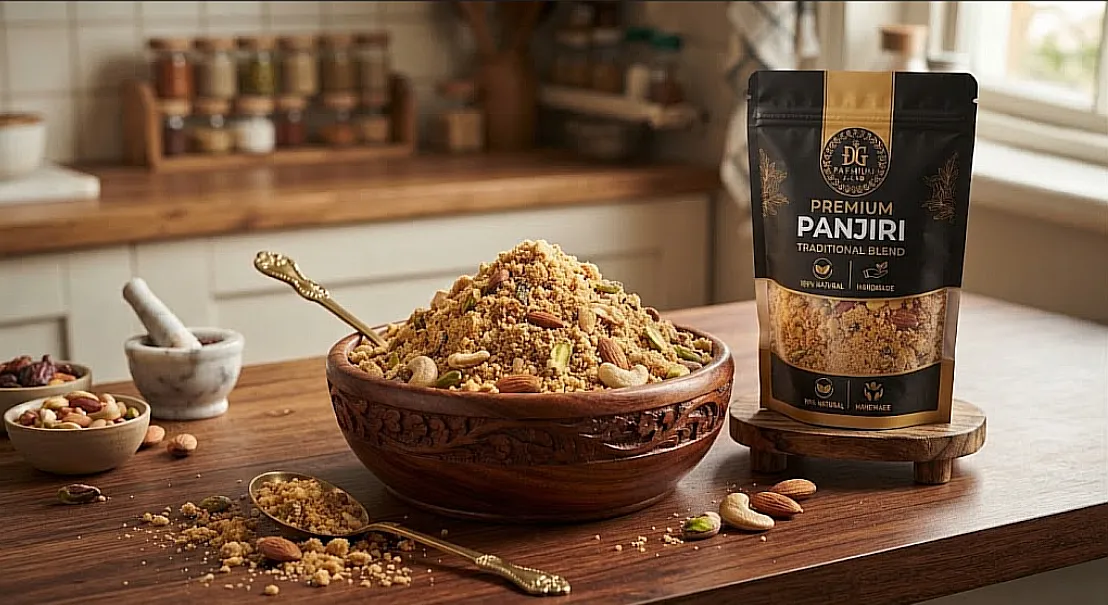
Panjiri is a roasted mixture traditionally made with ingredients such as flour or semolina, ghee, dry fruits, seeds, edible gum, spices, and sugar or another sweetener.
The exact combination depends on the recipe.
A traditional-style version may include:
Some versions also use semolina, raisins, dried dates, figs, poppy seeds, pumpkin seeds, fennel, or other ingredients.
Recent Pakistani and regional recipes demonstrate just how much these combinations can vary. One Pakistani recipe, for example, uses semolina, gond, makhana, almonds, pistachios, dates, sugar, and cardamom, while another traditional-style version uses whole wheat flour, ghee, gond, dry ginger, melon seeds, almonds, cashews, and optional makhana.
So when someone says, “This isn't how my grandmother made panjiri,” they may actually have a perfectly valid point.
Panjiri is one of those foods where family recipes matter.
Panjiri is strongly associated with colder weather in many South Asian households.
That makes practical sense from a culinary perspective.
It is a rich preparation made from roasted flour, ghee, nuts, seeds, and often a sweetener. These ingredients create a dense, satisfying food that fits naturally into winter meals and snacks.
Traditional recipes also frequently include ingredients such as dry ginger and cardamom, which contribute distinctive warm and aromatic flavors. Current recipes continue to position panjiri as a winter preparation.
In Pakistan, panjiri may be prepared at home during winter, served to family members, shared with guests, or made as part of traditional postpartum food practices.
It can also be prepared in larger quantities and stored for later use.
Not really.
That's worth saying upfront.
Panjiri has many variations.
A Punjabi-style preparation may differ from a Pakistani household version. A family recipe from Lahore may look different from one prepared in Karachi, Hyderabad, Peshawar, or another part of the country.
Some recipes are flour-based.
Some are semolina-based.
Some contain gond.
Others don't.
Some use sugar.
Others use gur.
Some contain many varieties of dry fruits and seeds.
Others keep the ingredient list simple.
One current recipe source even describes panjiri as having variations between household traditions, while another Pakistani recipe gives a semolina-based version rather than a wheat-flour-heavy formula.
For this guide, we'll use a traditional-style dry-fruit panjiri based on atta, desi ghee, nuts, seeds, gond, and aromatic spices.
Think of it as a dependable base recipe that you can customize.
This recipe makes a substantial batch suitable for family use.
These quantities are a starting point rather than a rigid formula.
You can increase the dry fruits if you want a more nut-heavy panjiri or reduce them for a simpler everyday version.
Current recipes demonstrate similarly flexible proportions. For example, one recent recipe uses 2 cups atta with almonds, cashews, melon seeds, gond, dry ginger, sugar or gur, and cardamom, while another uses whole wheat flour alongside a larger combination of nuts and seeds.
Understanding the ingredients makes it easier to customize the recipe.
Whole wheat atta forms the base of the panjiri.
It provides the characteristic roasted flour flavor and gives the mixture its familiar crumbly texture.
The most important thing is to roast it properly.
Raw atta tastes floury.
Properly roasted atta smells nutty and develops a deeper color.
Ghee is one of the defining ingredients.
It helps roast the flour and other ingredients while contributing richness and aroma.
You don't necessarily have to pour all the ghee in at once.
Adding it gradually gives you more control over the final texture.
Almonds add crunch and a familiar nutty flavor.
They also hold up well during roasting.
Walnuts bring a richer, slightly earthy flavor.
Because walnuts can become bitter if heavily over-roasted, keep the heat moderate.
Cashews contribute a creamy, buttery texture and mild sweetness.
They can brown quickly, so watch them closely.
Pistachios add color and a distinctive flavor.
They also make the finished panjiri look more attractive.
Gond, or edible gum, is a traditional ingredient used in many versions of panjiri.
When heated in ghee, suitable edible gum crystals puff up and become light and crisp. Recipes commonly fry gond separately before crushing or mixing it into the final preparation.
Make sure you're using food-grade edible gum intended for culinary use.
Makhana, or fox nuts, is optional.
It adds a light, crisp texture and is used in many panjiri variations.
Melon seeds, pumpkin seeds, watermelon seeds, and other edible seeds can add texture and variety.
You don't need all of them.
Choose one or two.
Cardamom gives panjiri its unmistakable sweet-spiced aroma.
A little goes a long way.
Dry ginger powder, or sonth, is common in some traditional winter versions.
It adds a warm, spicy note.
Use it according to your preferred flavor because too much can overpower the nuts.
Start by checking all your dry fruits.
Make sure they are:
Don't roast questionable nuts simply because you're planning to grind them later.
If almonds, walnuts, pistachios, or cashews smell strongly rancid or otherwise unpleasant, discard them.
Next, chop the larger nuts into reasonably similar pieces.
You don't need to turn everything into powder.
A mixture of small pieces and slightly larger pieces gives panjiri a much better texture.
Aim for roughly chopped pieces.
Avoid making everything extremely fine.
You want to be able to notice the dry fruits while eating the panjiri.
For a smoother version, you can grind part of the nuts and leave the rest chopped.
That's a great compromise.
Gond requires special attention.
Place a small amount of ghee in a heavy-bottomed pan over low to medium heat.
Add the gond in small batches.
Don't overcrowd the pan.
As the edible gum heats, the pieces should puff up.
This happens fairly quickly.
Once the gond has expanded, remove it immediately and place it on a plate.
Repeat with the remaining gond.
Let it cool.
Then crush it into smaller pieces.
Don't fry gond at extremely high heat.
The outside can darken while the inside remains hard.
The goal is for it to puff rather than burn.
Current recipes similarly recommend frying gond in batches until it puffs before crushing it.
If you're using makhana, roast it separately.
Add a small amount of ghee to the pan.
Add the makhana.
Roast over low to medium heat while stirring.
The pieces should become crisp.
You can test one after allowing it to cool slightly.
If it becomes crunchy rather than chewy, it's ready.
Remove it and set it aside.
You can leave the makhana whole or crush it lightly.
Now roast the nuts.
Add a small amount of ghee to the pan.
Start with the almonds and cashews.
Stir continuously or very frequently.
Once they become fragrant and lightly golden, remove them.
Next, roast the pistachios briefly.
Walnuts should also be treated gently because their natural oils can develop a bitter flavor if overheated.
Remove each batch as it reaches the desired level of roasting.
Because not every ingredient cooks at the same speed.
Cashews can brown quickly.
Walnuts have irregular shapes.
Small seeds toast faster than whole almonds.
Roasting separately gives you control over each ingredient.
Some traditional recipes also follow this staged approach, roasting different dry fruits and seeds separately before combining them.
Add the melon seeds or other seeds you're using.
Use low to medium heat.
Stir constantly.
Seeds can burn quickly because of their small size.
Once fragrant and lightly toasted, remove them.
Set everything aside.
If you're using dry coconut, roast it briefly.
This doesn't need much time.
Coconut can turn from lightly golden to burnt surprisingly fast.
Stir continuously and remove it as soon as it develops a pleasant toasted aroma.
This is the step that makes or breaks panjiri.
Take a heavy-bottomed kadhai or pan.
Add the remaining ghee gradually.
Add the whole wheat atta.
Keep the heat low.
Now start roasting.
And be patient.
It can be tempting to turn the heat up because the flour seems to take forever.
Don't.
High heat can brown or burn the outside of the flour while leaving parts of it under-roasted.
Instead, keep stirring.
Scrape the bottom and sides of the pan regularly.
Make sure there are no dry pockets.
As the flour cooks, it will gradually change:
Pale flour → light golden → deeper golden → fragrant roasted mixture
You're looking for a rich roasted aroma and a deeper color, not burnt brown flour.
Current panjiri recipes similarly emphasize slow roasting and warn that rushing the atta on high heat can burn it before it is properly roasted.
Don't rely only on color.
Look for several signs.
The flour should smell deeply roasted and nutty.
The raw flour smell should disappear.
The mixture should become smoother as the ghee incorporates.
It should develop a golden to deeper toasted color depending on your recipe.
If you're unsure, take a tiny amount, let it cool, and taste it.
Raw atta has an obvious floury flavor.
Properly roasted atta tastes richer and more developed.
This is probably the most important ingredient.
Panjiri is not a recipe you want to rush.
Once the atta is properly roasted, reduce the heat or turn it off.
Add:
Mix thoroughly.
Make sure the ingredients are distributed evenly.
At this point, your kitchen should smell absolutely ridiculous. 😂
That's the good sign.
Add the cardamom powder.
If you're using dry ginger, add it now.
Mix well.
Taste a small amount after it cools slightly.
Adjust the spices if necessary.
Cardamom should add aroma without dominating the dry fruits.
Dry ginger should provide warmth without making the panjiri harsh.
This is where different panjiri traditions really diverge.
You can use:
For the easiest version, powdered sugar is straightforward.
Make sure the mixture isn't extremely hot when adding sugar.
If the panjiri is too hot, the sugar can begin melting rather than remaining part of the dry, crumbly mixture.
A traditional recipe source specifically advises adding sugar after the roasted ingredients have cooled sufficiently so that the sugar does not dissolve into the mixture.
If you're using gur, make sure it is finely grated or powdered so it distributes evenly.
Use a large bowl if your pan isn't big enough.
Mix until:
Break apart any large clumps.
The finished panjiri should have a loose, crumbly texture rather than feeling wet or pasty.
This is one of those questions where the answer depends on the style you're making.
Some traditional recipes use a generous quantity of ghee, producing a richer and more cohesive texture.
Other home cooks deliberately use less ghee for a looser, powderier panjiri.
Current recipes demonstrate this variation clearly: one traditional-style recipe uses roughly 400 g ghee with 500 g atta, while another recent recipe uses 1 cup ghee with 2 cups atta.
Rather than dumping in a fixed quantity, add ghee gradually while roasting the flour.
The goal is to achieve the texture you want.
If the finished panjiri is too dry, a little additional melted ghee can sometimes be incorporated.
If it's excessively greasy, you've probably added more than necessary for the style you're making.
Traditional panjiri can be quite sweet.
But you don't have to make it that way.
Start with less sugar than you think you'll need.
After the mixture cools slightly, taste it.
Then add more if necessary.
This is easier than trying to correct an overly sweet batch.
If you want the natural flavor of the nuts to stand out, keep the sweetener moderate.
The richness of ghee, aroma of cardamom, and roasted flavor of the dry fruits can carry the dish without requiring excessive sweetness.
Gur can give panjiri a deeper, more caramel-like flavor.
Choose clean, good-quality gur.
Grate it finely.
Don't add large chunks directly into the hot panjiri.
If you want a loose, dry panjiri rather than a sticky mixture, allow the roasted base to cool before incorporating finely grated gur.
You can also adjust the quantity according to taste.
The finished result will generally have a darker color and deeper sweetness than a version made with white powdered sugar.
If you're making panjiri specifically for a special winter occasion, increase the dry-fruit component.
Try:
Keep the atta base and ghee balanced so the mixture doesn't become overwhelmingly nut-heavy.
This style is particularly nice when serving panjiri to guests.
You don't need a dozen ingredients.
For a simpler version, use:
That's enough to make a delicious panjiri.
The more elaborate versions are fun, but the basic preparation remains excellent.
Absolutely.
Raisins add sweetness and chewiness.
But don't roast them for too long.
They can puff quickly and become hard if overcooked.
A better approach is to warm them briefly in a small amount of ghee and remove them as soon as they plump.
Then add them during the final mixing stage.
Yes.
Dried dates can add natural sweetness and a chewy texture.
Remove any hard pits.
Chop the dates finely or pulse them briefly in a food processor.
Add them after the roasted flour has cooled sufficiently.
Be careful not to turn the dates into a wet paste.
You want small pieces distributed throughout the panjiri.
Dried figs can also work.
Cut them into small pieces.
Because figs are naturally chewy and contain many seeds, a little can go a long way.
They pair especially well with walnuts and almonds.
Makhana has become a popular addition to many modern and traditional-style panjiri recipes.
Its light, crisp texture contrasts nicely with:
Roast it separately and crush it lightly before mixing.
Don't grind every piece into powder.
Keeping some small chunks creates better texture.
Seeds can make the mixture more interesting.
Good options include:
You can use one type or create a combination.
Melon seeds are particularly common in panjiri-style recipes. Recent recipes include them alongside almonds, cashews, gond, and flour.
As always, roast seeds gently.
They're small, so they can burn much faster than whole nuts.
Dry coconut can add sweetness and a pleasant chewy texture.
You can use:
Keep the roasting brief.
Burnt coconut has a strong, bitter flavor that can dominate the entire batch.
The easiest way is to focus on the spices.
Cardamom is the classic choice.
You can also experiment with small amounts of:
But don't add everything at once.
Panjiri should still taste like roasted flour and dry fruits.
The spices are there to support the main ingredients.
Texture depends heavily on the amount of ghee and how finely the ingredients are processed.
Use moderate ghee and keep the nuts partly chopped.
Use more ghee and allow the flour to become deeply roasted.
Grind more of the nuts and seeds.
Leave more nuts and makhana in larger pieces.
There isn't one correct texture.
Think about how you want to eat it.
You can.
But you don't have to.
A mixed approach often works best.
Grind about one-third of the nuts into a coarse powder.
Keep the rest chopped.
This gives the panjiri a richer base while retaining visible pieces of almonds, walnuts, pistachios, and cashews.
Avoid grinding them into a smooth nut butter.
You're making panjiri, not almond butter. 😄
There are several ways to enjoy it.
This is the simplest.
Take a small serving and enjoy it on its own.
A spoonful of panjiri can be stirred into warm milk.
This is a popular way of serving traditional-style panjiri.
You can sprinkle a small amount over:
Keep a jar available and serve small portions with tea or milk.
Homemade panjiri can be packed into food-safe jars or decorative containers and given to family and friends during winter.
Proper storage matters because panjiri contains nuts and ghee.
Allow the mixture to cool completely before storing it.
Then transfer it to a clean, dry, airtight container.
Good options include:
Keep it:
Use a clean, dry spoon every time you serve it.
Don't introduce water or moisture into the container.
It depends on the recipe and your storage conditions.
A dry, properly roasted panjiri can often be stored in an airtight container, but the presence of nuts, ghee, and other ingredients means storage life varies.
If your kitchen is particularly warm, refrigeration can be useful.
However, refrigerated panjiri may become firmer because the ghee solidifies.
Letting it sit briefly at room temperature before serving can improve the texture.
If you're making a very large batch, dividing it into smaller containers can be more practical than repeatedly opening one large jar.
There isn't one universal shelf-life number.
It depends on:
A dry preparation made with properly roasted ingredients and stored airtight will generally keep better than one containing moist ingredients such as poorly dried dates or other additions.
Some traditional recipes describe storage for several weeks, but homemade shelf life should be treated conservatively rather than assumed from a recipe alone.
If you notice:
discard the panjiri.
Don't try to rescue spoiled food by reheating it.
This is probably the most common mistake.
Low heat and patience are your friends.
More ghee doesn't automatically mean better panjiri.
Add it gradually.
Different nuts need different roasting times.
Gond should puff rather than become dark and hard.
Let the roasted mixture cool enough before incorporating powdered sugar.
Texture matters.
Keep some nuts chunky.
Panjiri should generally have a loose, crumbly consistency rather than becoming a paste.
A long ingredient list isn't automatically better.
A balanced panjiri with six or seven excellent ingredients can be more enjoyable than one containing twenty ingredients fighting for attention.
Always cool the mixture before sealing it.
If you're making a large batch, don't simply multiply everything and throw it into one enormous pan.
Use a large, heavy-bottomed cooking vessel and work in stages.
Roast the nuts separately.
Roast gond separately.
Roast the seeds separately.
Then prepare the atta.
If necessary, make the flour in two batches.
This gives you better control over roasting.
Once everything has cooled enough, combine the ingredients in a large clean container.
This approach also makes it easier to check the consistency and seasoning before storing.
Panjiri can make a thoughtful winter food gift because it is traditional, homemade, and easy to package.
Use a clean food-safe jar.
Fill it with completely cooled panjiri.
Add a simple label.
You could write:
Homemade Dry-Fruit Panjiri
Then include the preparation date and basic ingredients if you're gifting it to someone who may have food allergies.
A small ribbon or fabric cover can turn a simple jar into an attractive winter gift.
For a larger family gift, use several smaller jars rather than one enormous container.
That makes the gift easier to share and keeps the unused portion sealed.
Although panjiri is particularly associated with winter in many households, there's no reason it has to be limited to one occasion.
A dry-fruit-heavy version can work as a homemade food gift during family visits, festive gatherings, or other celebrations.
If you're serving it to guests, keep the sweetness moderate and make the dry fruits visible.
A beautiful bowl of golden panjiri topped with sliced pistachios and almonds can be surprisingly attractive.
Before serving, sprinkle a little:
You don't need much.
The garnish should complement the panjiri rather than cover it.
This question needs a little nuance.
Panjiri can contain nutrient-dense ingredients such as nuts and seeds, but it is also traditionally made with significant amounts of ghee and often sugar or gur.
So it is better thought of as a rich traditional food, not as a food that automatically becomes “healthy” simply because it contains dry fruits.
The nutritional profile depends heavily on the recipe.
A version containing more nuts and seeds but less added sugar will be different from a very sweet, ghee-heavy version.
Portion size matters too.
Traditional recipes should be enjoyed for what they are: flavorful, culturally meaningful foods.
If you have a medical condition, dietary restriction, food allergy, or specific nutritional requirement, adapt the recipe with appropriate professional guidance rather than assuming that every traditional ingredient is suitable for everyone.
Panjiri has a long association in South Asian food traditions with postpartum meals.
Some Pakistani recipes specifically describe it as a food traditionally given to new mothers after delivery.
However, traditional use should not automatically be interpreted as medical advice.
Postpartum nutritional needs can vary significantly, especially when someone has diabetes, anemia, allergies, digestive problems, is breastfeeding, or has other medical or dietary considerations.
If panjiri is being prepared specifically for someone recovering from childbirth, the recipe can be adjusted according to that person's dietary needs, ideally with guidance from a qualified healthcare professional.
This is especially important because traditional panjiri can be high in calories, ghee, and added sugars depending on the recipe.
If traditional panjiri feels too rich for your taste, you can modify the balance.
Try:
You can also reduce the portion size rather than trying to completely reinvent the dish.
The goal is to preserve the roasted, nutty character.
If you want a version that feels particularly familiar in a Pakistani kitchen, focus on:
This combination captures many of the ingredients found across Pakistani and broader South Asian panjiri traditions, while still leaving plenty of room for family-specific variations.
Honestly?
Make a small batch first.
Don't start with a huge five-kilogram family production.
Try one batch.
Pay attention to the atta.
Notice the color.
Smell it.
Taste it after cooling.
Then adjust.
Maybe you prefer more walnuts.
Maybe you want less sugar.
Maybe your family likes a stronger cardamom flavor.
Maybe your grandmother's version contains semolina instead of atta.
That's exactly how traditional recipes evolve.
There are already many versions of panjiri, including flour-based, semolina-based, nut-heavy, seed-heavy, and gond-based preparations.
Your version can become another family favorite.
Before you start, make sure you have:
Then remember the order:
Roast gond → roast makhana → roast nuts → roast seeds → roast coconut → slowly roast atta → combine → season → sweeten → cool → store.
That sequence makes the whole process much easier.
Panjiri is much more than a mixture of flour, ghee, sugar, and dry fruits.
It is one of those traditional foods where the preparation itself becomes part of the experience. The slow roasting of atta, the aroma of desi ghee, the crunch of almonds and pistachios, the richness of walnuts and cashews, and the distinctive texture of puffed gond all come together to create something that feels deeply connected to winter and South Asian home cooking.
There is also no need to argue over one “perfect” panjiri recipe. Different families use different combinations of atta, suji, gond, makhana, seeds, nuts, spices, and sweeteners. Pakistani recipes themselves show considerable variation, which is part of the charm of the dish.
If you're making panjiri for the first time, keep the process simple.
Roast each ingredient separately.
Keep the heat controlled.
Give the atta enough time to cook properly.
Watch the nuts carefully.
Use ghee gradually.
Add the sweetener only after the mixture has cooled sufficiently.
And don't rush the final mixing.
The most important ingredient isn't actually one of the ingredients at all.
It's patience.
Once you've mastered the basic recipe, you can make it your own. Add more walnuts if that's your family's favorite. Increase the pistachios for color. Add dates or figs for extra sweetness and texture. Use gur instead of sugar. Include more seeds. Make a rich winter version for guests or a simpler everyday batch for the family.
And when that first spoonful hits—warm, nutty, buttery, fragrant, and slightly crumbly—you'll understand why this humble traditional preparation has stayed in South Asian kitchens for generations.
That's the real magic of panjiri.
Panjiri is traditionally made with roasted flour, desi ghee, dry fruits, seeds, spices, and often edible gond. Additional ingredients such as makhana, coconut, gur, dates, or figs can also be used to customize the preparation.
Almonds, walnuts, pistachios, and cashews are among the dry fruits commonly used in a rich dry-fruit panjiri. Additional dry fruits can be added according to personal preference.
The ingredients should be roasted properly and combined in suitable proportions to achieve a balanced, crumbly texture. Careful preparation of the flour, dry fruits, seeds, and gond can help prevent the panjiri from becoming overly greasy or uneven.
Roast the ingredients carefully and pay close attention to the cooking process, particularly when preparing flour, gond, dry fruits, and seeds. Avoiding excessive heat can help protect the ingredients from burning and affecting the flavor.
Fasih Frankly
SEO Expert and eCommerce Specialist. Shopify, eBay and online selling.
Questions about this article?
Email us and we will get back to you.
Explore more
Proper storage can help preserve the flavor and texture of homemade panjiri for longer. Once prepared, allow it to cool appropriately and keep it in a suitable airtight container away from conditions that could introduce excess moisture.
