- 100% Natural
- Premium Quality
- No Preservatives
- Fresh & Healthy
Learn how to roast dry fruits at home and bring out deeper flavor, aroma, and crunch in almonds, cashews, walnuts, and pistachios. This practical guide explains oven and stovetop roasting, dry roasting versus oil roasting, seasoning ideas, Pakistani-style masala nuts, sweet roasted almonds, common mistakes, cooling and storage, and how to create your own homemade roasted dry-fruit mixes.
There is something seriously satisfying about freshly roasted dry fruits. But the question is how to roast dry fruits, and specially at home?
Raw almonds can become deeper and more aromatic. Cashews develop a richer, toastier flavor. Walnuts become crisp around the edges while keeping their distinctive buttery character, and pistachios can take on an even more pronounced roasted taste.
The good news is that you don't need a commercial roasting machine to get excellent results.
With a pan or a conventional oven, a little oil if desired, and careful attention to heat, you can roast many popular dry fruits at home. The key is not simply turning up the temperature and waiting for them to become dark. Nuts contain natural oils, so they can move from perfectly toasted to bitter and burnt surprisingly quickly.
Home roasting is therefore more about control than complicated technique.
You need to choose good-quality raw or unroasted nuts, use moderate heat, spread them evenly, watch their color and aroma, and let them cool properly before storing them.
This guide explains how to roast almonds, cashews, walnuts, and pistachios at home, compares oven and stovetop methods, covers dry roasting and oil roasting, and shares ideas for salted, spiced, sweet, and Pakistani-inspired roasted dry fruits.
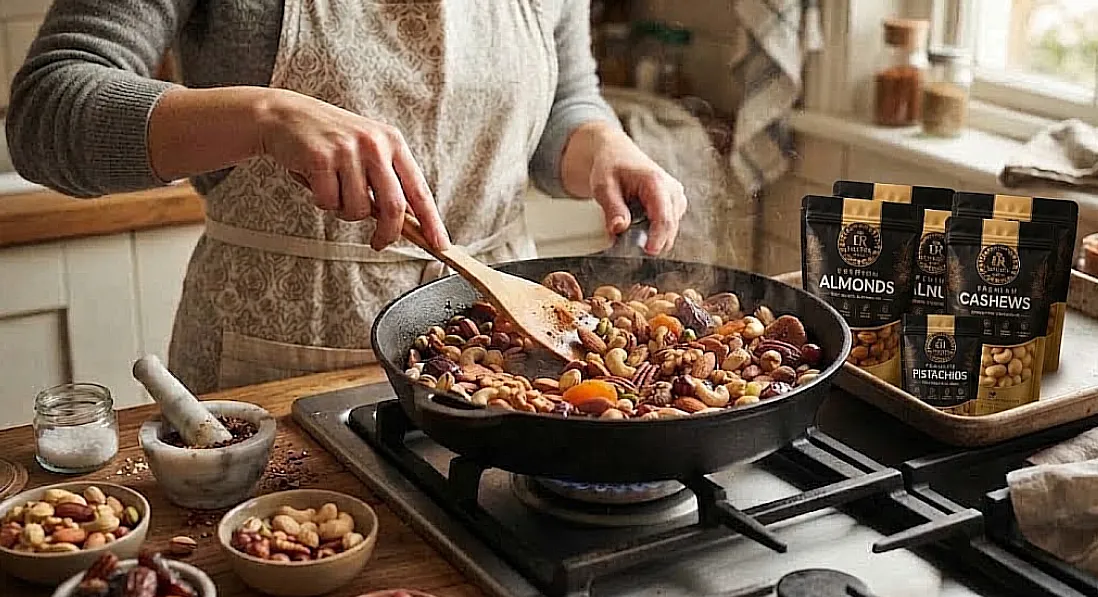
Roasting changes more than just the temperature of a nut.
Heat can deepen the aroma, intensify toasted flavors, alter texture, and make the finished product feel noticeably different from raw nuts.
The roasting process can also bring out a more pronounced nutty aroma. Utah State University Extension, for example, recommends oven-roasting whole almonds at 350°F for about 10–12 minutes and notes that aroma can help indicate when they are ready.
That doesn't mean every nut should be roasted for exactly the same amount of time.
Different varieties have different shapes, sizes, moisture levels, and fat content. A walnut half, for example, does not behave exactly like a whole almond.
Roasting at home lets you adjust the process to your preferred result.
You can make nuts:
It also lets you roast small batches instead of preparing a large quantity at once.
Before worrying about temperature, start with the ingredient itself.
Roasting cannot turn poor-quality or spoiled nuts into good ones.
Look through your almonds, walnuts, cashews, and pistachios before roasting.
Discard pieces that show obvious:
The FDA's guidance on tree-nut defects specifically identifies issues such as mold, insect infestation, rancidity, gumminess, and shriveled or empty shells as quality defects.
If a nut smells strongly stale, paint-like, or unpleasant before roasting, don't assume heat will fix it.
It is better to discard it.
For home roasting, look for nuts that are specifically sold as raw, natural, or unroasted if you want complete control over the process.
If the packet already says roasted, roasting it again can easily push the nuts too far.
Also check whether the nuts are:
If they already contain seasoning or oil, you may need to adjust your recipe.
For DIY roasting, plain unroasted nuts are the easiest starting point.
Both methods work.
The better choice depends on how much you're making and how closely you want to monitor the nuts.
The oven is convenient for larger batches.
Advantages include:
The main downside is that ovens can continue heating the nuts after you remove the tray, so timing matters.
A dry skillet works particularly well for small batches.
Advantages include:
The downside is that the nuts can develop hot spots if you don't keep them moving.
For your first attempt, a small stovetop batch can actually be useful because you can watch the transformation closely.
Almonds are one of the easiest nuts to roast.
A moderate temperature around 350°F (175°C) is a useful starting point for whole almonds.
Utah State University Extension uses 350°F and approximately 10–12 minutes as a reference method for whole almonds.
Your oven may behave differently, however.
Place the almonds in a single layer.
Don't pile them into a deep mound.
A single layer helps expose the nuts more evenly to the heat.
Place the tray in the oven.
Start checking them around the 8-minute mark.
Depending on your oven and the almonds, they may need several additional minutes.
A strong roasted-nut aroma is one of the most useful signs.
The almonds should become fragrant and lightly browned.
Don't wait until they are very dark.
If you want salted almonds, add your seasoning while the nuts are still warm.
Spread them out and let them cool.
They will continue to firm up as they cool.
Stovetop roasting is excellent when you only need a small batch.
Place a dry, heavy-bottomed skillet over low to medium heat.
Add the almonds in a single layer.
Stir or shake the pan regularly.
After several minutes, you should notice the aroma becoming stronger.
Keep the heat moderate.
If the pan becomes too hot, the outside can darken before the inside has developed the flavor you want.
Once the almonds are fragrant and lightly toasted, transfer them immediately to a cool plate or tray.
Don't leave them sitting in the hot skillet.
The residual heat can continue cooking them.
Cashews require a little more attention because their light color can make browning harder to judge.
They can go from beautifully golden to overdone fairly quickly.
Preheat the oven to around 325–350°F (165–175°C).
Spread the cashews in a single layer.
Roast them while checking frequently.
Because cashews vary in size and moisture, don't rely on a single exact roasting time.
Look for:
If you are using split cashews or smaller pieces, check them particularly often.
They generally need less time than large whole pieces.
Use low to medium heat.
Stir continuously or very frequently.
Cashews don't need to be aggressively browned.
A light golden appearance is often enough.
Once they reach the desired color, remove them from the pan immediately.
Walnuts are a little different.
Their natural flavor is already strong, so the goal is often to enhance the nuttiness without turning them bitter.
Set your oven around 325–350°F (165–175°C) as a starting range.
Arrange walnut halves in one layer.
Begin checking them early.
Walnuts can develop a toasted aroma quickly.
You want:
If the walnut pieces become very dark or develop a harsh smell, they have likely gone too far.
Place walnut halves in a dry skillet.
Use low to medium heat.
Stir or turn them regularly.
Because walnut halves have irregular shapes, some areas can brown faster than others.
Pay attention to the smaller edges and thinner sections.
Remove them as soon as they reach the desired level of toastiness.
Pistachios can be roasted shelled or in their shells, depending on the product.
Shelled pistachios are easier to season because the seasoning can contact more of the nut.
Spread them across a baking tray.
Roast at moderate heat and begin checking early.
They should become fragrant and slightly deeper in color.
In-shell pistachios require a little more attention because the shell changes how heat reaches the edible portion.
If you're seasoning them, you may find that a coating adheres better when the nuts are shelled.
For a simple snack, however, lightly roasted in-shell pistachios can be excellent on their own.
This is one of the biggest choices you'll make.
Dry roasting means heating the nuts without adding oil.
The natural oils already present in the nuts provide much of the flavor.
Dry roasting works especially well for:
It is also useful if you want a straightforward toasted-nut flavor.
Oil roasting means coating the nuts lightly with oil before heating or roasting them with oil.
You don't need much.
A small amount can help seasonings adhere and can contribute to a richer mouthfeel.
Suitable options may include:
The key is restraint.
Too much oil can make the nuts greasy rather than pleasantly roasted.
Salt is probably the easiest way to upgrade a batch of roasted nuts.
Roast the nuts until nearly finished.
Remove them from the heat.
While they are still warm, add a small amount of fine salt and toss thoroughly.
The residual warmth can help the seasoning adhere.
If you use coarse salt, distribute it carefully because larger crystals can produce uneven bites.
Start conservatively.
You can always add more.
You cannot easily remove excess salt once it has coated the nuts.
This is particularly important if you're serving the nuts alongside other salty foods.
Want something with a little kick?
Try chili almonds.
Mix the almonds with a light coating of oil.
Add your seasoning.
Toss thoroughly.
Spread the almonds on a baking tray.
Roast at moderate heat until fragrant and lightly browned.
Stir once during roasting.
Remove and allow them to cool before serving.
The flavor becomes more noticeable as the nuts cool.
If you want a snack with a more familiar South Asian flavor profile, build your seasoning around warm spices.
Try a mixture of:
You can use this with almonds, cashews, or pistachios.
For a mixed batch, keep the seasoning balanced so that it enhances rather than overwhelms the natural flavor of the nuts.
For approximately two cups of mixed nuts, start with:
Adjust according to taste.
This isn't a strict recipe. Think of it as a starting point.
If you prefer sweet rather than savory, honey can create a delicious coating.
But there is a catch.
Honey and other sweet coatings can brown much faster than plain nuts.
That means you should use lower heat and close supervision.
Combine your nuts with a modest amount of honey and a little oil if desired.
Spread them thinly on a lined baking tray.
Roast at a lower temperature than you would use for plain nuts.
Stir carefully during roasting.
Remove them before the coating becomes excessively dark.
Allow the nuts to cool completely before breaking them apart.
Because high-temperature cooking can contribute to acrylamide formation in some foods, moderation and avoiding unnecessary over-browning are sensible approaches when roasting foods at home. The FDA notes that acrylamide can form during high-temperature cooking methods including roasting, frying, and baking.
For a sweeter snack, almonds work particularly well with cinnamon.
Mix:
Coat the almonds evenly.
Roast gently.
Watch them carefully because sugar can caramelize and burn much faster than the nuts themselves.
Let the finished almonds cool completely before serving.
Cashews are excellent for savory seasoning.
Try:
Toss everything together before roasting.
Keep the temperature moderate.
The goal is a golden, fragrant cashew rather than a heavily browned one.
Yes, but it isn't always ideal.
Different nuts can roast at different speeds.
For example, a small cashew piece may brown before a larger walnut half is ready.
If you're preparing a mixed batch, choose nuts of reasonably similar size and roast them carefully.
Alternatively, roast each variety separately and combine them afterward.
The second approach gives you much more control.
It is particularly useful if you're preparing a premium mixed dry-fruit snack containing almonds, cashews, walnuts, and pistachios.
For the most consistent result, yes.
This gives you control over each variety.
You can roast:
Batch 1: Almonds
Batch 2: Cashews
Batch 3: Walnuts
Batch 4: Pistachios
Then combine them after everything has cooled.
This also makes seasoning easier.
You could keep the almonds lightly salted, give the cashews a masala coating, and leave the walnuts plain.
That creates a more interesting mixed snack.
This is one of the biggest home-roasting traps.
Nuts contain natural oils.
Once the surface gets very hot, browning can accelerate quickly.
The problem becomes even more noticeable when:
That's why roasting should be treated as a visual and sensory process rather than a timer-only recipe.
Whole nuts generally give you more room for error.
Chopped nuts have more exposed surface area and can toast much faster.
If you're roasting chopped almonds or walnuts for:
reduce the roasting time and check frequently.
For chopped nuts, a few minutes can make a major difference.
Don't depend on color alone.
Use several signals together.
The smell should become noticeably nutty and toasted.
Look for a gentle deepening in color.
You don't necessarily want dark brown nuts.
The nuts should become crisp once cooled.
Freshly roasted nuts may sound slightly different when moved across a tray, although this is less reliable than aroma and appearance.
If you're comfortable tasting a small piece, allow it to cool enough to avoid burning your mouth and check the flavor.
A perfectly roasted nut should taste deeper and toastier rather than bitter or smoky.
Don't skip this.
Once the nuts come out of the oven or skillet, transfer them to a cool plate or tray.
Spread them into a single layer.
Let them cool completely.
This does two things.
First, it stops them from continuing to cook in a hot pan.
Second, it allows their texture to firm up.
Utah State University Extension's almond roasting method specifically calls for cooling the roasted almonds before storage.
If you put hot nuts directly into a sealed container, trapped heat can also create condensation, which is not what you want for a crisp roasted snack.
Once the nuts are completely cool, place them in an airtight container.
Good options include:
Keep them away from:
For longer storage, refrigeration or freezing can help preserve quality, particularly for nuts because their natural oils can eventually become rancid.
Storage recommendations vary according to the nut, packaging, temperature, and moisture conditions, so treat any general shelf-life figure as a guide rather than a guarantee.
If the nuts develop an unpleasant smell, unusual flavor, visible mold, or other obvious signs of spoilage, discard them.
The FDA advises consumers to be alert for spoiled food and says mold is a sign that food should be discarded.
There is no universal number that applies to every homemade batch.
Storage conditions make a big difference.
Utah State University Extension gives an example of roasted almonds being stored in an airtight container at room temperature for up to three months, while other nuts and conditions can have different storage expectations.
For homemade snacks, the practical approach is simple:
Make smaller batches if you expect to eat them quickly.
If you're preparing a large amount, consider refrigeration or freezing rather than keeping everything at room temperature for a long period.
Always prioritize actual freshness over an arbitrary date.
Roasted dry fruits can make simple breakfasts more interesting.
Try adding them to:
Top oats with:
Add roasted pistachios and chopped dates.
Use chopped roasted almonds or cashews as a topping.
Add chopped roasted nuts to toast with suitable spreads.
Roasted nuts can also be used as toppings for dishes such as kheer, halwa, or other sweet preparations.
You don't need a large amount.
A small handful can provide plenty of texture and flavor.
Roasting can be especially useful before using nuts in desserts.
Try roasted:
Roasting first can give the nuts a more pronounced flavor.
For baking, however, don't roast them too dark because the bitterness can become more noticeable once they're combined with other ingredients.
If you regularly serve guests, a jar of homemade roasted nuts can be an easy snack to keep available.
Make a mixed batch with:
You can keep the main batch lightly salted and prepare a smaller spicy portion separately.
Serve them in small bowls rather than leaving a large container open for long periods.
This helps preserve texture and keeps the serving presentation neat.
For a practical household routine, you don't need to roast everything at once.
Try this:
Buy a manageable amount of raw or unroasted nuts.
Inspect them for freshness.
Divide them by variety.
Roast each variety separately.
Cool everything completely.
Season according to preference.
Store in airtight containers.
Keep smaller quantities available for immediate snacking.
Store larger quantities in a cooler, more protected environment.
This is particularly useful during hot weather.
Pakistan's warm climate can make heat management important when storing nuts, especially when large quantities are purchased for family use.
High heat may seem faster, but it gives you less control.
A few unattended minutes can turn lightly roasted nuts into burnt nuts.
Overcrowding can interfere with even roasting.
The nuts can become greasy.
Sugar can burn before the nuts are properly toasted.
Hot nuts continue cooking after removal.
Let them cool completely before sealing.
Don't try to rescue rancid or moldy nuts through roasting.
Different varieties roast at different speeds.
Start with a small amount of seasoning and adjust after tasting.
There is no single universal temperature for every nut, but a moderate oven is generally easier to control.
As a practical starting point:
Dry Fruit | Starting Oven Range | What to Watch For |
|---|---|---|
Almonds | 325–350°F / 165–175°C | Nutty aroma and light browning |
Cashews | 325–350°F / 165–175°C | Golden color and toasted aroma |
Walnuts | 325–350°F / 165–175°C | Fragrance and lightly toasted edges |
Pistachios | 325–350°F / 165–175°C | Deeper aroma and gentle browning |
These are starting ranges, not guarantees.
Utah State University Extension's published almond method uses 350°F for about 10–12 minutes, while its other nut and seed roasting guidance uses different temperatures and timings depending on the product.
That is exactly why you should check your nuts before the expected finish time.
If you've never roasted dry fruits before, don't start with a huge batch.
Take a small handful.
Roast it.
Watch the color.
Smell it.
Taste it after cooling.
Then adjust.
If it tastes under-roasted, increase the time slightly next time.
If it tastes bitter, reduce the temperature or shorten the roasting time.
After two or three small batches, you'll have a much better feel for your oven or skillet.
That experience is more useful than memorizing one exact roasting time.
Once you've mastered individual varieties, create your own blend.
Try:
Classic Mix
Masala Mix
Sweet Mix
Premium Mix
Roast the nuts separately first.
Cool them.
Season them individually if desired.
Then combine them.
This gives you far better control over the finished mix.
Dates and raisins are different from nuts because they are dried fruits rather than high-fat tree nuts.
They generally don't need the same roasting treatment.
If you want to warm dates for a recipe, use gentle heat and short cooking times.
Raisins can also be lightly warmed in some recipes, but aggressive roasting can make them hard or overly caramelized.
For a roasted dry-fruit snack, it is usually better to roast the nuts and add dates or raisins afterward.
That way you preserve their softer texture and natural sweetness.
Homemade roasted nuts can also be turned into a simple edible gift.
Prepare a batch of lightly seasoned almonds, cashews, pistachios, or mixed nuts.
Allow them to cool completely.
Then place them into:
Add a simple label showing:
That last point matters when gifting food.
Tree nuts are common allergens, and cross-contact can occur when different nuts are processed or mixed. FDA recall notices have documented cases involving undeclared cashews or other tree nuts in products labeled as containing a different nut.
If you're gifting homemade mixed nuts to someone whose allergies you don't know, clearly identifying the ingredients is a sensible precaution.
Use dry roasted nuts when you want:
Use seasoned nuts when you want:
Neither approach is inherently better.
It depends on how you plan to use the nuts.
If there is one thing to remember, it's this:
Don't roast by the clock alone. Roast by observation.
The timer tells you how long the nuts have been exposed to heat.
It doesn't know how hot your oven actually runs.
It doesn't know whether your almonds are unusually large.
It doesn't know whether your walnuts were chilled beforehand.
It doesn't know whether your tray is dark or reflective.
And it certainly doesn't know how toasted you want them.
Your eyes, nose, and eventually your taste buds provide the final check.
That's why the best home-roasting approach is to use published temperatures and times as starting points, then adjust according to your equipment and batch.
Roasting dry fruits at home is one of those kitchen skills that looks more complicated than it really is.
The basic process is simple: start with good-quality raw or unroasted nuts, use moderate heat, spread them evenly, monitor them closely, remove them before they become overly dark, and let them cool completely before storing.
Almonds are a great place to start because they are forgiving and develop a strong toasted aroma. Cashews need closer attention because their light color can make browning harder to judge. Walnuts benefit from gentle roasting that enhances their natural richness without pushing them into bitterness, while pistachios can be lightly roasted to deepen their characteristic flavor.
You can keep things simple with dry roasting or experiment with small amounts of oil, salt, chili, cumin, black pepper, cinnamon, honey, or other seasonings.
For Pakistani kitchens, masala-roasted almonds and cashews can make particularly satisfying snacks, while lightly roasted almonds, walnuts, and pistachios can be used in breakfast dishes, desserts, tea-time snacks, and homemade mixed-nut blends.
The biggest mistake is rushing the process. High heat isn't automatically better, and a darker nut isn't necessarily a better-roasted nut. Nuts can burn quickly because of their natural oils, while sweet coatings can brown even faster.
Start with small batches.
Learn how your oven or skillet behaves.
Check early.
Trust aroma and appearance.
And when in doubt, take the nuts off the heat a little sooner rather than later. They can continue cooking from residual heat, and they'll firm up as they cool.
Once you get the hang of it, you'll probably start experimenting with your own combinations—and that's where homemade roasted dry fruits get really fun. 🥜🔥
Dry fruits such as almonds, cashews, walnuts, and pistachios can be roasted using an oven or stovetop. The guide covers different roasting methods to help bring out deeper flavor, aroma, and crunch.
Dry roasting involves roasting the dry fruits without added oil, while oil roasting uses a small amount of oil during the process. The choice can affect the flavor, texture, and overall result of the roasted dry fruits.
Roasted dry fruits can be prepared with a variety of sweet or savory seasonings. Options include Pakistani-style masala nuts and sweet roasted almonds, depending on your preferred flavor.
Common mistakes can affect the flavor, texture, and quality of roasted dry fruits. Following the appropriate roasting method and paying attention to the cooking process can help produce more consistent results.
Fasih Frankly
SEO Expert and eCommerce Specialist. Shopify, eBay and online selling.
Questions about this article?
Email us and we will get back to you.
Explore more
Allow roasted dry fruits to cool properly before storing them. Once cooled, use suitable storage conditions and containers to help maintain their crunch, flavor, and freshness.
