- 100% Natural
- Premium Quality
- No Preservatives
- Fresh & Healthy
Learn how to make traditional Pakistani sheer khurma, a rich Eid dessert made with creamy milk, roasted vermicelli, dates, almonds, pistachios, cashews, raisins, and fragrant cardamom. This detailed recipe explains how to roast seviyan properly, reduce the milk without burning it, prepare dried dates and dry fruits, achieve the perfect consistency, and fix common problems such as watery, overly thick, mushy, or overly sweet sheer khurma. Discover variations with khoya, saffron, figs, coconut, rose water, and additional dry fruits, plus practical serving, storage, reheating, Eid, and large-batch preparation tips.
Few desserts are as closely associated with Eid in Pakistan as a warm bowl of sheer khurma. Rich milk, delicate vermicelli, sweet dates, cardamom, ghee, and colorful dry fruits come together to create a dessert that feels festive from the very first spoonful.
Sheer khurma is more than simply sweetened milk with vermicelli. The best versions have layers of flavor and texture: lightly roasted seviyan, creamy reduced milk, tender dates, crunchy almonds and pistachios, and the warm fragrance of cardamom. Depending on the family recipe, ingredients such as cashews, raisins, saffron, khoya, coconut, rose water, or kewra may also be included.
The name itself reflects two of the traditional ingredients. “Sheer” refers to milk, while “khurma” refers to dates. Pakistani recipes commonly prepare the dessert with vermicelli, nuts, dry dates, milk, sugar, and cardamom, and it can be served warm or chilled.
For many Pakistani families, however, sheer khurma is about more than ingredients. It is the dessert prepared early on Eid morning, served to relatives and guests, carried to family gatherings, and offered alongside tea or other festive foods.
This guide explains how to make traditional Pakistani-style sheer khurma at home, from roasting the vermicelli and preparing the dry fruits to reducing the milk, balancing sweetness, achieving the right consistency, and storing leftovers properly.
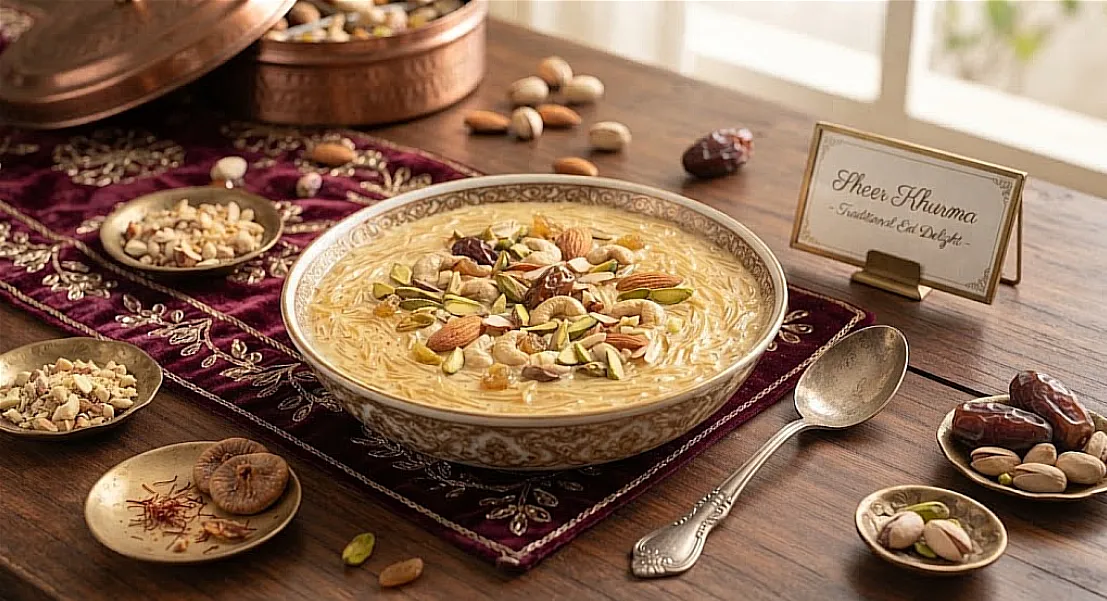
Sheer khurma is a rich milk-based vermicelli dessert popular throughout South Asia and particularly associated with Eid celebrations.
The basic preparation combines:
Almonds and pistachios are especially common, while cashews, raisins, walnuts, and other ingredients can be added according to family preference.
A Pakistani recipe from Food Tribune uses milk, cardamom, sugar, dry dates, pistachios, ghee, vermicelli, and almonds as garnish. The vermicelli is roasted in ghee before being cooked in the milk, with dates and pistachios added afterward.
That basic technique gives us the foundation for a rich homemade version.
Eid food traditions vary from family to family, but sheer khurma has become strongly associated with Eid celebrations across Pakistan.
It is often prepared early in the morning so that family members can enjoy it after Eid prayers or during visits from relatives and friends.
The dish also works particularly well for entertaining because one pot can provide multiple servings.
A large batch can be prepared for:
Pakistani food references describe sheer khurma as a traditional celebration dessert and specifically associate it with Eid.
This recipe makes approximately 6 to 8 servings.
You do not need to use every optional ingredient.
The beauty of sheer khurma is that families often develop their own version.
The vermicelli used for sheer khurma is much thinner than the pasta commonly used in savory dishes.
Fine seviyan cooks quickly and gives the dessert its delicate texture.
Some varieties are already roasted, while others are plain and need to be toasted in ghee before cooking.
Check the package before starting.
If the vermicelli is already roasted, you only need a short warming step. If it is plain, roasting becomes an important part of the recipe.
For a rich sheer khurma, full-fat milk is the easiest choice.
Milk provides the main body of the dessert, so low-fat milk will generally produce a lighter result.
If you want a particularly rich festive version, you can reduce the milk slowly and add a little khoya toward the end.
The goal is not necessarily to make the milk extremely thick.
Remember that the vermicelli will continue absorbing liquid as the dessert sits.
Dates are one of the defining ingredients of traditional sheer khurma.
You can use:
Dried dates have a firmer texture and usually need to be sliced or softened before cooking.
Soft dates can be chopped directly and added later.
If using dried dates with pits, remove the pits before slicing.
Start by checking all your dry fruits.
They should smell fresh and nutty.
Discard anything that smells rancid, stale, moldy, or unusual.
Slice almonds thinly or chop them.
For a more traditional appearance, thin almond slivers work beautifully.
Slice or chop pistachios.
Their green color provides an attractive contrast against the creamy milk.
Chop cashews into small pieces.
They add richness and a softer crunch.
Walnuts are optional.
If you use them, chop them fairly finely so their stronger flavor does not dominate the dessert.
Raisins can be added whole.
They become plump and soft during cooking.
Light roasting can add extra aroma and crunch.
Heat a small pan over low heat.
Add a little ghee and lightly toast the almonds, cashews, pistachios, and walnuts.
Do not brown them heavily.
Remove them as soon as they become fragrant.
You can also dry roast them without ghee if you want to keep the dessert slightly lighter.
Keep the roasted nuts aside.
If using dried dates, slice them into thin pieces.
If they are particularly hard, soak them briefly in warm water.
Drain them thoroughly before adding them to the dessert.
For softer dates, simply remove the pits and chop them into small pieces.
The dates should be small enough to distribute throughout the bowl rather than forming large chewy chunks.
This step makes a big difference.
Place a heavy-bottomed pan over low to medium-low heat.
Add the ghee.
Once warm, add the vermicelli.
Stir continuously.
The thin strands can go from lightly golden to burnt surprisingly quickly.
You are looking for a light golden-brown color and a pleasant toasted aroma.
Do not walk away from the pan.
Once the vermicelli is evenly toasted, immediately transfer it to a plate or reduce the heat substantially.
Over-roasted vermicelli can give the entire dessert a bitter flavor.
Pakistani sheer khurma recipes commonly roast the vermicelli in ghee before adding it to the milk.
Pour the milk into a large, heavy-bottomed pot.
Bring it gently toward a boil over medium heat.
Once it begins to steam and rise, lower the heat.
Stir occasionally.
Allow some of the water content to evaporate slowly.
This concentrates the milk and creates a richer base.
Do not keep the heat excessively high.
Milk can scorch on the bottom of the pan even when the surface looks perfectly fine.
A heavy-bottomed pot makes this process easier.
Add cardamom while the milk is simmering.
You can use:
Cardamom powder distributes quickly throughout the milk.
Crushed pods can provide a more subtle fragrance but should be removed before serving if you prefer a smooth dessert.
Add sugar after the milk has warmed and reduced somewhat.
Start with less than you think you need.
The dates and raisins contribute sweetness too.
Stir until the sugar dissolves completely.
Taste carefully once the mixture has cooled slightly.
It is much easier to add a little more sugar than to rescue an overly sweet pot of sheer khurma.
Once the milk has developed a richer consistency, add the roasted vermicelli.
Stir immediately.
Because fine vermicelli cooks quickly, do not leave it unattended.
Continue simmering gently until the strands become tender.
The exact cooking time depends on the thickness and variety of vermicelli.
Instead of following the clock blindly, taste a small strand.
It should be soft enough to chew comfortably without turning completely mushy.
Add the prepared dates once the vermicelli has softened.
If your dates are very firm, they can be added slightly earlier.
The goal is to let them become tender without completely dissolving into the milk.
Some people prefer visible pieces of date throughout the dessert, while others prefer the dates to soften significantly and blend into the milk.
Both approaches work.
Add most of the chopped pistachios, almonds, cashews, and raisins toward the end.
Reserve some for garnish.
This gives you two different textures:
The nuts cooked into the milk become softer and release some of their flavor.
The nuts added as garnish remain more distinct and provide crunch.
Khoya is optional but can make the dessert noticeably richer.
Crumble a small amount of khoya into the simmering milk.
Stir until it dissolves.
Do not add too much.
Sheer khurma should still have a recognizable milk-and-vermicelli character.
Excessive khoya can turn it into a much heavier pudding.
Saffron is another optional ingredient.
Soak a few strands in a tablespoon of warm milk.
Allow them to sit for several minutes.
Add the saffron milk toward the end of cooking.
You do not need a large amount.
The purpose is a delicate fragrance and subtle golden color.
A few drops of rose water or kewra can give sheer khurma a more festive aroma.
Use these sparingly.
These flavorings are concentrated.
Too much can overpower the cardamom, milk, dates, and nuts.
If you are serving the dessert to guests, subtlety is usually better.
This is where many homemade versions go wrong.
Sheer khurma should be creamy and rich but still spoonable.
It should not be as thick as barfi.
It should also not resemble plain milk with a few noodles floating in it.
When you turn off the heat, the dessert should look slightly thinner than the final consistency you want.
Why?
Because the vermicelli continues absorbing liquid as it rests.
If you cook it until it is already extremely thick, it may become almost solid after an hour.
The most common reason is overcooking the vermicelli or using too little milk.
The vermicelli absorbs liquid continuously.
This becomes especially noticeable after refrigeration.
If your leftover sheer khurma has become too thick, add a small amount of warm milk.
Stir gently while reheating.
Adjust the consistency gradually.
Do not pour in a large amount of cold milk all at once.
If the dessert is too thin, continue simmering it gently.
The milk will reduce and the vermicelli will absorb additional liquid.
Keep the heat low.
Do not attempt to solve the problem by dramatically increasing the flame.
That increases the risk of scorching.
Burnt milk usually means the bottom of the pot became too hot.
Possible causes include:
If only the bottom has lightly caught, immediately transfer the unburnt portion to another pot without scraping the bottom.
Do not stir the burnt layer into the rest.
If the entire dessert smells strongly burnt, the flavor may be difficult to recover.
The vermicelli was probably cooked too long.
Fine seviyan requires relatively little cooking.
It can also become mushy when the finished dessert is kept hot for a long time.
For this reason, slightly undercooking the vermicelli can be better than overcooking it.
It will continue softening in the hot milk.
This usually happens when sugar is added without accounting for the dates and raisins.
If the dessert is already too sweet, adding more milk can dilute the sweetness while also increasing the volume.
You can then adjust the consistency by simmering gently.
Do not attempt to balance excessive sweetness with large amounts of spices.
Cardamom and saffron add aroma, not a reliable fix for too much sugar.
There are several possibilities.
The milk may not have been reduced enough.
The cardamom may be too weak.
The nuts may not have been roasted.
Or the dessert may simply need a small amount of salt.
Yes, salt.
A tiny pinch can help balance sweetness and bring out other flavors without making the dessert taste salty.
Use it cautiously.
For a classic rich version, use:
This combination provides different textures and colors.
Almonds give firmness.
Cashews add richness.
Pistachios bring color and a slightly sweet nuttiness.
Raisins become soft and juicy.
Dates provide the characteristic sweetness and chewy texture.
For a more luxurious version, you can add:
However, more ingredients do not automatically mean better flavor.
Too many nuts can make the dessert heavy and distract from the creamy milk base.
Choose a balanced combination.
Fresh soft dates can be used if dried dates are unavailable.
Remove the pits and chop them finely.
Because fresh dates contain more moisture and have a softer texture, they can blend more readily into the milk.
This creates a slightly different dessert from the classic dried-date version.
Coconut is not essential to the traditional base, but a small amount of desiccated coconut can add texture.
Lightly toast it before adding it.
Use it sparingly so that coconut does not dominate the milk and cardamom.
Dried figs can be chopped into small pieces and added alongside dates.
They provide tiny seeds and a chewy texture.
If the figs are very dry, soften them in warm water first and drain thoroughly.
Because figs add sweetness, adjust the sugar accordingly.
For special occasions, try adding a little khoya.
The method is simple:
This produces a thicker and richer dessert.
Although both use vermicelli, they are not identical preparations.
Regular sweet seviyan can be made by cooking roasted vermicelli with sugar and water or milk, often with nuts as garnish.
Sheer khurma places much greater emphasis on milk, dates, and a creamy consistency.
Food Tribune's seviyan recipe, for example, uses ghee-roasted vermicelli with sugar, water, cardamom, almonds, and pistachios, while its sheer khurma recipe centers on milk, dry dates, vermicelli, pistachios, and cardamom.
That difference is worth remembering when developing the recipe.
If you simply make sweet vermicelli and call it sheer khurma, you miss much of what gives the dish its distinctive character.
Sheer khurma can be served warm, at room temperature, or chilled.
Warm sheer khurma is especially comforting.
The aroma of cardamom and toasted nuts becomes more pronounced, and the milk feels rich and creamy.
Refrigerated sheer khurma becomes thicker and more pudding-like.
This can be particularly refreshing in warm weather.
If it becomes too thick, stir in a small amount of chilled or room-temperature milk before serving.
For Eid gatherings, room-temperature serving can be practical when guests are eating at different times.
Keep dairy-based desserts properly refrigerated when they are not being served.
Garnishing should emphasize the dry fruits.
Try:
Sprinkle the garnish immediately before serving.
This keeps the nuts looking fresher and helps preserve their texture.
If you are preparing sheer khurma for Eid, organization makes the process much easier.
The night before, you can:
Then, on Eid morning, you only need to cook and assemble.
This reduces the amount of work during an already busy morning.
If you expect many guests, multiply the ingredients carefully.
Use a large heavy-bottomed pot.
Do not fill it so high that stirring becomes difficult.
Cook over moderate-to-low heat and stir frequently.
Remember that larger quantities take longer to heat and reduce.
It can be tempting to increase the flame to speed things up, but that also increases the chance of burning the milk.
For a very large gathering, making two medium batches can sometimes give you more control than making one enormous pot.
A standard home batch can provide approximately six to eight modest servings.
For Eid, serving size depends heavily on what else is being served.
If guests are also eating breakfast, tea, savory dishes, and other mithai, smaller bowls may be enough.
If sheer khurma is the primary dessert, you may want larger portions.
For gifting, small sealed containers are convenient because guests can take them home without disturbing the main serving bowl.
Sheer khurma can be prepared ahead of time, but remember that the vermicelli continues absorbing milk.
If you are preparing it several hours before serving, leave it slightly looser than your final desired consistency.
When reheating, add a little milk if necessary.
Stir gently.
Avoid repeatedly boiling it.
Place the dessert in a saucepan over low heat.
Add a small amount of milk if it has thickened.
Stir slowly and continuously.
Heat until warmed through.
Do not use very high heat.
The milk can scorch, and the vermicelli can become overly soft.
For a small serving, gentle reheating is usually enough.
Because sheer khurma contains milk, it should be handled as a perishable dessert.
Once it has cooled appropriately, transfer leftovers to a clean airtight container and refrigerate.
Avoid leaving a large pot sitting at room temperature for extended periods.
For serving, take out only the amount you need and return the rest to the refrigerator.
Clean serving utensils also help reduce contamination.
Storage life depends on ingredients, temperature, handling, and refrigeration conditions.
A milk-based dessert should generally be treated as a short-term refrigerated food rather than something to keep at room temperature for several days.
If the dessert develops:
discard it.
Do not taste questionable leftovers simply to decide whether they are safe.
Freezing is generally less attractive for sheer khurma than refrigeration because the milk and vermicelli texture can change after thawing.
The vermicelli may become softer, and the dairy base may not return to exactly the same consistency.
For the best texture, prepare an amount that can reasonably be consumed while fresh.
You can reduce the sugar according to your preference.
Start with a smaller amount and taste after the dates have softened.
Remember that dates and raisins contribute sweetness.
If you are using sweetened condensed milk or another sweet ingredient, reduce the added sugar further.
There is no need for sheer khurma to be extremely sweet to taste festive.
The nuts, cardamom, milk, and dates should remain noticeable.
Absolutely.
Khoya is optional.
Milk, vermicelli, dates, sugar, cardamom, and dry fruits can create a rich dessert without it.
The key to richness is allowing the milk to reduce gently and using enough nuts and dates to create body and flavor.
A date-heavy version can be made with little or no added sugar, depending on the sweetness of the dates.
However, the final dessert will taste different from a traditional sugar-sweetened sheer khurma.
Dates contain naturally occurring sugars, so “no added sugar” does not mean sugar-free.
If you are changing the sugar significantly, adjust the liquid and cooking process carefully because sugar can affect the final texture.
For an elegant Eid breakfast, serve sheer khurma alongside a small dry-fruit platter.
Include:
This creates a beautiful visual connection between the dessert and the ingredients used inside it.
You can also serve tea or coffee afterward.
One of the best things about this dessert is its flexibility.
A single recipe can be adapted for a small family breakfast or a large gathering.
For a family bowl, keep the recipe simple.
For a formal gathering, increase the dry fruits, add saffron and khoya, and garnish each serving individually.
The basic technique remains the same.
If your sheer khurma tastes good but lacks fragrance, focus on the aromatics rather than adding more sugar.
Try:
Add floral flavorings at the end.
Their aroma is easier to preserve when they are not boiled aggressively.
A successful sheer khurma should have balance.
The milk should be creamy.
The vermicelli should be tender but not mushy.
The dates should be soft.
The dry fruits should provide texture.
The cardamom should be noticeable but not overwhelming.
The sweetness should complement the other ingredients.
And the consistency should be thick enough to feel rich while remaining easy to spoon.
That balance is more important than following an exact cooking time.
Fresh nuts make a noticeable difference.
Light golden color is enough.
It gives the dessert a naturally richer base.
Low heat gives you more control.
Remember that it continues softening.
Dates and raisins already contribute sweetness.
Too much can overwhelm the milk.
The dessert thickens as it rests.
Fresh nuts look and taste better when they retain some texture.
Milk-based desserts should be refrigerated rather than left sitting out for long periods.
For a quick reference, the process is:
Sheer khurma does not need complicated equipment or a long list of exotic ingredients.
Its appeal comes from a handful of familiar ingredients treated carefully.
Good milk creates the creamy foundation.
Properly roasted vermicelli adds a subtle toasted flavor.
Dates provide sweetness and chewy texture.
Almonds, pistachios, cashews, walnuts, and raisins add richness and contrast.
Cardamom brings everything together.
The biggest secret is patience.
Let the milk reduce slowly.
Roast the vermicelli gently.
Do not rush the cooking.
And most importantly, remember that the dessert will continue thickening after you remove it from the heat.
Traditional sheer khurma is a beautiful example of how a relatively simple combination of milk, vermicelli, dates, and dry fruits can become one of the most memorable desserts on a Pakistani festive table.
The recipe is flexible enough for every household to give it its own identity. Some families prefer a lighter version with milk, seviyan, dates, almonds, and pistachios. Others make a richer batch with khoya, cashews, saffron, raisins, and additional dry fruits.
The most important techniques remain the same: use fresh ingredients, roast the vermicelli carefully, reduce the milk gently, control the sweetness, avoid overcooking, and stop cooking while the dessert is still slightly looser than the consistency you ultimately want.
Whether served warm on Eid morning, chilled after a family lunch, or prepared in a large batch for visiting relatives, sheer khurma has a special place in Pakistani food culture.
And when the bowl is finished with a generous scattering of pistachios, almond slivers, dates, and a few saffron strands, you get exactly what a festive dessert should be: creamy, fragrant, rich, comforting, and unmistakably celebratory.
Sheer khurma is made with creamy milk, roasted vermicelli, dates, almonds, pistachios, cashews, raisins, and cardamom. Ingredients such as khoya, saffron, figs, coconut, or rose water can be added for different variations.
The vermicelli, or seviyan, should be roasted properly before being added to the dessert. Careful roasting helps develop its flavor and prepares it for cooking with the milk.
The milk should be cooked carefully while it is being reduced. Paying attention to the cooking process and avoiding conditions that cause the milk to burn can help produce a smoother, richer dessert.
The recipe includes troubleshooting approaches for common consistency and sweetness problems. Adjustments during preparation can help address sheer khurma that becomes too watery, overly thick, mushy, or sweet.
Fasih Frankly
SEO Expert and eCommerce Specialist. Shopify, eBay and online selling.
Questions about this article?
Email us and we will get back to you.
Explore more
Yes, sheer khurma can be prepared in larger quantities for Eid gatherings and other occasions. Proper storage and reheating techniques can help maintain its consistency and quality when serving it later.
