- 100% Natural
- Premium Quality
- No Preservatives
- Fresh & Healthy
Knowing how to store dry fruits properly can help preserve their flavor, texture, freshness, and overall quality for longer. Almonds, walnuts, cashews, pistachios, dates, raisins, and other dried fruits respond differently to heat, moisture, air, and light. This guide explains the best ways to store dry fruits at home, when to use airtight containers, which varieties benefit from refrigeration or freezing, how to protect them during hot Pakistani summers, and how to recognize rancid, moldy, stale, or spoiled dry fruits before eating them.
Dry fruits are among the easiest foods to keep at home. They are convenient, nutrient-rich, versatile, and useful for everything from everyday snacking to desserts, breakfast dishes, festive meals, and gifting. But buying quality dry fruits is only part of the equation. How you store dry fruits them can make a major difference in how long they retain their freshness, texture, aroma, and taste.
A bag of almonds sitting beside a sunny kitchen window, for example, may not stay in the same condition as almonds kept sealed in an airtight container in a cool cupboard. Walnuts are particularly sensitive to warm conditions because their natural oils can deteriorate over time. Dried fruits can also absorb moisture from humid air, which may affect their texture and contribute to spoilage.
This becomes especially important in warmer climates such as Pakistan, where kitchen temperatures can become quite high during summer. A storage method that works reasonably well during a cool winter may not be the best choice during a hot, humid season.
The good news is that proper storage does not have to be complicated.
With the right container, location, temperature, and handling habits, you can help your almonds, walnuts, cashews, pistachios, dates, raisins, and other dry fruits stay enjoyable for longer.
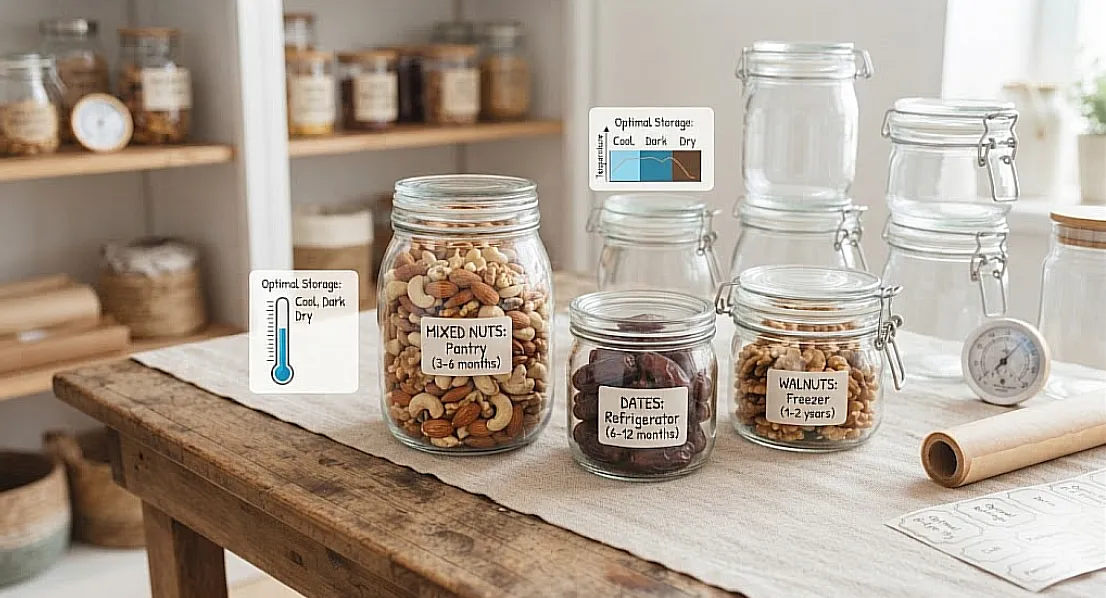
Dry fruits may have relatively long shelf lives compared with many fresh foods, but they are not immune to deterioration.
Several factors can affect their quality:
Nuts contain natural fats and oils. Prolonged exposure to warmth and oxygen can eventually cause these fats to oxidize, resulting in rancid flavors and unpleasant odors. Research-based consumer guidance from the University of California Agriculture and Natural Resources notes that nuts generally retain quality longer under refrigeration or freezing than at room temperature.
Dried fruits have a different challenge. Because they have had much of their moisture removed, they are relatively shelf-stable when properly prepared and stored. However, dried foods can absorb moisture from the surrounding air. Extension guidance recommends keeping dried foods tightly sealed and storing them in cool, dry, dark conditions.
In other words, good storage is mainly about controlling the environment around the food.
For most dry fruits, a simple formula works well:
Keep them cool, dry, dark, clean, and tightly sealed.
A good basic method is:
The ideal method can still vary depending on what you are storing.
Almonds, walnuts, pistachios, cashews, dates, raisins, and seeds do not all have exactly the same storage requirements.
One of the easiest improvements you can make is transferring dry fruits into an airtight container after opening the original package.
Glass jars with tight-fitting lids, food-grade plastic containers, and suitable freezer containers can all be useful for storing dried foods. Extension guidance emphasizes tight packaging because it helps prevent moisture reabsorption and insect contamination.
A good container should:
Glass containers are particularly convenient because you can see what is inside without opening them.
For example, you could keep separate containers for:
This also makes it easier to monitor freshness and avoid repeatedly exposing the entire supply to air.
It depends on the packaging.
If a package is professionally sealed and designed for storage, keeping it unopened can be perfectly reasonable. Once opened, however, resealing the original package tightly may not provide the same protection as transferring the contents to a well-sealed container.
For walnuts, consumer guidance from California Walnuts specifically recommends transferring opened or bulk walnuts into an airtight container before returning them to cold storage.
The same general principle can be useful for other nuts and dried foods.
Heat is one of the biggest enemies of long-term dry fruit quality.
This is particularly important for nuts because they contain natural oils.
A kitchen cabinet directly above a stove may seem like a convenient storage location, but it can experience significantly more heat than a cabinet farther away from cooking appliances.
Avoid storing dry fruits:
Research-based storage guidance for nuts notes that room-temperature storage can shorten quality life, especially in warmer conditions, because nut oils can become rancid more quickly.
This is especially relevant in Pakistan during the summer.
If your kitchen becomes extremely hot, simply moving dry fruits to a cooler part of the home can make a meaningful difference.
Humidity is another major storage problem.
Dried fruits are designed to have reduced moisture, but they can absorb moisture from humid surroundings when left exposed.
That can affect:
University extension guidance recommends storing dried foods in moisture-resistant, tightly sealed containers and keeping them in cool, dry locations.
This is particularly important in humid environments.
If you live in a humid area, avoid leaving dry fruits sitting in an open decorative bowl for days at a time.
A serving bowl is fine for immediate consumption.
For longer storage, keep the main supply sealed.
Take out what you plan to eat, then close the container.
That small habit reduces repeated exposure to air and moisture.
Sometimes, yes.
Refrigeration is particularly useful for nuts when you want to extend their freshness.
The University of California Agriculture and Natural Resources reports that nuts generally retain quality for a year or more under refrigerator temperatures of about 40°F (4°C) or below, while freezer storage can extend quality even further for many varieties.
Oregon State University Extension also notes that nuts and dried fruits can be refrigerated to help maintain quality for longer, with refrigeration slowing mold growth.
But refrigeration is not automatically necessary for every dry fruit in every household.
If you are going to finish a small quantity quickly and your home is cool and dry, a properly sealed pantry container may be sufficient.
If your home is hot, humid, or you are storing a larger quantity for several weeks or months, refrigeration can be more useful.
Walnuts are particularly well suited to cold storage. California Walnuts recommends refrigeration for short-term home storage and freezing for longer storage.
Almonds are relatively easy to store, but proper conditions still matter.
For everyday use, keep almonds in a tightly sealed container in a cool, dry, dark place.
If your home is warm or you have purchased a large quantity, refrigeration is worth considering.
The Almond Board of California recommends cool, dry storage conditions and notes that almonds can have a long shelf life under appropriate storage conditions.
A practical setup is:
If you refrigerate almonds, use a tightly sealed container because nuts can absorb odors from surrounding foods.
Walnuts deserve special attention.
Their naturally high oil content means warm storage can eventually affect their flavor.
California Walnuts recommends keeping walnuts cold and explains that prolonged exposure to warm temperatures can contribute to rancidity and unpleasant odors.
For home storage:
Shorter-term:
Keep walnuts sealed in the refrigerator.
Longer-term:
Consider freezing them in suitable airtight packaging.
After opening:
Transfer bulk or opened walnuts to an airtight container.
The California Walnut Board recommends refrigeration around 32–41°F (0–5°C) for storage of up to six months and freezing at 0°F (-18°C) for longer storage.
For most households, you do not need to think in such precise commercial-storage terms. The practical takeaway is much simpler:
If you're keeping walnuts for a while, keep them cold.
Walnuts can absorb surrounding odors.
That means a container sitting next to strongly scented foods may eventually develop an unwanted aroma.
Avoid storing walnuts directly beside foods such as:
A sealed container helps, but separating strongly aromatic foods is still a good practice.
Cashews and pistachios can also be stored in airtight containers in a cool, dry location for everyday use.
If you live in a hot climate or purchase larger quantities, refrigeration can help maintain quality.
The general principle is the same:
Less heat + less air exposure + less moisture = better long-term quality.
For pistachios, keep the container sealed and protect the nuts from humidity.
For cashews, avoid storing them somewhere warm for extended periods, particularly if the package has already been opened.
If you purchase these nuts in bulk, divide them into smaller airtight containers rather than opening one large container repeatedly.
This reduces the amount of the entire supply exposed to air every time you need a handful.
Dates behave somewhat differently from nuts.
They contain more moisture and are naturally soft and sweet, so their storage needs depend on the variety, packaging, processing, and how quickly you plan to consume them.
For packaged dates, always start with the manufacturer's storage instructions.
For dates sold loose or in bulk, a clean, airtight container can help protect them from moisture, dust, insects, and odors.
If your home is hot, refrigeration may be useful for maintaining quality, particularly for soft dates or longer storage.
Keep dates away from:
If dates become unusually wet, develop mold, or show other signs of spoilage, they should not be eaten.
Because dates can naturally be soft and sticky, texture alone is not always a reliable indication of spoilage. Look at the overall condition, smell, appearance, packaging, and storage history.
Raisins, dried apricots, dried figs, dried cranberries, prunes, and similar products should generally be protected from moisture and excessive heat.
For properly dried fruits, extension guidance commonly recommends tightly sealed containers and cool, dry, dark storage. Depending on the product and conditions, dried fruits can maintain quality for several months and, under appropriate storage conditions, around a year.
Once opened:
In a hot climate, refrigeration can be considered when you need to keep the product for a longer period.
This is where storage becomes particularly practical.
Pakistan can experience very high temperatures during summer, and indoor kitchen conditions may be much warmer than the ideal cool-storage environments recommended for maintaining dried foods and nuts.
That does not mean every packet of almonds needs to go straight into the freezer.
It means you should pay attention to where you keep them.
Consider these habits:
For example, instead of keeping a 2-kilogram supply of mixed nuts in a container that you open several times a day, you could divide it into smaller portions.
One container can be your "daily-use" supply.
The remainder can stay sealed in cooler storage.
This approach reduces repeated exposure to air and humidity.
Yes. Freezing can be a useful option for longer-term storage, particularly for nuts.
The University of California Agriculture and Natural Resources reports that nuts can retain quality for significantly longer in the freezer than at room temperature, with some varieties maintaining quality for years under appropriate frozen conditions.
California Walnuts similarly recommends freezing walnuts when they need to be stored for longer periods.
Use packaging that protects the food from moisture and odors.
A practical method is:
Freezing a large quantity in one container and repeatedly opening it is less convenient than dividing it into portions.
Freezer burn primarily affects food quality rather than being a sign that the food is automatically dangerous.
Good packaging helps minimize exposure to air and moisture and can reduce quality loss.
For dry fruits, airtight packaging is therefore important even when you're using the freezer.
Generally, do not wash dry fruits and then put them away wet.
Moisture is exactly what you are trying to keep out of long-term storage.
If you wash or soak dry fruits before eating them, use them appropriately rather than returning wet fruit to the main storage container.
For example, if you like soaked almonds, take out the portion you intend to eat, soak that portion separately, and keep the remaining dry almonds sealed.
This prevents moisture from entering the main supply.
The same principle applies to raisins, dates, dried figs, and other dried fruits.
Soaked almonds are different from dry almonds.
Once you add water, you have changed the food's storage characteristics.
Do not soak an entire month's supply and expect it to store like dry almonds.
Instead:
The key distinction is simple:
Dry almonds can be stored as a dry product. Soaked almonds require refrigerated handling because they contain added moisture.
You can, but it is not always the best option.
Mixed dry fruit containers are convenient, especially for snacking and gifting, but different products can have different textures, moisture levels, aromas, and storage characteristics.
For long-term storage, separate containers may be preferable.
For example, keep:
This allows you to manage each product according to its needs.
It also prevents one product from affecting the texture or aroma of another.
For short-term consumption, a properly prepared mixed-nut container can be perfectly practical.
Dry fruit gift boxes are often designed to look beautiful, but presentation should not replace proper storage.
If you receive a premium dry fruit gift box, check the packaging first.
If the products are individually sealed, keep them sealed until you are ready to consume them.
If the packaging has been opened, transfer the contents to appropriate airtight containers.
For gifting occasions such as:
it is useful to think about when the recipient will actually consume the products.
A gift box that will be eaten quickly may not require the same storage approach as a large assortment intended to last for several weeks.
For premium gifting, packaging quality matters not only for appearance but also for protecting the product between purchase and consumption.
Knowing how to recognize deterioration is just as important as knowing how to store dry fruits.
Look for changes in:
Rancid nuts can develop an unpleasant smell.
Fresh walnuts, for example, should have a mild nutty aroma. California Walnuts notes that rancid walnuts may develop an odor similar to paint thinner.
If a nut smells sharply chemical, sour, stale, or otherwise unpleasant, don't try to disguise it with spices or roasting.
It's better to discard it.
If a nut tastes sharply bitter, stale, sour, or otherwise significantly different from normal, stop eating it.
Taste is not the only indicator, but an obviously unpleasant flavor is a good reason to discard questionable nuts.
Visible mold is a clear reason to discard the affected food.
Do not simply remove one visibly moldy piece and assume the rest of the package is automatically fine.
Mold can be difficult to assess from appearance alone, particularly when food has been exposed to moisture.
Extension guidance recommends discarding dried foods that show mold.
Insects or signs of insect activity are another reason to inspect the entire package carefully.
This is one reason airtight, insect-resistant packaging is recommended for dried foods.
If you discover an infestation, don't simply pick out the visible insects and return the remaining food to the same container.
Condensation or unexplained moisture inside a container is a warning sign.
Dried food that has absorbed moisture may experience quality deterioration and, under suitable conditions, spoilage.
Check containers periodically, particularly if you live in a humid environment.
Rancidity is a quality problem that mainly affects foods containing fats and oils.
Nuts naturally contain oils, so prolonged exposure to heat, oxygen, and unfavorable storage conditions can cause their fats to oxidize.
Rancid nuts may have:
UC Agriculture and Natural Resources explains that warm storage can cause nut oils to become rancid more quickly.
If a nut is clearly rancid, discard it rather than trying to roast it back into freshness.
Roasting may change the flavor, but it does not reverse oxidation that has already occurred.
Sometimes the problem isn't the quality of the dry fruit.
It's the storage method.
Here are some common mistakes worth avoiding.
An open bag exposes dry fruits to air, humidity, insects, and odors.
Close the package properly or use an airtight container.
Sunlight and heat can raise the temperature of the food and accelerate quality deterioration.
A dark cupboard is usually preferable.
Walnuts are particularly sensitive to warm storage.
Refrigerate them when you need to keep them for longer.
This combines heat with repeated temperature changes.
Choose a cooler cabinet instead.
Water and long-term dry storage do not mix.
Keep soaked or washed portions separate.
Every opening introduces air and potentially moisture.
Divide large quantities into smaller containers.
Nuts can absorb odors from nearby foods.
Use sealed containers and keep them away from strongly aromatic foods.
Bulk buying can look economical, but it isn't necessarily a good deal if the product loses quality before you finish it.
Buy quantities that match your household's consumption and storage capacity.
There is no single universal shelf-life number for every dry fruit.
Storage life depends on:
For properly dried fruits, extension resources commonly give a broad range of roughly 4 to 12 months, depending on conditions. Cooler, drier storage generally supports longer quality retention.
Nuts can also last substantially longer under refrigeration or freezing than at warm room temperatures. UC Agriculture and Natural Resources reports that many nuts can retain quality for a year or more when refrigerated and even longer when frozen.
However, these are storage-quality guidelines rather than permission to ignore the product's package instructions.
Always check the manufacturer's date, storage instructions, and packaging condition.
Dry Fruit | Short-Term Storage | Longer Storage |
|---|---|---|
Almonds | Airtight container in a cool, dry place | Refrigerate or freeze |
Walnuts | Airtight container, preferably refrigerated | Freeze |
Cashews | Airtight container in a cool, dry place | Refrigerate if needed |
Pistachios | Airtight container in a cool, dry place | Refrigerate or freeze |
Dates | Sealed container in a cool location | Refrigerate when appropriate |
Raisins | Airtight container in a cool, dry place | Refrigerate if needed |
Pumpkin seeds | Airtight container away from heat | Refrigerate or freeze |
Mixed nuts | Airtight container | Refrigerate for longer storage |
These are practical general guidelines rather than universal expiration dates. Product-specific packaging instructions should take priority.
If you're looking for a simple system rather than a complicated food-storage routine, try this.
Keep a small amount of almonds, cashews, pistachios, or mixed nuts in an airtight container.
Store it in a cool cupboard away from sunlight and cooking appliances.
Keep larger quantities sealed in airtight containers.
During hot weather, consider refrigerator or freezer storage for nuts you won't consume soon.
Give walnuts special attention.
Keep them refrigerated if you're not going to finish them quickly.
Keep dates, raisins, figs, and other dried fruits sealed and protected from humidity.
During particularly hot periods, inspect your dry fruits more frequently for:
This system is simple enough for everyday use without turning your kitchen into a laboratory.
A little organization can make storage much easier.
Consider labeling containers with:
You don't necessarily need to write a complicated expiration schedule.
A simple label such as “Walnuts — opened Sept. 2026” can help you remember which container should be used first.
For multiple packages, follow the first-in, first-out principle:
Use the older supply before opening the newer one.
This is particularly helpful if you regularly buy dry fruits in bulk.
Good storage cannot completely compensate for buying more food than your household can realistically consume.
If your family eats almonds every morning, purchasing a larger quantity may make sense if you have suitable storage.
But if walnuts are only used occasionally for baking, a smaller package may be more practical.
The right purchase quantity depends on:
Freshness is part of value.
A cheaper bulk purchase is not necessarily better value if the product becomes stale or rancid before you finish it.
Shells can provide an additional physical barrier around some nuts.
UC Agriculture and Natural Resources notes that nuts generally retain quality longer under cooler storage and that shelled nuts can absorb moisture and external flavors, making clean, moisture-free, odor-tight packaging particularly important.
For consumers, however, convenience matters too.
Shelled nuts are easier to eat and use in cooking.
The best choice depends on how quickly you plan to consume them and how well you can store them.
If convenience is important and you consume them quickly, shelled nuts can be practical.
If you're storing nuts for longer, good packaging and cool conditions become increasingly important.
Vacuum packaging can be useful for longer-term storage because it reduces the amount of air surrounding the food.
The National Center for Home Food Preservation lists vacuum packaging as one option for storing dried foods, alongside airtight jars, freezer containers, and suitable bags.
However, vacuum sealing is not a substitute for proper temperature and moisture control.
If the product needs cool storage, vacuum sealing doesn't suddenly make a hot kitchen ideal.
Think of packaging and temperature as two parts of the same storage strategy.
Proper storage helps preserve more than just safety.
It also helps maintain the characteristics people actually want from premium dry fruits.
Good storage can help protect:
Fresh nuts should taste naturally nutty rather than stale or rancid.
Almonds and pistachios should retain their characteristic bite, while dried fruits should retain an appropriate texture rather than becoming excessively damp or degraded.
Good-quality nuts and dried fruits should have a pleasant, recognizable aroma.
Excessive moisture, mold, insects, and poor storage can affect appearance.
Whether you're eating a handful of almonds at breakfast or opening a premium dry-fruit gift box for a celebration, freshness affects the experience.
That is why storage deserves as much attention as purchasing.
Before putting your dry fruits away, ask:
Is the container clean?
Is it completely dry?
Does it seal tightly?
Is the storage location cool?
Is it away from direct sunlight?
Is it away from steam and cooking heat?
Could humidity enter the container?
Does the product need refrigeration?
Will I finish this quantity quickly?
Have I labeled older bulk purchases?
If the answer to these questions is yes, you're already doing most of the important things correctly.
Learning how to store dry fruits properly doesn't require expensive equipment or complicated techniques.
The fundamentals are simple: keep dry fruits sealed, dry, cool, dark, and protected from excessive heat and humidity.
For everyday quantities of almonds, cashews, pistachios, raisins, and similar products, an airtight container in a suitable cupboard can be practical. For longer storage or warmer household conditions, refrigeration or freezing can help preserve the quality of many nuts. Walnuts deserve particular attention because their natural oils can deteriorate when exposed to warm conditions for extended periods.
Dried fruits also benefit from protection against moisture. Properly dried fruit should be stored in tightly sealed containers and kept in cool, dry, dark conditions.
For households in Pakistan, where summer heat can make kitchen storage challenging, one of the most practical approaches is to keep a small everyday supply readily available while storing larger quantities in cooler conditions when appropriate.
Most importantly, pay attention to the food itself.
Unusual odors, rancid flavors, visible mold, unexpected moisture, insects, or significant changes in appearance are reasons to stop and inspect the product rather than assuming it is still good.
Whether you're storing almonds for your morning routine, walnuts for baking, dates for Ramadan, raisins for everyday snacking, or a premium assortment purchased for gifting, proper storage helps you get more enjoyment and value from the dry fruits you bring home.
Store dry fruits in clean, airtight containers to protect them from air, moisture, heat, and light. Keeping them in a cool, dry place can help preserve their flavor, texture, and freshness.
Some varieties may benefit from refrigeration, particularly when temperatures are high. The appropriate storage method can vary depending on the type of dry fruit and the conditions in your home.
Freezing can help extend the storage life of certain dry fruits by slowing changes caused by heat and air. Properly sealed containers or packaging can help prevent moisture and unwanted odors from affecting them.
During hot weather, keep dry fruits away from direct sunlight, heat sources, and humid areas. Refrigeration may be useful for varieties that are more sensitive to heat, especially when indoor temperatures are high.
Fasih Frankly
SEO Expert and eCommerce Specialist. Shopify, eBay and online selling.
Questions about this article?
Email us and we will get back to you.
Explore more
Look for signs such as a rancid or unusual smell, mold, significant changes in texture, or other signs of spoilage. If dry fruits appear moldy or spoiled, they should not be eaten.
