- 100% Natural
- Premium Quality
- No Preservatives
- Fresh & Healthy
Learn how to make delicious stuffed dates at home with 10 easy filling ideas using almonds, pistachios, walnuts, cashews, coconut, chocolate, sesame, peanut butter, figs, and saffron. This guide explains how to choose and pit dates, prepare simple nut and creamy fillings, create attractive date platters, and store different varieties properly. Discover Pakistani-inspired stuffed-date combinations for Ramadan, Eid, weddings, tea-time, dinner parties, homemade gifts, and special occasions.
Dates are already one of the easiest dry fruits to enjoy. They are naturally sweet, soft, chewy, and convenient enough to eat straight from the box. But with one simple step, you can turn them into something much more special: homemade stuffed dates.
Stuffed dates are made by removing the pit from a whole date, gently opening the fruit, and filling the center with nuts, seeds, coconut, chocolate, spreads, or creamy mixtures. The finished treats can be served as an afternoon snack, placed on an iftar platter, offered with tea or coffee, arranged for guests, or presented as part of a homemade gift.
The beauty of stuffed dates is how little preparation they require. You do not necessarily need an oven, complicated equipment, or advanced cooking skills. A sharp knife, a bowl, and a few good ingredients are often enough.
For a Pakistani-inspired version, almonds, pistachios, walnuts, cashews, coconut, sesame, cardamom, rose flavors, and dates make particularly natural combinations. Pakistani recipe sources also use cream-based nut fillings and coatings of chopped almonds, pistachios, walnuts, and cashews for stuffed dates.
This guide explains how to make stuffed dates at home, how to choose the right dates, how to remove the pits without damaging them, and how to create 10 delicious fillings ranging from simple nut-stuffed dates to chocolate, coconut, sesame, and creamy variations.
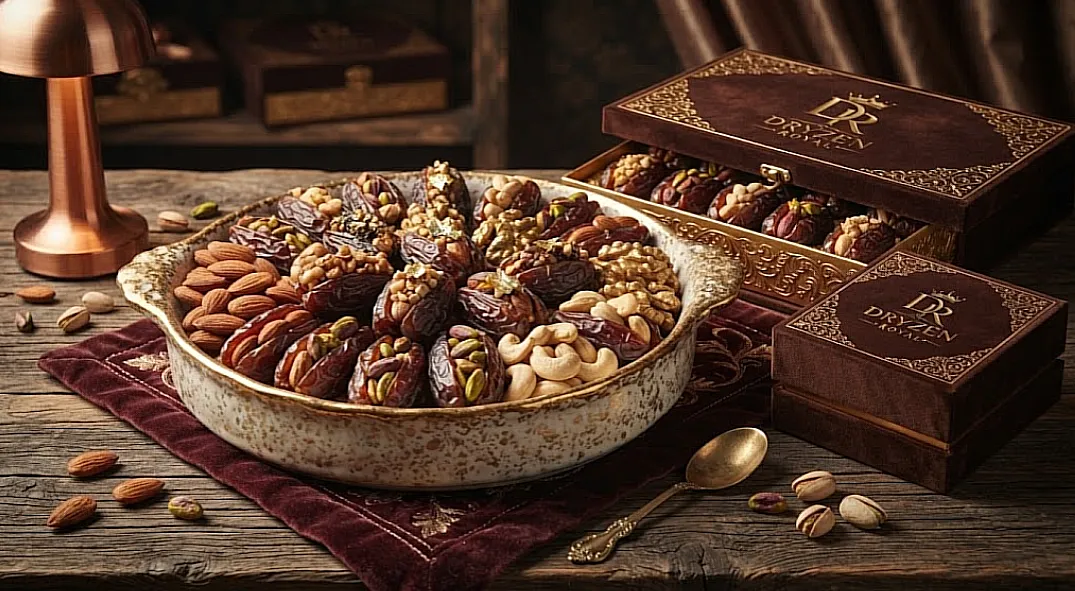
Stuffed dates are whole dates filled with another ingredient or mixture.
The simplest version is nothing more than a pitted date with an almond pushed into the center.
From there, the possibilities become much wider.
You can fill dates with:
The date acts almost like a naturally sweet edible wrapper.
Its soft texture surrounds the filling while its caramel-like sweetness contrasts with salty, roasted, creamy, or slightly bitter ingredients.
BBC Good Food uses a mixture of almonds and pistachios with cinnamon and cardamom as a stuffed-date filling, demonstrating how easily nuts and warm spices can be combined inside pitted dates.
There are several reasons homemade stuffed dates are worth trying.
First, they are extremely easy to customize.
You can make a batch specifically for children, another for guests, and another with more luxurious ingredients for gifting.
Second, they are visually attractive.
A tray of open dates filled with green pistachios, white coconut, golden sesame, or dark chocolate can look much more elaborate than the amount of work involved suggests.
Third, they are convenient.
Once prepared, stuffed dates can be served individually without plates, cutlery, or complicated presentation.
And finally, they are an excellent way to use premium dates and dry fruits together.
The quality of the date matters.
Look for dates that are:
Different date varieties have different textures.
Soft dates are generally easier to open and fill.
Very dry dates may crack when you try to cut them.
If your dates are slightly firm, you can leave them at room temperature for a while before preparing them.
For very dry dates, a small amount of gentle warming can help soften them.
Avoid adding water directly to the dates unless a particular recipe calls for it because excess moisture can shorten storage life.
Yes, Ajwa dates can be used for stuffed dates.
Their smaller size means you may need less filling per piece, but they can make an attractive premium platter.
Larger dates are often easier for beginners because they provide more room for the filling.
If you are preparing stuffed dates for gifting, you can also use different varieties to create a mixed platter.
Dates naturally vary in moisture and softness.
Some are soft and almost creamy inside.
Others are firmer and chewier.
Soft dates are generally easier to stuff because they open without splitting.
If your dates are too firm, warm them gently at room temperature and handle them carefully.
If they are extremely dry, consider using them for a chopped date-and-nut mixture rather than trying to insert a large whole nut.
Removing the pit is simple.
Place the date on a cutting board.
Use a small sharp knife to make a lengthwise cut through the date until you reach the pit.
Do not cut all the way through.
Open the date gently.
Remove the pit with your fingers or the tip of the knife.
The goal is to create a pocket.
You want the date to remain connected along one side so the filling can sit neatly inside.
This basic technique is also used in established stuffed-date recipes.
Do not force a dry or stiff date open.
Instead:
A blunt or oversized knife can crush the date rather than making a clean opening.
Before exploring the different fillings, start with the basic method.
For simple almond- or pistachio-stuffed dates, there is no cooking required. BBC Good Food's version similarly prepares the nut mixture, fills pitted dates, coats them, and serves them at room temperature.
The almond version is probably the easiest place to begin.
You need:
Remove the date pits and insert one whole almond into each date.
For a more aromatic version, lightly toast the almonds first.
Allow them to cool before stuffing.
The contrast is excellent:
Soft date + crunchy almond + warm spice
For a simple afternoon snack, you can stop there.
For a more polished presentation, roll the exposed filling side gently in finely chopped almonds.
Pistachios are especially attractive because their green color contrasts beautifully with the dark exterior of the date.
For this version, use:
You can either insert whole pistachios or make a coarse pistachio paste.
For a simple paste:
Do not add too much rose water.
You want a fragrant filling rather than a wet mixture.
Walnuts and dates are a natural combination.
The date provides sweetness while the walnut contributes a deeper, slightly earthy flavor.
For this filling:
Roughly chop the walnuts.
Add just enough honey to bind them.
Mix in a small pinch of cinnamon.
Place a small amount inside each date.
Because honey is sticky, these dates are best prepared shortly before serving or stored carefully in a cool environment.
You can also add a tiny amount of sesame seeds for extra texture.
For a softer, creamier flavor, try cashews and coconut.
Use:
Grind the cashews until coarse.
Mix them with coconut and a small amount of cardamom.
If the mixture is too dry, add a very small amount of honey.
Stuff the dates and finish them with a light coating of coconut.
These look particularly attractive on a white serving platter.
This is where stuffed dates move from everyday snack to dessert.
Use:
First, stuff the dates with your chosen nuts.
Melt the chocolate gently.
Dip one end of each stuffed date into the chocolate.
Place them on parchment paper.
Add chopped pistachios or coconut before the chocolate sets.
Allow the chocolate to firm up.
For a more decorative finish, drizzle a second type of chocolate across the top.
Pakistani recipe creators also use chocolate, sesame, peanuts, dried figs, dates, cinnamon, and coconut oil in date-based dessert bites, showing how naturally dates work with chocolate and roasted ingredients.
This version has a more savory, nutty character.
Use:
Place a small amount of tahini inside each date.
Add a toasted almond.
Sprinkle sesame seeds over the opening.
Be careful not to overfill the dates.
Tahini has a strong flavor, so a small amount can be enough.
For a sweeter version, mix the tahini with a little honey before filling.
Peanut butter makes a simple filling that requires almost no preparation.
Use:
Open the date.
Add a small spoonful of peanut butter.
Press a roasted peanut into the center.
For a dessert-style version, dip the filled date in melted dark chocolate.
A tiny pinch of salt can make the combination more balanced.
For a richer Pakistani-inspired version, you can prepare a creamy filling using dairy ingredients and chopped dry fruits.
Food Fusion's Pakistani stuffed-date recipe combines cream, milk powder, rose water, optional sugar, and chopped pistachios, almonds, walnuts, and cashews. The cream mixture is cooked until thick, cooled, piped into pitted dates, and finished with chopped nuts and rose petals.
For a simplified homemade version, prepare a thick cream-based filling and allow it to cool completely.
Then:
Because this version contains dairy, it should be handled and stored differently from simple nut-filled dates.
Keep it refrigerated and avoid leaving it at room temperature for extended periods.
For a richer dried-fruit combination, combine dates with dried figs and walnuts.
Use:
If the figs are very dry, soften them according to the recipe before processing.
Chop or pulse the figs and walnuts together.
Add cinnamon and cardamom.
The filling should be thick enough to hold its shape.
Place a small amount inside each date.
This combination gives you multiple layers of chewy texture.
For an elegant festive version, combine:
Keep the saffron subtle.
You do not need much.
Mix finely chopped pistachios with coconut and cardamom.
Add a few saffron strands.
Stuff each date.
Finish with chopped pistachios.
The result is colorful, fragrant, and particularly suitable for Eid, weddings, dinner parties, or premium gifting.
Instead of choosing one filling, make several varieties.
For example:
Pistachio and cardamom
Almond and honey
Cashew and coconut
Chocolate and walnut
Tahini and sesame
Arrange them in separate sections on a large platter.
This immediately makes the dessert look more elaborate.
You can also place a small label beside each variety when serving guests.
Dates naturally have an important place on Ramadan tables.
Stuffed dates can add variety to a traditional date serving without requiring a complicated dessert.
For iftar, prepare a small platter containing:
This gives guests a choice without overwhelming the table.
You can also prepare chocolate-coated versions for after-iftar.
Keep the simpler nut-filled dates separate from dairy-based versions because their storage requirements differ.
Eid is an excellent occasion for decorative stuffed dates.
You can make them a day ahead when using fillings that are suitable for advance preparation.
A festive platter might include:
Add a few whole pistachios and almonds around the platter for decoration.
You can also use small paper cups to separate individual pieces.
Stuffed dates can work beautifully as part of a wedding dessert table.
For a sophisticated presentation, keep the flavors simple.
Consider:
Use uniform-sized dates.
Consistency makes the platter look more polished.
For larger events, prepare the dates in batches and keep each flavor separate until presentation.
You do not need a special occasion.
A small platter of stuffed dates works well alongside:
Nut-filled dates are especially convenient because guests can pick them up individually.
For an after-dinner dessert, chocolate-dipped dates can be served with coffee.
One of the easiest ways to turn stuffed dates into a gift is to create a mixed box.
Use several varieties.
For example:
Box One
Box Two
Premium Box
Arrange them in individual compartments if possible.
This prevents the softer fillings from touching the drier varieties.
Presentation does not have to be complicated.
Use:
The key is restraint.
Too many toppings can make the platter look messy.
Choose two or three visual elements and repeat them consistently.
Toasting the nuts before stuffing them can dramatically increase their aroma.
Place almonds, walnuts, cashews, or pistachios in a dry pan over low to medium heat.
Stir frequently.
Remove them once they become fragrant and lightly golden.
Allow them to cool completely before stuffing.
Do not walk away while nuts are roasting.
They can move from perfectly toasted to burnt surprisingly quickly.
Both work.
Use them when you want:
Use them when you want:
For premium stuffed dates, lightly roasted nuts often provide a particularly satisfying contrast with soft dates.
If you want a paste rather than whole nuts, use a food processor.
Add roasted nuts.
Pulse several times.
Stop and scrape down the sides.
Continue until you reach the texture you want.
Do not automatically process until completely smooth.
A slightly coarse filling usually provides better texture inside a soft date.
If the mixture refuses to hold together, add a small amount of:
Use only enough to bind the mixture.
Dates are naturally sweet, so many fillings do not require additional sugar.
Good combinations include:
If you use chocolate, cream, honey, or sweetened coconut, the finished product will contain additional sugars.
If you find stuffed dates too sweet, balance them with savory or slightly bitter ingredients.
Try:
Avoid adding extra honey or sugar.
If your dates are too firm, leave them at room temperature for a while.
If necessary, warm them very gently.
You can also choose a softer variety for recipes where the date needs to be opened widely.
Do not soak the dates unnecessarily.
Excess moisture can change their texture and complicate storage.
Storage depends heavily on the filling.
Dates filled only with nuts are generally easier to store because they contain no fresh dairy filling.
Keep them in a clean, airtight container in a cool, dry place if appropriate for the ingredients and local conditions.
Keep them away from excessive heat.
Chocolate can soften or melt in warm conditions.
Refrigerate them.
Do not treat cream-filled dates like shelf-stable nut-filled dates.
These are more stable than dairy-filled versions, but their storage life still depends on the ingredients and preparation conditions.
When in doubt, follow the storage requirements of the most perishable ingredient.
Yes.
Refrigeration can be useful for:
However, refrigerated dates may become firmer.
Let simple nut-filled dates sit at room temperature briefly before serving if you prefer a softer texture.
Avoid repeated cycles of warming and refrigerating.
There is no single storage period for every stuffed-date recipe.
A plain date filled with a whole almond is very different from a date filled with fresh cream.
For example, BBC Good Food's nut-filled stuffed dates are described as keeping at room temperature for up to five days.
That should not be applied automatically to cream-filled versions.
The ingredients, moisture level, preparation hygiene, packaging, and storage temperature all matter.
If a stuffed date develops:
Discard it.
If you are gifting stuffed dates, presentation and protection both matter.
Use a food-safe container.
Separate delicate pieces with:
Avoid packing soft cream-filled dates alongside dry nut-filled dates.
If chocolate is involved, consider the temperature during transport.
In warm Pakistani weather, chocolate-coated dates can soften quickly.
A cool environment is preferable.
Heat is one of the biggest challenges when preparing date-based gifts or desserts.
During very warm weather:
This is particularly important for Eid gatherings, weddings, and deliveries.
For simple nut-filled dates, preparing them ahead can make entertaining much easier.
Prepare the dates.
Stuff them.
Place them in an airtight container.
Store them appropriately.
Then arrange them on a serving platter shortly before guests arrive.
For dairy-based fillings, prepare them closer to serving and keep them refrigerated.
The basic preparation can be a fun family kitchen activity.
Children can help with:
Adults should handle:
Whole nuts can also present choking risks for young children, so choose age-appropriate textures and sizes.
For a simple tea-time plate, choose three varieties:
Serve them with tea or coffee.
You do not need to make a complicated dessert.
A few attractive stuffed dates can be enough.
If unexpected guests arrive, the simplest version can be prepared quickly.
Remove the pits.
Insert:
Arrange them on a plate.
Add a few walnuts and raisins around the edges.
Within minutes, you have a more polished serving than simply putting a bowl of dates on the table.
Start with a large serving tray.
Place plain dates in the center.
Arrange stuffed varieties around them.
Use contrasting colors.
For example:
Finish with a few whole nuts around the edges.
Keep the arrangement symmetrical but not overly formal.
If you want the flavors to feel familiar rather than experimental, use ingredients commonly associated with South Asian sweets and dry-fruit preparations.
A strong combination is:
Pistachio + cardamom + rose
Another is:
Almond + coconut + cardamom
And another:
Cashew + cream + mixed nuts
For something richer:
Date + walnut + cinnamon
These combinations work because the ingredients complement rather than compete with the natural sweetness of the date.
For a festive version, combine finely chopped pistachios with a tiny amount of rose water.
Add cardamom.
Mix until the filling holds together.
Stuff each date.
Top with pistachio crumbs.
If desired, add one tiny edible rose petal.
Rose should remain subtle.
Too much can overwhelm the nuts and dates.
This is one of the easiest combinations.
Chop walnuts.
Mix with cinnamon.
Stuff the dates.
No cooking is necessary.
For a slightly richer filling, add a small amount of honey.
Combine:
Grind the almonds coarsely.
Mix with coconut.
Fill the dates.
Roll the exposed filling in more coconut.
This creates a clean white-and-brown presentation.
For a creamy dairy-free option, make a thick cashew-based filling.
Soak cashews if necessary for your chosen preparation.
Blend until creamy.
Add cardamom or vanilla.
Use a small amount inside each date.
Because homemade cashew cream contains moisture, refrigerate the finished dates and consume them promptly.
This is one of the easiest premium-looking versions.
Stuff the dates with pistachios.
Dip half of each date in melted dark chocolate.
Immediately sprinkle chopped pistachios over the chocolate.
Allow the coating to set.
The finished pieces look like miniature confectionery.
They can crack while opening.
Too much filling can split the date.
Moist fillings require more careful storage.
Low-to-medium heat is usually safer for roasting.
A little fragrance is enough.
Heavy chocolate can overpower the date.
The fun of a mixed platter comes from contrast.
Different fillings have different storage needs.
If a date splits while you are filling it, do not throw it away.
Use the piece for:
For future batches, reduce the filling amount and handle the dates more gently.
Presentation is mostly about consistency.
Try to keep:
Instead of decorating every date differently, create groups.
For example, make ten pistachio dates with the same topping and ten chocolate dates with another.
This creates a much cleaner presentation.
It depends on the ingredients and portion size.
Dates provide carbohydrates and naturally occurring sugars, while nuts and seeds can contribute protein, fiber, fats, vitamins, minerals, and other nutrients.
USDA FoodData Central is a comprehensive source of food-composition data for foods and ingredients, including dates and nuts.
However, stuffing dates with chocolate, honey, cream, sugar, or other calorie-dense ingredients changes the overall nutritional profile.
A date stuffed with an almond is different from a date filled with sweetened cream and dipped in chocolate.
That does not make one automatically “good” or “bad.”
It simply means the ingredients and portion size matter.
There is no universal serving size that applies to everyone.
A practical approach is to treat stuffed dates as a snack or dessert rather than an unlimited food.
Remember that both dates and many common fillings are energy-dense.
If you are serving them alongside other desserts, a smaller portion may be enough.
For gatherings, stuffed dates can provide something different from conventional mithai.
They are smaller.
They are easy to portion.
They can be prepared in advance.
And you can create a wide variety of flavors without making a large batch of one complicated dessert.
A platter containing pistachio, almond, chocolate, coconut, and walnut dates can therefore work alongside traditional sweets rather than replacing them.
For a simple homemade gift, make five varieties:
Whole roasted almond with cinnamon.
Chopped pistachio with cardamom.
Walnut with a small amount of honey.
Cashew and coconut filling.
Pistachio-filled dates dipped in dark chocolate.
Place four or five pieces of each flavor into separate sections.
Add a small ingredient label if gifting.
For a larger event, use all ten fillings from this guide:
You can serve them as individual desserts or alongside tea and coffee.
Once you understand the basic concept, you do not need a recipe for every combination.
Think in four parts:
Base: date
Crunch: almond, walnut, pistachio, cashew, peanut, or seed
Flavor: cardamom, cinnamon, vanilla, rose, saffron, or cocoa
Finish: coconut, sesame, chopped nuts, chocolate, or a light drizzle
For example:
Date + pistachio + cardamom + coconut
or:
Date + walnut + cinnamon + honey
or:
Date + almond + dark chocolate + pistachio
This makes it easy to experiment.
If the dates are intended as a gift, think about the entire journey from kitchen to recipient.
Choose a filling that can tolerate transport.
For warm weather, simple nut fillings are generally easier to manage than cream-based fillings.
For chocolate-coated versions, temperature control matters.
Use secure packaging so the dates do not move around excessively.
Label the major ingredients, particularly when nuts or dairy are present.
And prepare the gift as close to the intended presentation date as practical.
Stuffed dates are one of those recipes that look far more complicated than they really are.
The basic technique is simple: choose soft, good-quality dates, make a careful lengthwise cut, remove the pits, add a filling, and gently close the fruit around it.
From there, you can create almost endless combinations.
Almonds provide classic crunch. Pistachios bring color and a delicate flavor. Walnuts create a richer combination. Cashews and coconut provide a softer, creamier profile. Chocolate turns dates into an indulgent dessert, while sesame and tahini offer a more nutty and balanced alternative.
For Pakistani homes, flavors such as cardamom, rose, saffron, coconut, almonds, pistachios, walnuts, and cashews fit naturally into festive stuffed-date recipes. These combinations can work particularly well for Ramadan iftar, Eid gatherings, weddings, dinner parties, tea-time serving, and homemade gifting.
The most important practical consideration is storage. Simple nut-filled dates are easier to keep than versions containing fresh cream or other moist fillings. Dairy-based stuffed dates should be refrigerated, while chocolate-covered varieties need protection from excessive heat. Always consider the most perishable ingredient when deciding how to store a particular batch.
You also do not need to make ten different fillings every time. Start with three: almond and cinnamon, pistachio and cardamom, and walnut and honey. Once you become comfortable with the basic technique, experiment with coconut, chocolate, sesame, peanut butter, figs, saffron, and other flavors.
With a few quality dates and some premium dry fruits, you can turn a simple pantry ingredient into an elegant homemade treat that works equally well as an everyday snack or a beautifully arranged gift.
Stuffed dates can be filled with almonds, pistachios, walnuts, cashews, coconut, chocolate, sesame, peanut butter, figs, or saffron. Different combinations can create both nut-based and creamy fillings.
Choose suitable dates and carefully remove the pits before adding the filling. Preparing the dates properly makes them easier to fill and helps create an attractive finished treat.
Stuffed dates can be arranged attractively on serving platters or trays. They can be presented for Ramadan, Eid, weddings, tea-time, dinner parties, family gatherings, or as homemade gifts.
Pakistani-inspired combinations can pair dates with ingredients such as almonds, pistachios, walnuts, coconut, figs, sesame, and saffron. These combinations can be adapted according to personal taste and the occasion.
Fasih Frankly
SEO Expert and eCommerce Specialist. Shopify, eBay and online selling.
Questions about this article?
Email us and we will get back to you.
Explore more
Different stuffed-date varieties may require appropriate storage to help maintain their texture and freshness. Proper storage is especially important when fillings such as nuts or creamy ingredients are used and when preparing them ahead of an event.
